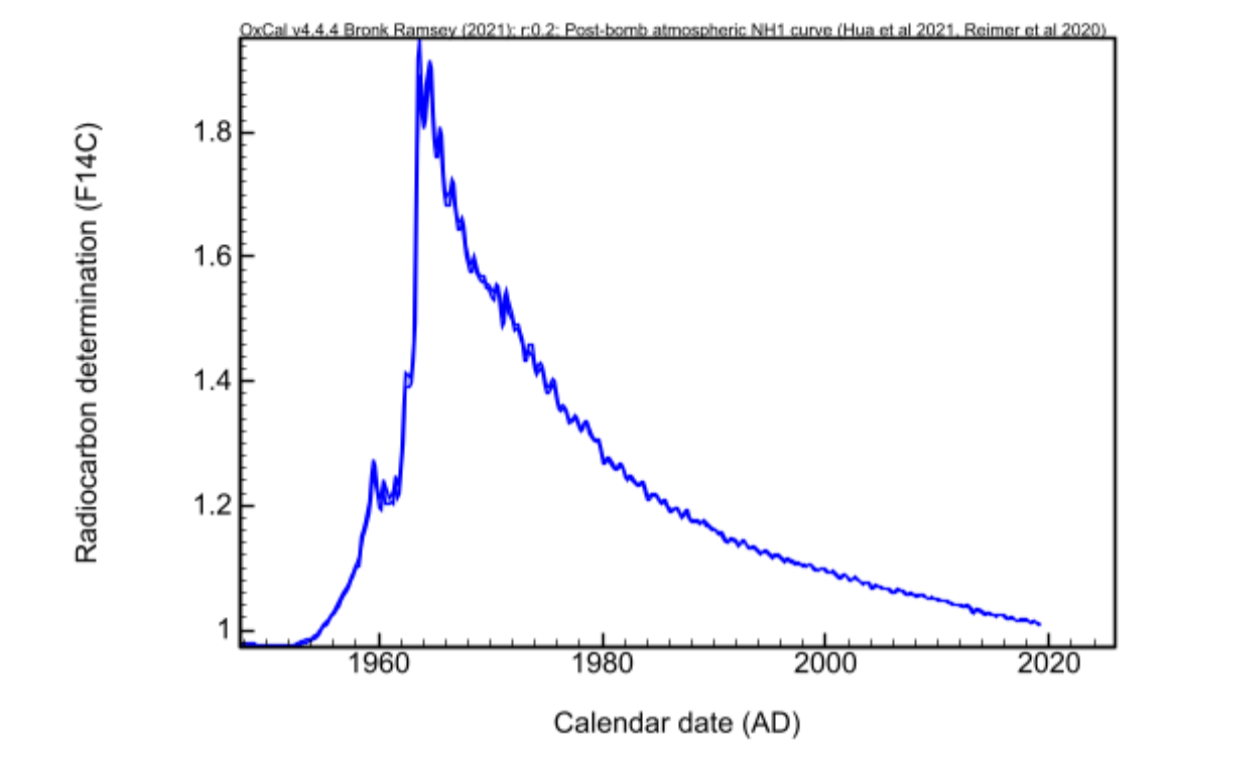

The post-atomic bomb effect has profoundly renewed our understanding of carbon-14. The radiocarbon peak resulting from the more than 500 nuclear tests carried out between the 1950s and 1960s has left a unique temporal signature. Today, this signature is exploited by scientists for carbon-14 dating for the art market and the analysis of organic materials such as wood, ivory, bone, teeth, linen, straw, paper and other textiles.
For art professionals who rely on authentication techniques to identify objects that can be composited or restored, the post-bomb effect represents an opportunity to make provenance more reliable. Mastery of post-bomb reference frames (Northern/Southern hemisphere) and isotopic corrections is therefore essential to guarantee the reliability of results and their interpretation (provenance, historical consistency, due diligence).
In this article, we clarify the mechanisms and analytical implications of the post-bomb effect, detail carbon-14 measurement by AMS and calibration reference frames applied to art. You will also find case studies (linen canvases, wooden stretchers, papers, ivories, bones/teeth) and explanations of the role of an expert laboratory like CIRAM in transforming a carbon 14 measurement into scientific evidence useful to experts, auction houses, galleries, museums and collectors.
Carbon-14 and the post-bomb effect: mechanisms & analytical implications
Mastering the isotopic behavior of carbon 14 lays the foundations for rigorous dating and credible authentication.
Carbon-14 dating in art contexts: principles, the Suess effect and analytical issues
The sudden increase in atmospheric carbon-14 following nuclear testing generated a very distinct radiocarbon curve, known as the "bomb-peak". Nuclear bombs led to a massive production of radiocarbon from 1954 onwards, almost doubling its concentration in 1963 and 1964. This allows us to draw a strict line between organisms that lived before and after 1954. This isotopic anomaly, long perceived as a disturbance, has become a time marker of unprecedented precision for scientists.
Carbon-14, produced by cosmic rays, is integrated into living organic matter (plants, animals). Measuring carbon enables us to date a variety of materials: wood, plant fibers (linen, straw, paper), ivory, bone and teeth.
Two notable phenomena are upsetting the natural balance:
- Suess effect: burning fossil CO₂ (without carbon 14) reduces the proportion of atmospheric carbon 14
- Post-bomb effect: conversely, nuclear testing greatly increased carbon-14 concentrations (peaking between 1963 and 1964).
Unlike conventional carbon-14 dating (which is limited to a few hundred years' accuracy for recent periods), the post-bomb signal enables organic material to be dated to within ±1-2 years between 1954 and 2020. The abnormal concentration of carbon 14 in living organisms that lived after 1954 is ideal for spotting recent fakes.
Identifying this over-concentration is particularly useful for :
- Determining whether an object is pre or post-1954: a critical threshold for "modern" or "post-war" objects
- Check whether a work claimed to be from 1963, for example, was actually produced during the radiocarbon peak (which is measurable).
- Distinguish between old ivory (pre-CITES) and modern, illegally harvested ivory.
What materials can be dated using the post-bomb effect?
The post-bomb effect exclusively concerns materials of organic origin that have incorporated atmospheric carbon after 1954. Here are the main materials that can be analyzed using post-bomb analysis:
- Wood (supports, stretchers, sculptures): to distinguish modern from old wood, to identify a replaced stretcher or a datable restoration, or to spot young wood in a supposedly old work.
- Linen canvases, papers, textiles: it's possible to date the fiber (and not the paint), to reveal a post-1960 canvas behind a 19th-century attribution or, for example, to check the homogeneity of the constituent elements (canvas, lining, passe-partout, collage).
- Ivories, bones, teeth: analysis can show that a supposedly ancient ivory is in fact modern (post-bomb signal), or on the contrary, confirm the absence of a bomb-pulse.
However, there are limits and precautions to be noted:
- Carbon-14 dating targets the material sampled: dating canvas ≠ dating paint and dating wood ≠ dating sculpture.
- Restorations (PVA adhesives, varnishes, consolidants) can contaminate organic materials, so targeted sampling and appropriate pre-treatment (alpha-cellulose extraction for fibers, collagen purification for bone/dentine or acid-alkali acid procedures, ultrafiltration, etc.) are essential.
- Old reused wood exists (which is rare but possible): it is then crucial to cross-reference this method with xylology/dendrochronology, imaging and provenance studies.
Each material, depending on its origin, preparation and possible treatments, requires a rigorous sampling strategy, which CIRAM establishes in collaboration with curators, restorers and experts.
Post-bomb carbon-14 measurement methods for the art market
Gas pedal Mass Spectrometry (AMS): precision, reliability and use cases
Gas pedal coupled mass spectrometry (AMS) is the reference method for post-bomb in art. It directly measures carbon ratios ¹⁴C, ¹³C and ¹²C with excellent sensitivity from micro-quantities (discrete samples, not visible after intervention).
This technology enables :
- Micro-sampling : analysis of very small quantities of material (a few milligrams): linen thread, wood flakes, ivory micro-splinters, paper fibers.
- Ability to handle restored materials (with appropriate decontamination protocols).
- Results in pMC (percent Modern Carbon), with a precise calendar interval.
The process takes place in several stages:
- Targeted sampling (masked areas, edges, excess wire)
- Pretreatment: mild/strong solvents depending on matrix, alpha-cellulose extraction (fibers/paper), collagen purification (bone/ivory), varnish/glue removal.
- Graphitization to isolate pure carbon
- AMS measurement with isotope correction via δ¹³C
- Interpretation according to the post-bomb frame of reference (North or South) and submission of a documented scientific report.
Reference systems, calibration and interpretation: making the material speak
CIRAM uses post-bomb calibration curves published by the scientific community (such as NH1, NH2, NH3, SH1-2, SH3) to convert measured pMC into calibrated dates. This reading enables us to answer specific questions:
- Was the work created before or after 1954?
- Does the material correspond to a production made after the artist's death?
- Is it possible to distinguish an original piece from a modern reproduction based on the same material?
To convert a measurement into proof, laboratories specializing in carbon-14 dating for art:
- Use post-bomb calibration curves (different NH/SH) reflecting changes in atmospheric carbon-14 since 1954
- Apply international standards and deliver comparable results (pMC/Fcarbon 14, probable year interval)
- Interpret results on a case-by-case basis: they relate support, context, presumed geographical origin, restoration history and sampling strategy.
Thanks to the post-bomb effect, each variation in pMC becomes a clock, and each work a witness to its era. CIRAM follows comprehensive QA/QC protocols (blanks, bomb-peak standards, duplicates, yield validation) and records every step. Reports are quotable, written in operational language (useful for sales catalogs, expert reports, committees and insurers).
The post-bomb effect and the art market: broader use cases & the role of laboratories
Advanced use cases for art: from suspicion to opposable proof
Post-bomb analysis is particularly useful for art market professionals in the following cases:
- Authentication of modern works: this can prove, for example, that a material actually dates from the 1960s-1970s.
- Detection of fakes or imitations: this identifies materials that are too recent to be consistent with the advertised attribution.
- Regulatory compliance (CITES): this differentiates pre-1975 ivory (legal) from more recent ivory (prohibited).
- Litigation or insurance: it is used to establish scientific proof that can be used in the event of a dispute or claim.
Here are a few examples of how post-bomb analysis can be used by art professionals and collectors:
- 19th century" painting on canvas: with linen dating. If a bomb-pulse is detected, then the canvas is post-1954. We can therefore consider a replacement canvas, an apocryphal work, or a copy.
- Drawing on paper: the absence or presence of a post-bomb signal can validate or disqualify an alleged dating. This analysis is particularly useful in the case of contested archives or manuscripts.
- Assemblies, collages, marouflages: cross-dating (support, lining, glue) enables us to reconstruct the chronology of interventions. This analysis is essential for insurance purposes.
In the end, a post-bomb analysis transforms a doubt (stylistic incoherence, incomplete provenance, contentious signatures) into an objective scientific element that can be understood by a committee, a court or an auction house.
CIRAM: from samples to authentication arguments
The scientific teams at CIRAM laboratories provide end-to-end support to art market professionals. Their action covers several stages:
- Framing: choice of the most convincing material (flax vs. glue, frame wood vs. key, dentin vs. dental cement, etc.), proposal of a micro-sampling strategy, anticipation of contamination risks.
- AMS measurement: implementation of procedures dedicated to organic art materials, NH/SH references, isotopic corrections, management of mixed matrices.
- Interpretation & writing: creation of a clear, citable report, presenting results (pMC/Fcarbone 14), post-bomb calendar interval, uncertainty, interpretation scenarios and reasoned conclusion.
- Confidentiality: signature of an NDA, anonymization of samples, secure circuits, traceable chain of custody. This is a key issue for sensitive dossiers.
If the situation requires it (depending on the subject of the study), CIRAM also carries out complementary analyses (FTIR for binders and glues, dendrochronology for wood, imaging for interventions, pigments and/or binders on a pictorial layer) in order to provide a coherent material reading.
Far from being a scientific curiosity, the post-bomb effect has become an indispensable tool for authenticating works of art. Thanks to post-1954 carbon-14 dating, it is now possible to provide rigorous scientific proof of the temporal origin of organic materials such as wood, ivory, linen and paper. When properly used, post-bomb analysis strengthens authentication, identifies restorations, secures sales and protects collectors and institutions alike. The key to a successful study lies in appropriate sampling, rigorous AMS protocols and contextualized interpretation.
With its experience of art market issues, CIRAM transforms carbon 14 measurements into legible evidence, which can be integrated into appraisals, catalogs and due diligence procedures. As an expert laboratory in dating and material characterization for the art market, CIRAM puts its skills, cutting-edge equipment and customized support at your disposal to transform every carbon-14 analysis into usable, documented and enforceable proof.
If you would like to have your art object(s) analyzed by the leader in carbon-14 dating in France, contact the CIRAM teams and request your study.