Industry

Radiocarbon analysis

At CIRAM, we put our expertise and cutting-edge technologies at the service of manufacturers to carry out reliable and precise carbon-14 analyses.

Contact our teams
dsc00708

Would you like to carry out a carbon-14 analysis?

Whether you're a bioplastics manufactureror cosmeticsor food products or any other biobased productsCarbon 14 measurement can provide valuable information. It allows you to :

  • Check the composition of your raw materials,
  • Quantify the proportion of renewable carbon in your products,
  • Meet the requirements of current standards and regulations (ASTM D6866, EN 16640, ISO 16620-2, ISO 21644, ISO 13833, etc.),
  • Obtain eco-labels,
  • Promote your environmental approach to your customers.

At CIRAM, we're with you every step of the way, from defining your needs to interpreting the results.

Discover application fields

They trust us

Leading companies in the green chemicals, packaging and energy sectors trust us to measure the carbon 14 content of their products.

logo dossier essilor 2023
Solvay Logo 2023.svg
IFPEN
L'Oréal
Michelin
Eiffage

Our techniques for industrial carbon-14 analysis

At CIRAM, we use state-of-the-art methods to accurately measure the amount of amount of carbon 14 in your industrial materials. Depending on the nature of your product and your objectives, we apply two complementary approaches:

01 - Radiocarbon analysis by gas pedal mass spectrometry (AMS)

This method enables radiocarbon to be quantified with great precision, even in very small quantities. It is ideal for :

  • Determine the percentage of biobased carbon in polymers, bioplastics, cosmetics, biofuels and all carbon-containing materials.
  • Check compliance with ASTM D6866, EN 16640 and ISO 16620-2.
  • Distinguish between fossil and renewable sources in complex formulations.

02 - Stable isotope analysis of carbon, nitrogen, oxygen and hydrogen

This method is based on the study of isotope ratios. This approach makes it possible to :

  • Trace the origin of carbon (plant, animal, marine, etc.).
  • Refine interpretation of radiocarbon analysis results.
  • Check the authenticity of natural products (fragrances, flavors, food additives).
  • Define the geographical origin of raw materials (cotton, coffee, meat, etc.).

By combining these two methods, CIRAM guarantees reliable analyses tailored to industrial requirements.

The steps in a CIRAM analysis

CIRAM 's analysis process is rigorous and transparent:

01 - Making contact and defining your needs

We discuss your objectives and advise you on the best analytical approach.

02 - Sending the sample

We provide you with clear instructions for collecting and sending the sample.

03 - Sample preparation

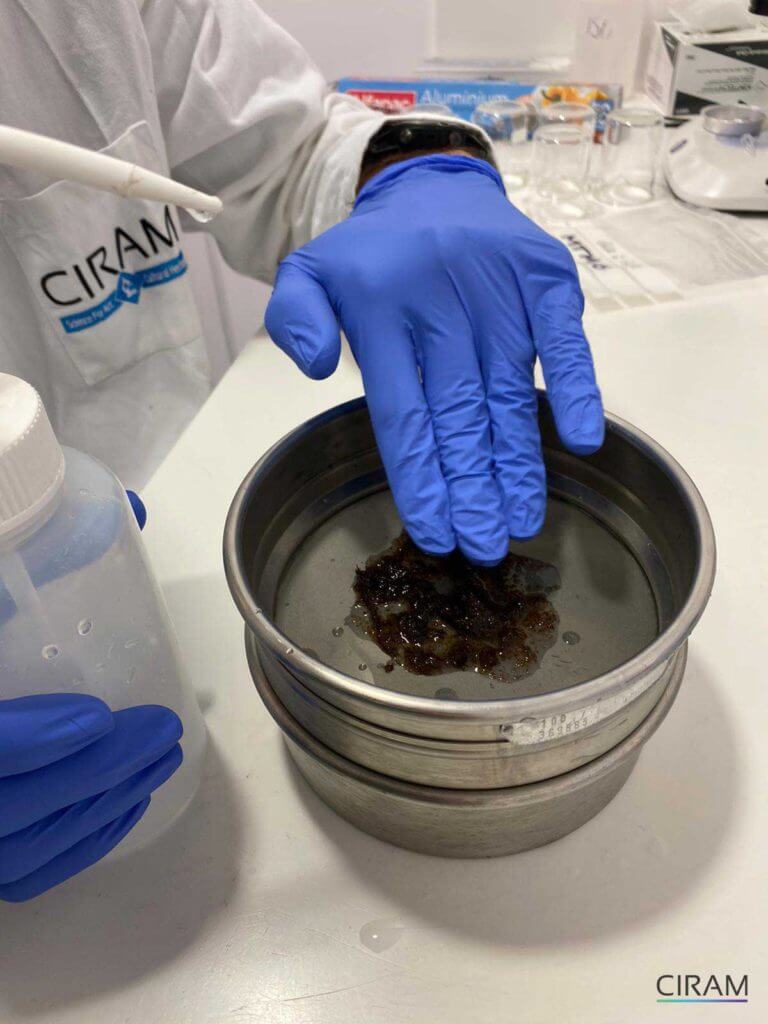
Our experts carefully prepare the sample to guarantee accurate results.

04 - Analysis

We carry out carbon-14 and stable isotope analysis using the most appropriate technique.

05 - Interpretation of results

We provide you with a detailed analysis report and help you interpret the results.

Why choose CIRAM for your radiocarbon analyses?

With over 20 years' experience in radiocarbon analysis, CIRAM is an independent, innovative laboratory located near Bordeaux. Our expertise is recognized worldwide, with over 5,000 analyses carried out each year.

  • Accredited laboratory: we operate to strict international standards, guaranteeing the reliability and recognition of our analyses.
  • Optimized lead times: we understand industrial imperatives and are committed to delivering results within 10 working days.
  • Multidisciplinary expertise: our team combines skills in materials science, analytical chemistry and mass spectrometry to offer comprehensive analyses.
  • Personalized support: we offer solutions tailored to each business sector, ensuring dedicated monitoring throughout the analytical process.

Our commitment to quality and customer satisfaction makes CIRAM a trusted partner for your bio-based analysis needs.

Contact our teams

Are you asking yourself these questions?

What types of samples can be analyzed by carbon-14?

We can analyze all materials containing carbon, liquids, gases and solids, such as bioplastics, paints, cosmetics, biofuels, foodstuffs, textiles, paper, inks, etc.

How do I send a sample for analysis?

We provide detailed packaging and shipping instructions, guaranteeing sample integrity right through to analysis.

How much does carbon-14 analysis cost industry?

The cost of a carbon 14 analysis depends on the nature of the sample, the technique used and the number of samples to be analyzed. Please contact us for a personalized quotation.

How long does a carbon-14 analysis for industry last?

The duration of a carbon 14 analysis depends on the nature of the sample and the technique used. It takes between 5 and 10 working days to obtain the results.

Make an appointment with an expert

Get all the answers to your questions!

Make an appointment

Your other challenges in the Biobased Industry

Quantifying biobased content

Measure the proportion of renewable raw materials in your formulations and certify their biobased origin.

Measuring naturalness

Check the authenticity and natural composition of your products to meet the requirements of eco-labels and consumers.

Characterizing biofuels, RDF and emissions

Determine the biobased content of your fuels and quantify biogenic emissions in line with environmental standards.

Analyze according to ASTM D6866

Make sure your products meet international standards for biobased content by following ASTM D6866.

Explore our dating and analysis resources

Industry
Milk adulteration: what laboratory testing methods are available?

Milk adulteration: what laboratory testing methods are available?

Milk adulteration is a threat to the quality and conformity of dairy products. What methods can be used to detect these frauds quickly, reliably and ...

Read the article

Industry
How to check the naturalness of a flavor using carbon 14?

How to check the naturalness of a flavor using carbon 14?

Test the naturalness of your flavors and dietary supplements using radiocarbon and stable isotopes. Carbon 14 and stable isotopes allow...

Read the article

Industry
Why trust an ISO/IEC 17025 accredited laboratory for your stable isotope analyses?

Why trust an ISO/IEC 17025 accredited laboratory for your stable isotope analyses?

Stable isotope measurements play a key role in the quality control and traceability of industrial materials. But how can you be sure of the reliability of your results? By entrusting your...

Read the article

Industry
ISCC Plus certification: how to secure your biobased supply chains?

ISCC Plus certification: how to secure your biobased supply chains?

Increasing demands for traceability and sustainability make ISCC Plus certification a strategic asset for manufacturers involved in biobased products. Find out more...

Read the article

Industry
ISO 21644: an essential framework for CSR analysis

ISO 21644: an essential framework for CSR analysis

EN ISO 21644 is an essential standard for ensuring the compliance and traceability of solid recovered fuels (SRF). But how can you be sure that your materials comply ...

Read the article

Industry
How to recognize adulterated honey

How to recognize adulterated honey

Honey adulteration is a growing threat to the industry, compromising quality, conformity and traceability. Addition of exogenous sugars, falsification of origin, purity tests ins...

Read the article

Request a quote