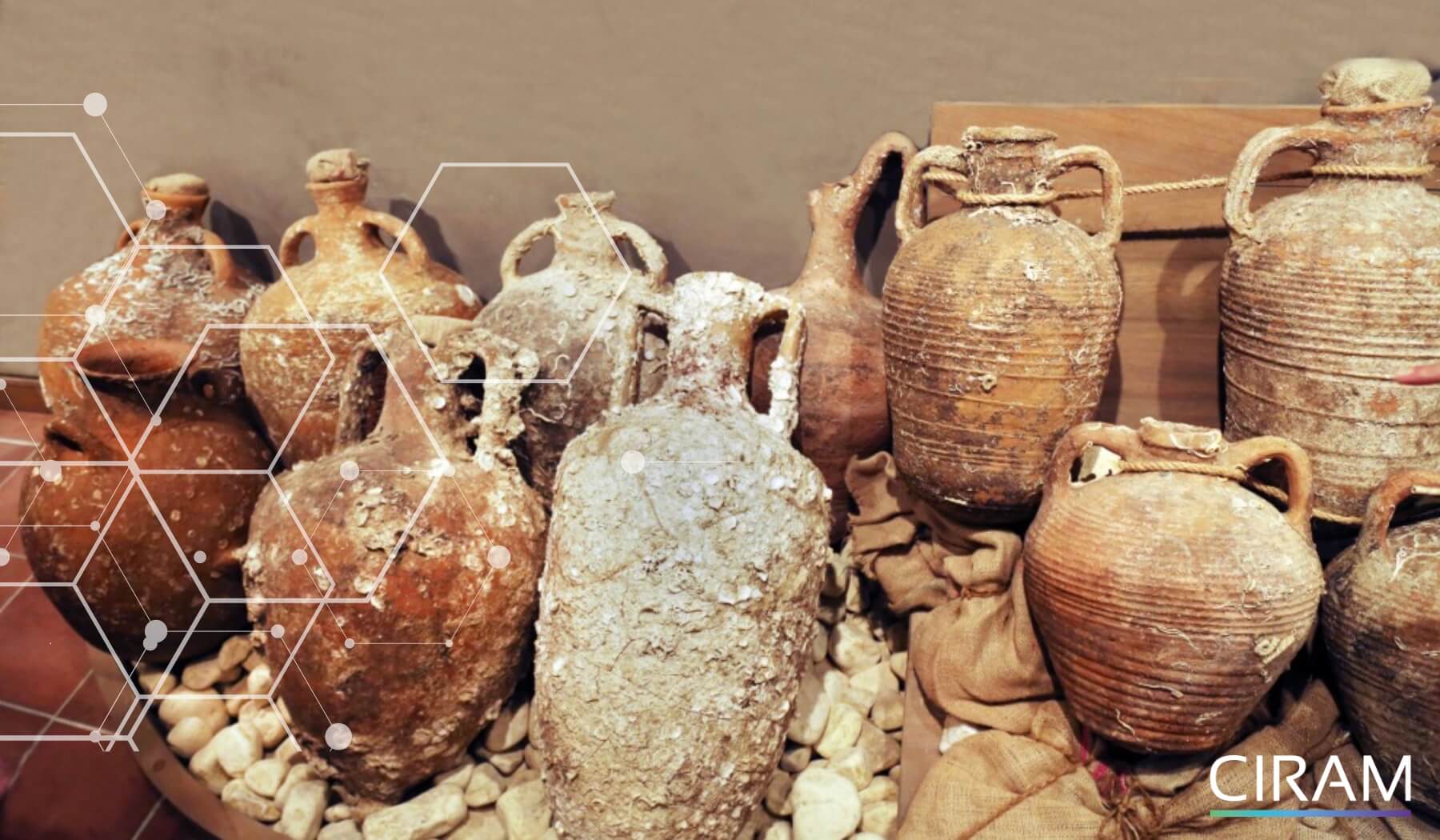

Ancient ceramic amphorae

Analysis of organic residues for archaeology

By combining cutting-edge technologies such as infrared spectrometry, Raman spectrometry and chromatography, our scientists are able to detect and identify the organic remains found in ancient amphorae and pottery. The techniques developed by CIRAM enable us to characterize oils, fermented beverages, resins, fats and perfumes, so as to understand the dietary and cosmetic habits of ancient peoples.

Organic residues: understanding old habits and practices

Organic residues found in dishes, vases and flasks provide clues to food customs and ancient cooking methods, for example. But they can also provide information about trade in Antiquity or the Middle Ages, as well as ancestral burial practices. CIRAM laboratories have an analytical network that covers a wide spectrum of investigations, from the identification of major product families (oil, fat, resin, etc.) to the discovery, in the best of cases, of ancient cooking recipes.

Organic residue analysis methods

Fourier transform infrared spectroscopy, in ATR mode or under microscopy, is used to identify the major families of organic compounds. For example, the presence of oil, animal fat or natural resin can be characterized. Mineral matter, however, can provide a spurious signal, preventing identification of the organic compounds present. For this reason, infrared spectrometry will usually be used as a preliminary step. CIRAM teams will generally couple FTIR spectrometry with other analysis techniques, such as chromatography or Raman spectrometry.

GC-MS coupling to locate and identify substances

Gas chromatography (GC) coupled with mass spectrometry (MS) is the technique dedicated to the study of organic compounds. Chromatography separates compounds in a sample, while mass spectrometry identifies compounds according to their mass. This GC-MS coupling enables the precise identification and quantification of many substances present in very small quantities, or even in trace amounts. Using GC-MS analysis, our scientists can characterize most of the molecules present in an archaeological mixture or organic residue. It is the nature of these molecules, combined with their concentration, that enables us to trace them back to the material used: olive oil, walnut starch, animal fat, tannin...

Complementary analytical techniques for the analysis of certain residues

Although Raman spectrometry is more suited to the study of mineral matter, it is nonetheless an interesting method for archaeometry, as it is non-invasive and requires no sample pre-treatment.

This analysis provides very good spatial resolution, making it possible to study samples on a very small scale (spots of a few µm). Raman spectrometry can be used on its own, or in conjunction with FTIR spectrometry or GC-MS chromatography. In fact, the residues found in ancient pottery are so complex that it is generally necessary to use different complementary analytical techniques.

Carpology for the study of seeds and fruits that have been discovered

Carpology is the study of seed and fruit remains found in ancient containers or archaeological sediments. Analysis of these plant residues provides information on human activities and ancestral lifestyles. Even when charred, CIRAM scientists are able to identify the nature of these seeds, and thus understand their use and reconstruct environments.

Palynology, the study of pollen and spores

Palynology is the study of pollen and spores released by plant species. Coupled with carpology and anthracology, these techniques enable us to reconstruct environments and climates. Observations made using light microscopy or electron microscopy will make it possible to determine the size and shape of pollen grains or spores, the number and shape of apertures, ornamentation, wall structure... and thus define the plant family, genus and, in the best case, species.

CIRAM laboratories, specialists in carbon-14 dating and archaeometric analysis.

CIRAM, a specialist in carbon-14 dating and archaeomaterials analysis, offers a meticulous examination of organic residues. To deliver relevant and accurate results, we interpret the results and remain at your disposal to discuss hypotheses according to your needs.


How is archaeological charcoal analyzed?

Reading time:

5–8 minutes

Written by:

The charcoal discovered during archaeological excavations is not only used for carbon-14 dating. Indeed, their study also makes it possible to identify wood species, reconstruct ancient landscapes, and better understand the practices of past societies. This discipline, called anthracology, relies on the meticulous observation of the anatomical structures of charred wood.

Discover how laboratories analyze archaeological coals and what scientific information they obtain from simple charcoal fragments.

In summary:

  • Anthracology consists of identifying wood species from archaeological charcoal.
  • The samples are observed under the microscope according to the three anatomical planes of the wood.
  • Scientists analyze numerous criteria to reconstruct the origin of the wood, its state before combustion, and its use.
  • These observations complement the carbon-14 dating and improve the interpretation of the remains.

How does an anthracological analysis take place?

Anthracological study requires a meticulous sample preparation protocol. After refreshing the surfaces with a razor blade, the anatomical analysis of charcoal is carried out along the three axes: transverse, tangential, and radial. Thanks to this three-dimensional observation, scientists can determine the family and genus, and more rarely the species.

Observations are made using a stereomicroscope (Olympus® SZ61 binocular loupe) and a dark-field metallographic microscope (Olympus® BX53M), under "natural" light (calibrated white light), coupled with digital cameras.

What anthracological criteria are analyzed?

Beyond identifying species, an anthracological study involves observing numerous anatomical criteria. These observations allow for the characterization of charcoal, the reconstruction of the wood's history before its combustion, and a more refined interpretation of archaeological contexts.

These observations are not based solely on the anatomical identification of the wood. Archaeobotanists also study several indicators that allow them to trace the history of the wood before and during its combustion.

Identify the origin and the part of the tree used

  • The presence of bark and pith: by simultaneously observing these two elements on a sample, we deduce the calibration of the stem.
  • Reaction wood (characteristic of small branches or leaning trunks). This criterion, combined with a strong curvature, indicates that we are dealing with a small branch.
  • Calibration assessment: analyzing the curvature of growth rings and the angle of woody rays will identify the part of the tree from which the charcoal originated. Charcoal is classified into 4 categories:
High curvature dark circlesIndicate very small caliber woods
Dark circles with moderate curvature
Low curvature dark circlesIndicates the use of large-caliber wood (thick branch or trunk)
Rings with indeterminate curvatures

To determine the state of the wood before burning it.

  • The presence of tyloses: tyloses form in the vessels of some hardwood species during heartwood formation. The presence of tyloses helps us to determine potential species, but also to indicate the location of the sample.
  • The presence of fungal hyphae: filaments can be observed in the vessels of charcoal. They indicate the development of fungi in the wood before its combustion, particularly during the degradation phases of a dead or dying tree. Their observation thus provides information on the state of the wood before its use.
  • Degradation by boring insects or worms: similarly, the presence of galleries in coals is proof of an attack by boring insects or worms. It is possible to find the carbonized organisms in these galleries. These clues are proof that the wood was dead and rotten before its combustion. In some cases, the sapwood of a living subject can be attacked by such organisms.

Analyze the combustion conditions

  • The presence of radial shrinkage and vitrification cracks: water-saturated wood will exhibit a large number of shrinkage cracks. Vitrification is a complex phenomenon that occurs during combustion. The aspects of vitrification depend on the nature of the wood (species, size, moisture content) and the combustion conditions (temperature and oxygenation conditions). We will distinguish 4 aspects of vitrification corresponding to 4 levels of carbonization:
Matte finish (level 0)The coals are matte in appearance, gray or black in color. The anatomical structure is preserved.
Shiny aspect (level 1) The coals are dark gray to light gray in color and very shiny.
Melted aspect (level 2)The surfaces are very shiny and the anatomical structure is no longer discernible.
Scoriaceous appearance (level 3)This is the highest degree of vitrification for which the coals are totally unstructured.

Study of wood growth and its use

  • The width of the growth rings and growth rate. A narrow width indicates that the wood grew slowly (unfavorable growing conditions or an old subject). Conversely, wider rings indicate greater growth, linked for example to favorable environmental conditions or a younger tree. Therefore, the growth rate, i.e., the regularity of the ring widths, indicates whether the subject grew uniformly or if there were events that temporarily hindered growth (climatic conditions, fungal attack, tree injuries, etc.).
  • Woodworking traces: surface grooves/scratches can attest to work done on the wood using tools.

Why are these observations important?

For each archaeological site referenced, a systematic analysis of all charcoal is carried out according to the criteria mentioned above. The data compiled in tables and graphs then allows for the drafting of an analysis report.

Anthracological analysis therefore does not consist solely of identifying a wood species. By observing the anatomical characteristics and alterations of the charcoal, specialists reconstruct the origin of the samples, the combustion conditions, and the history of the woods used. This information enriches archaeological interpretation and allows for the selection of the most relevant samples before potential carbon-14 dating.

To understand how anthracology improves the reliability of carbon-14 dating, also consult our article on the role of anthracology in preventive excavations.

Share this article

Joey Montagut's avatar

You may have these questions about anthracology?

To observe a piece of coal under a microscope rather than with the naked eye, one can see its fine structure, composition, and potential fossilized remains, which are invisible to the naked eye.

The anatomical structures that allow for the identification of a wood species are invisible to the naked eye. Microscopic observation reveals details such as vessels, medullary rays, or pits, which are essential for distinguishing different species.

Can extremely degraded coal be analyzed?

Yes, in some cases. Even when completely fragmented, coals sometimes retain sufficient anatomical structures. On the other hand, significant vitrification or advanced degradation can limit identification possibilities.

Does anthracological study always allow the identification of the wood species?

No. Based on the state of preservation of the charcoal and the observable anatomical characteristics, scientists most often identify the botanical genus, and more rarely the species. Some species indeed present very similar anatomical structures.

Need more information or have a question?

Our team will get back to you as soon as possible.

In this article, we discuss the use of stable carbon and nitrogen isotopes (δ13C and δ15N) in bone collagen. Thanks to these methods, it is possible to identify the environment from which individuals have drawn their resources, as well as their relative positions in the food web. Stable isotope analysis not only reveals a group's food choices, but also socio-cultural and economic distinctions. Our laboratory scientists propose individual and collective dietary trends based on information from each individual.

Determining diet using stable carbon and nitrogen isotopes

Carbon-14 dating is not the only technique used in archaeometry. Stable isotope analysis of carbon and nitrogen also provides a wealth of information. As far as plants are concerned, our scientists distinguish between two types of photosynthesis:

  • In C3 for woody trees, rice, cotton or wheat which have a δ13C lower than -20 ‰ ;
  • In C4, such as grass, corn or sugarcane, which have a δ13C of between -10 and -20%.

We also use the isotopic ratio of nitrogen 15 and 14 to determine the origin of proteins.

Thanks to stable carbon and nitrogen isotopes, it is possible to determine the diet of a person or animal. We know, for example, whether they were carnivores, herbivores or omnivores. We can also determine whether the diet was more terrestrial or marine in origin.

Determining the state of preservation of the bone material, an important step in exploiting the samples

By quantifying carbon and nitrogen concentrations and analyzing the C/N ratio, it is possible to assess the state of preservation of the organic bone material, collagen. If collagen is in a poor state of preservation, the samples cannot be processed. Only a C/N in the 2.9 to 3.6 range will reveal a state of preservation compatible with reliable carbon-14 dating and isotopic study.

Interpretation of results

The results of carbon and nitrogen stable isotope analysis provide valuable information such as :

  • Origin of animal proteins (predominantly meat, milk/dairy products or fish);
  • Importance of cereals and legumes in ancient times.

It is also possible to compare results with different groups of individuals to detect different habits and to understand archaeological issues. Our scientists interpret the results and work with you to resolve your hypotheses.

CIRAM laboratories use a vario ISOTOPE select elemental analyzer (EA) from ELEMENTAR, which measures carbon and nitrogen concentrations (atomic %). This is a high-temperature combustion unit, up to 1200°C. The weighing range is from 20 µg to 300 mg. Concentration range is up to 7 mg absolute for carbon and up to 10 mg absolute for nitrogen. External accuracy (1s) is less than 0.1% for carbon and nitrogen. The elemental analyzer is the IRMS gas injection system. ELEMENTAR's IRMS isoprime precisION is an isotope ratio mass spectrometer that measures the stable isotope ratios of carbon (13C/12C) and nitrogen (15N/14N) expressed in per thousand (‰). External precision (1s) is 0.1 ‰ for δ13C and 0.15 ‰ for δ15N.

CIRAM, leader in dation and analysis since 2005

Stable isotope analysis is a goldmine for understanding the dietary and social habits of a group of individuals, but to be reliable it must be carried out on a significant corpus of individuals, otherwise the results cannot be representative.

CIRAM, laboratory dating and analysis since 2005, accompanies all its results with a complete, documented report. Our teams of researchers are always ready to listen to your needs and to work closely with you in the field.

Carbon-14 is a radioactive isotope present in all living organisms. This isotope allows for the dating of a large number of organic materials found in archaeological contexts.

Specialists in AMS carbon-14 dating, our scientists perform laboratory analysis of materials such as wood, bone and charcoal, as well as peat and other organic sediments. Discover our peat analysis methods for precise dating of all your organic residues.

Valuable information thanks to C14 peat analysis

Peat bogs, which have been present in some areas for over 10,000 years, provide valuable information on environmental changes such as climate and anthropological changes.

For example, it is important to be able to define chronologically the start of turfigenesis on an archaeological site in order to carry out a paleo-environmental reconstruction.

Thanks to the distribution of the dates obtained and their comparison with geomorphological, paleoecological and archaeological data, it is possible to trace the evolution and changes in landscapes and societies.

While radiocarbon dating is the most suitable method for the chronological setting of peat bogs and other sediments, there are several methodological problems.

Different types of peat

We can analyze and date many types of peat and organic sediments. For accurate results, we take care to eliminate macro-rests.

For silty peats that do not contain macro-rests, we use organic sediment.

Fibrous peat (the most common in the samples we analyze) is a mixture of decomposing plant remains and silty peat. For this type of peat, we extract the fibrous part, which undergoes ABA (acid-base-acid) treatment to eliminate carbonates and humic and fulmic acids.

Sediment and peat analysis methods

Methods differ between silty peats and fibrous peats.

Silty peat is first sieved to 100 microns to remove micro-rests. Silty peats and the insoluble fraction of humic sediments are treated exclusively with acid to remove carbonates.

Fibrous peats are first treated with acid, then alkaline and finally washed with acid to remove carbonates and humic acids.

It is also necessary to sieve the soluble fraction of humic sediments to remove macro-rests. Once the fraction is clean, we use a hot acid treatment, repeated if effervescence persists, followed by an alkaline treatment. Our scientists recover only the alkaline solution by centrifugation or filtration. Finally, an acid treatment is applied until precipitation.

As a general rule, the acid-washed and sieved organic sediment fraction will give a more accurate dating.

Results and calibration

Our scientists systematically calibrate the analyses using international standards. There is a difference between the gross age and the calibrated dates, depending on the data and the estimated age of the peat. Gross age is expressed in BP years, i.e. before 1950. We always convert raw ages into calibrated dates, which are corrected by the calibration curve.

CIRAM laboratories can help you interpret your results

CIRAM's laboratories are committed to delivering results that are in line with the realities of the field, and always provide a detailed commentary to address your specific issues. We are also at your service to provide additional information and discuss the results in order to advance your research and meet your needs in relation to the archaeological context.

Follow-up of results, dialogue between professionals and proximity, CIRAM laboratories deliver serious expertise in collaboration with you.

Isotopes are found everywhere in the environment, in plants via sediments and water, and in animal tissues (and therefore in human tissues) through eating, drinking and breathing. The analysis of stable isotopes, such as those of carbon, nitrogen, strontium, etc., makes it possible to study the diets of an individual or group of individuals, and to determine where an individual grew up or lived for the last twenty to twenty-five years of his or her life.

Strontium is abundant in nature, found mainly in rocks and sediments. As sediments are eroded and dispersed in water and food resources, it is absorbed by the body and incorporated into bone tissue. The isotopic ratio of strontium varies from one geographical region to another. Consequently, the analysis of strontium isotope ratios in bones or teeth can be used to determine the geographical origin of an individual, or to measure the homogeneity of a group of individuals.

Bone and teeth are the most frequently analyzed tissues, as they are hard and can be preserved for a long time in archaeological contexts. Bone is made up of two components: an organic matrix composed mainly of collagen, and an inorganic mineral matrix composed mainly of calcium phosphates. Bone is a living tissue that constantly renews itself as we grow and age. However, this process is very slow, and dense cortical bone reflects approximately the last ten to fifteen years of an individual's life. Teeth are also composed of organic and mineral materials, but tooth enamel does not renew itself. Teeth are therefore very useful in determining the environment of an individual's early years. Moreover, by comparing the teeth and bones of the same individual, it is possible to determine whether he or she has migrated from one region to another since childhood. Teeth show where a person lived during childhood, and bones show where they lived in the years leading up to death.

The principle is to compare the 87Sr/86Sr ratio of bone and/or dental enamel with that of the environment (sediments) around the archaeological site and in neighbouring regions (with different geological substrates). This will enable us to discuss the geographical origin of the food ingested by the individuals.

The selection of materials will respect, as far as possible, the preservation of archaeological remains while meeting the study's needs. Sampling of bone fragments should preferentially be carried out on cortical bone. The study must involve several subjects to be relevant, and we will always attempt to select the same anatomical part. For dental tissue studies, depending on the inter- or intra-individual study issues, we will perform either an analysis per tooth or a multi-analysis per layer. The analysis will be carried out using a multi-collector mass spectrometer, with or without laser ablation coupling.

Animal tooth samples are cleaned with ethanol and placed on a glass slide to remove the outer enamel surface. For the specific case of herbivore teeth, we will choose analysis zones at the base, middle and top of each tooth, in order to assess the enamel formed at different times in the individual's life. The spectrometer is coupled to a laser system, equipped with an ablation cell (LA-ICP-MS). For laser ablation analysis, 500 µm long line scans are applied, with a circular spot size of 100 µm and a translation speed of 5 µm/s. We use several internal reference materials of bioapatite, as well as apatite and carbonate.

Strontium analysis is invaluable for studying the movement of populations. Thanks to our experienced scientists and state-of-the-art equipment, strontium analysis is a specialty of CIRAM laboratories.

The to carbon-14 dating is an essential method in archaeology. It allows for the determination of the age of organic artifacts (wood, coals, bone…). Regarding marine organisms, this method encounters unique challenges due to the reservoir effect, a phenomenon that makes interpreting results difficult. In this article, we we will explain this concept, the correction methods used by scientists, and the limitations of C14 dating in marine environments.

The reservoir effect in C14 dating of marine organisms

Origins and mechanisms of the reservoir effect

The reservoir effect is a variation in carbon-14 (C14) concentration between terrestrial and marine organisms. This difference poses unique challenges for dating marine samples. Unlike atmospheric carbon, which is uniformly distributed and rapidly recycled, seawater has significantly lower C14 levels. This C14 deficit can be explained by several factors.

First,the exchangeof carbon between the atmosphere and the ocean is a slow process due to the large mass of the oceans and the low solubility of carbon dioxide in water. Furthermore, ocean currents and water mass stratification lead to a circulation of carbon that varies with depth and latitude. On the other hand, the ocean contains significant amounts of old carbon, particularly in the form of dissolved carbonate that has not been in recent contact with the atmosphere. This old carbon can have several origins, such as the dissolution of carbonate rocks or submarine volcanism, contributing to an apparent "aging" of marine organisms.

Consequences of the reservoir effect: the reservoir age

The consequences of the reservoir effect lead to an "aging" of the age of marine organisms when they are dated using carbon 14. Marine organisms incorporate less C14 than their terrestrial counterparts due to reduced levels of C14 in seawater. Indeed, marine organisms start with a radiocarbon "clock" already offset compared to that of terrestrial organisms at the time of their death.

This difference, known as the "reservoir age", averages 400 years for surface ocean waters. However, reservoir age is not constant and can vary according to various geographical and environmental factors, such as water depth, proximity to freshwater sources, and the geochemical composition of water masses. For example, waters in estuaries or deltas show significant variations in carbon-14 concentrations due to mixing between fresh and marine waters, which impacts reservoir age. Similarly, C14 concentration varies according to latitude: polar waters often have higher reservoir ages due to slower circulation and low exchange with the atmosphere.

Scientists correct reservoir effect

Calibration methods with reference samples

Scientists rely on reference samples to compensate for shifts caused by the reservoir effect and thus obtain more accurate dating. One frequently used method is to compare results obtained on marine shells whose year of death is known. These shells from well-dated archaeological contexts or recent collections are used to calibrate the ages measured in C14. Using this reference point, researchers can adjust the results obtained for samples from the same region or of the same type, taking into account local variations in reservoir age.

Another key repository in this calibration process is the Marine 2020 Reservoir Database. This resource compiles data on reservoir ages observed around the world and provides corrective factors specific to different geographical locations. Scientists can then cross-reference the data from the sample under study with the information in this database, in order to apply an appropriate correction, taking into account the environmental and geographical particularities of the area concerned. This approach makes it possible to refine dating and reduce the margins of error associated with the reservoir effect.

Use of isotope ratio mass spectrometry (IRMS)

Isotope ratio mass spectrometry (IRMS) is an advanced technique used to analyze stable isotopes of carbon and nitrogen in samples. This technique is particularly useful for differentiating between sources of organic matter, identifying whether a sample comes from a terrestrial or marine environment. Isotope analysis therefore determines whether a correction for reservoir effect should be applied or not.

Using IRMS, archaeological dating laboratories can also refine the necessary corrections. For example, stable carbon isotopes can be used to detect the specific isotopic signatures of different carbon sources, such as those derived from marine or terrestrial photosynthesis. This process is essential for samples of uncertain origin, such as objects carved from organic materials of mixed or undetermined origin. Researchers can apply more precise corrections, reducing the uncertainties associated with the reservoir effect thanks to this improved knowledge of the isotopic composition of such samples.

Outlook for the reservoir effect

Geochemical models and reservoir age estimation

Another promising analytical method for improving age estimates of marine samples is the use of advanced geochemical models. These models integrate data on ocean circulation, atmospheric exchange, and spatial and temporal variations in ocean carbon-14 concentrations. These models can be used to calculate region-specific reservoir ages, adjusted for variables such as latitude, depth and ocean currents, taking into account the complex dynamics of oceanography.

The use of geochemical models offers greater precision in estimating reservoir ages by modeling the physical and chemical processes that influence the distribution of carbon 14 in the oceans. These take into account elements such as carbonate dissolution, circulation of deep water masses and ocean-atmosphere interactions. Researchers obtain more reliable estimates of the age of marine samples by applying these models, even in complex environments such as estuaries and deltas.

Carbon-14 dating of marine organisms is a complex yet essential field in archaeology. It requires precise methods to correct for reservoir effects. While limitations remain, technological and methodological advances are continually improving the accuracy of these dates.

Scientists from CIRAM laboratories offer this type of analysis and are available to guide you in your dating issues. If you wish to carry out a dating, you canrequest a studyto benefit from our expertise and obtain precise answers to your archaeological questions.

How to date bones using Carbon 14?

Reading time:

6–8 minutes

Written by:

In summary:

  • Carbon-14 dating is the gold standard method for dating bones through collagen analysis.
  • When collagen is insufficient or degraded, particularly for calcined bones, dating can be carried out using bioapatite.
  • The dating of bones also provides information about the diet of individuals through the analysis of stable isotopes.

Why is C14 used to date bones?

Carbon-14 dating, or radiocarbon dating, is the most well-known dating method to the general public. It is above all the most relevant technique for dating organic materials, particularly bones. Carbon-14 dating was developed in the 1940s and is based, like most dating methods, on radioactivity.

In living organisms, the amount of carbon remains stable. Carbon 14 decays constantly, but it is continuously renewed by respiration or photosynthesis. This is why C14 dating will date the death of the individual or plant, and the remaining amount of C14 will allow the date of death to be estimated.

Collagen extraction and dating

Why date collagen?

Bones are very good chronological markers in an archaeological dig, as they are closely linked to the stratigraphy in which they are found. A bone is composed of a mineral part, bioapatite, and an organic part, collagen. Collagen is the most suitable fraction, and is normally used for radiocarbon dating.

Extraction of collagen

The preliminary step to dating will therefore be collagen extraction. For this purpose, the bones are treated with hydrochloric acid (HCl, 1 M) at cold temperature for 24 hours, in order to eliminate all surface contaminations and partially degrade the mineral part of the bone, thus making collagen extraction more efficient. The samples are then treated with sodium hydroxide (0.1 M) at room temperature and once again treated with cold hydrochloric acid, to avoid the absorption of atmospheric carbon dioxide. After washing with demineralized water, scientists bring the samples to a boil to dissolve the collagen, and then recover it.

Quality control before dating

The collagen thus extracted undergoes combustion at 920°C and is transformed into gas. During this step, a first check of the C/N ratio is carried out using an elemental analyzer (Elementar Vario ISOTOPE Select). This step is crucial as it constitutes a quality control. Indeed, a C/N ratio value between 2.9 and 3.6 indicates that the collagen is well preserved and will provide reliable dating. If the C/N ratio is outside this range, C14 dating of the collagen will not be performed. In this case, the mineral part of the bone will have to be used and the bioapatite dated.

Next, stable isotopes of carbon and nitrogen will be analyzed by IRMS. These values will provide information on the diet of the individuals. At the same time, carbon dioxide from combustion is separated from other residues using a zeolite trap. This carbon dioxide is then catalytically converted into graphite using an automated system (AGE 3, Ion Plus).

C14 dating and calibration

In order to validate our analytical protocols, it is essential to first verify the accuracy of our measurements, as well as their reproducibility. To do this, we analyze international standards whose values are known and recognized. We use these values to evaluate our uncertainties, approximately 0.5 pMC, and 0.1 to 0.2‰ for δ¹³C and δ¹5N. Real-time verification of measured values for standards allows us to identify and resolve potential problems related to contamination, graphitization, and measurements.

Accelerator Mass Spectrometry (AMS) separates different carbon isotopes. Then, the 14C concentration is determined by simultaneously comparing 14C, 13C, and 12C measurements with those contained in international standards (oxalic acid, standard CO2, charcoal). We then calculate the conventional radiocarbon age according to the method described by Stuiver and Polach. It takes into account the correction for isotopic fractionation.

The results are calibrated using OxCal v4.4 software. The measurement taken is expressed in two different ways: part of Modern Carbon (or pMC) and conventional age. Conventional age is expressed in years before 1950 (BP standing for before present), which is the reference year. Age is expressed to one standard deviation. The dating intervals reflect a two-sigma distribution, i.e. 95.4% of all solutions. The dated event can be found in any interval, regardless of the probability distribution, which is given for information only.

How to date calcified bones or bones poor in collagen?

It sometimes happens that certain bones no longer contain enough collagen to allow for reliable dating. This is particularly the case for calcined bones, but also for certain bones from arid or acidic environments, where the protein has been heavily degraded over time.

Before any analysis, scientists assess the quality of collagen using the atomic carbon-to-nitrogen (C/N) ratio. When it falls between 2.9 and 3.6, the collagen is considered well enough preserved for dating. Conversely, if the ratio is outside this range or the amount of collagen is insufficient, another approach is necessary.

Biapatite as an alternative to collagen

When collagen cannot be used, dating is carried out using bioapatite, which is the mineral fraction of bone. This method requires a specific preparation protocol to eliminate contaminants that could alter the results.

For calcined bones, laboratories prefer fully bleached bones. They have generally been exposed to temperatures above 500 °C. At this stage of calcination, the structural carbonates of bioapatite are generally more resistant to chemical exchange with the soil, which improves the reliability of dating.

After an acid attack purification step, the released carbon dioxide is recovered, purified, and then transformed into graphite before being analyzed by accelerator mass spectrometry (AMS), according to the same principle as for other carbon-14 dated samples.

Thanks to these specific protocols, it is possible to obtain reliable dating even when collagen is absent or highly degraded. This approach thus makes it possible to extend dating possibilities to bone remains that would previously have been considered unusable.

Share this article

Avatar by Patrick Rossetti

You may be asking yourself these questions about bone dating?

Why can two bones found at the same site give different ages?

Bones discovered in the same archaeological layer are not necessarily contemporary. They may come from successive deposits, having been moved naturally or by human activities. Dating makes it possible to verify their chronological consistency with the excavation context.

Why date multiple bones from the same site?

The analysis of several individuals confirms the chronology of a site. This identifies potential reuse, stratigraphic disturbances, or distinct occupation phases. This approach strengthens the reliability of the archaeological interpretation.

To perform dating, what quantity of bone is necessary?

Thanks to current accelerator mass spectrometry (AMS) techniques, a few tens to a few hundred milligrams may suffice depending on the preservation state of the sample. The laboratory determines the minimum quantity required before sampling.

Can a tooth be dated with carbon 14?

Yes. Teeth can be dated when their collagen is sufficiently preserved. As with bones, the laboratory first assesses the quality of the organic matter before choosing the most suitable analytical protocol. Teeth often constitute an excellent alternative when bones are too degraded.

Need more information or have a question?

Our team will get back to you as soon as possible.

Request a quote