
What do organic residues in ancient pottery teach us?
Reading time:
Written by:

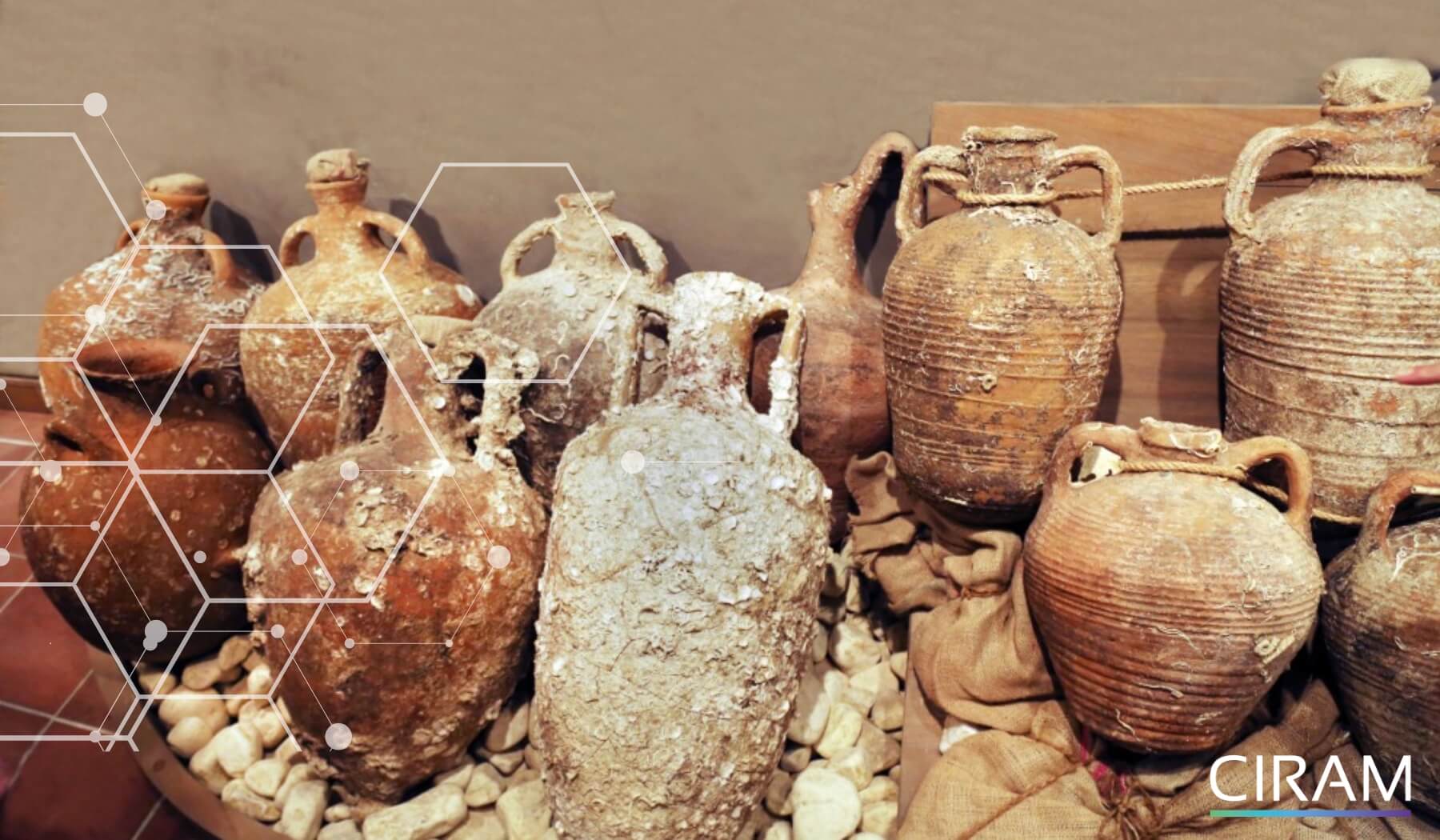
Pottery, amphorae, and ancient vessels can retain traces of the substances they once contained. By coupling different analytical techniques, such as infrared spectrometry, Raman spectrometry, and chromatography, scientists can detect and identify some of these organic residues.
The analyses performed by CIRAM allow for the characterization of oils, fats, resins, or even residues of fermented beverages. This information contributes to a better understanding of the dietary habits, artisanal practices, and trade exchanges of ancient peoples.
In summary:
- Understanding ancient practices: organic residues can provide information on diet, products used, and the uses of containers.
- Identify substances: different techniques make it possible to characterize the organic compounds preserved in archaeological objects.
- Combining methods: infrared spectroscopy, GC-MS chromatography, and Raman spectrometry provide complementary information.
- Interpret the results with caution: identification depends on the preservation of the residues, their composition, and the archaeological context.
Organic residues: understanding old habits and practices
The organic residues found in dishes, vases, amphorae, or flasks constitute valuable clues about the practices of ancient populations. They can provide information on dietary habits, methods of food preparation and preservation, as well as trade and certain artisanal or funerary activities.
Analyzing these residues allows for the identification of various substances, such as oils, fats, or resins. Their interpretation must, however, take into account their state of preservation and the archaeological context, as transformations occurring over time can complicate the identification of their initial nature.
Reconstruct dietary habits and products used
Traces of fats and oils can provide clues about the foods prepared, stored, or transported in ancient vessels. Other substances, such as resins, can attest to artisanal uses or specific practices.
This information contributes to a better understanding of the function of the objects and the activities with which they were associated. It complements the study of the shape of the vessels, their provenance, and the other remains discovered at the archaeological site.
Organic residue analysis methods
The residues found in ancient pottery often consist of complex mixtures. To identify the substances present, CIRAM scientists can combine several analytical techniques, depending on the nature of the sample and the information sought.
| Principle | Contributions to the analysis of organic residues | Limits and complementarity | |
| Infrared spectroscopy (FTIR) | Analysis of the response of molecules to infrared radiation | Identify the main families of compounds: oils, animal fats, resins | The mineral signal can complicate the analysis |
| Gas chromatography-mass spectrometry (GC-MS) | Separate the compounds then provide information to identify them | Characterizes and can quantify substances, even in trace amounts | The results depend on the markers retained and the state of the residue |
| Raman spectrometry | Analyze the scattering of light by molecules | Provides additional information, sometimes without sampling【1】…【/1】 | Its relevance depends on the substances being sought and the sample. |
What are the limitations of organic residue analysis?
The identification of organic residues depends on several factors, notably the quantity of material available, the state of preservation of the molecules, and potential contamination from the soil or the container itself. Some substances degrade over time, while others may present similar chemical signatures. Identifying a family of compounds therefore does not always make it possible to determine with certainty the initial product or its exact use.
This is why analytical results must be compared with the archaeological context and other information available on the object. This approach makes it possible to formulate better-supported hypotheses about the substances present and the practices with which they may be associated.
CIRAM's expertise in 【1】archaeometric analysis【/1】
CIRAM supports archaeology stakeholders in the scientific study of materials and remains. The analysis of organic residues allows for the search for clues about substances present in ancient containers and contributes to the understanding of the practices of ancient societies. The choice of techniques depends on the nature of the sample, its state of preservation, and the archaeological research question. The interpretation of the results then makes it possible to place the information obtained back into its context and to discuss the possible hypotheses.
To learn more, visit our page dedicated to organic residue analysis in archaeology.
Share this article

Are you perhaps asking yourself these questions about organic residues in ancient pottery【1】?【/1】
Organic residues can provide information about the food prepared or stored in containers, the products transported, and certain craft activities. Their analysis helps to better understand the practices of ancient populations.
Depending on their state of conservation, the analyses can reveal various substances, notably oils, animal fats, resins, or compounds associated with other organic materials.
Several techniques can be used, notably infrared spectroscopy (FTIR), gas chromatography-mass spectrometry (GC-MS), and Raman spectrometry. The choice depends on the sample and the substances being sought.
Not always. Over time, residues can degrade or undergo transformations that complicate their identification. Results must therefore be interpreted in light of the archaeological context and do not always allow for the precise determination of the container's initial contents.
The analysis of organic residues provides complementary information to the study of objects and remains. It helps archaeologists better understand the uses of containers, dietary practices, and certain economic or craft activities.
Related topics

Need more information or have a question?
Our team will get back to you as soon as possible.