
Article Outline
- Food quality control
- What is food quality control?
- The role of the food quality control laboratory
- The different stages of food quality control
- Control and monitoring procedures
- What analysis techniques are used in food quality control laboratories?
- Food quality control requirements
- Standards and regulations in the food industry?
- Responsibilities of food companies
- Adulteration and authentication in the food industry
- What is adulteration in the agri-food sector?
- Importance and methods of authentication

Nowadays, food safety is essential to avoid health risks, and food quality control is crucial for manufacturers. A single failure can lead to costly recalls and health risks.
But what are the components of this quality control? In this article, we explore the requirements of food quality control. This offers professionals an overview of best practices and analysis methods to ensure safe and compliant products.
Discover the behind-the-scenes of an essential process for maintaining trust and excellence in the food industry.
In summary:
- Quality control in the food industry is essential to ensure product safety, compliance, and quality.
- Laboratory analyses help detect contaminants, fraud, and nonconformities.
- HACCP and ISO 22000 standards, as well as relevant regulations, govern manufacturers' quality management systems.
- Authentication methods enhance product traceability and consumer confidence.
Food quality control
What is food quality control?
Food quality control is an essential process that ensures food products meet safety, quality, and regulatory compliance standards.
This process is composed of precise steps, from production to distribution, including the transformation of raw materials. Manufacturers are aware of the importance that rigorous quality control has in preventing health risks and ensuring consumer satisfaction.
The importance of agri-food quality control is explained by its ability to detect and prevent potential problems before products reach points of sale. By guaranteeing food safety, agri-food companies not only protect consumers but also their reputation and market share.
Thanks to effective quality control, manufacturers can ensure their products comply with national and international regulatory requirements (EU, RDM), and thus avoid potential sanctions. Food scandals can indeed destroy renowned companies due to their rapid media coverage.
The role of the food quality control laboratory
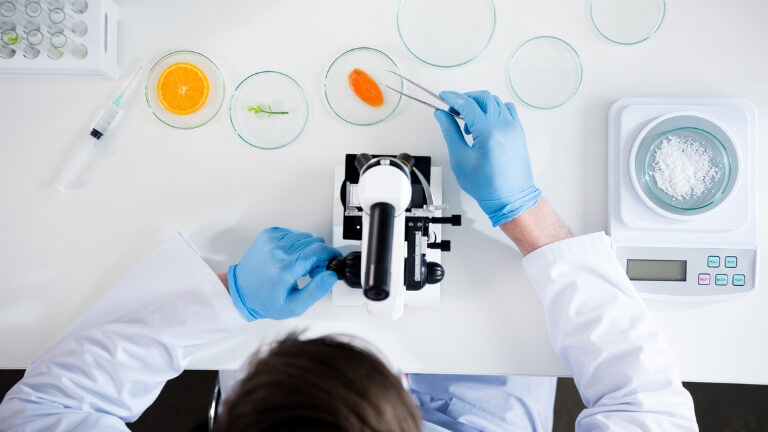
The food quality control laboratory is central to this process. It performs precise analyses on raw materials, products in the process of manufacturing, and finished products.
These analyses are used to check compliance with quality specifications, detect contaminants and guarantee product authenticity, and identify any adulterations.
To achieve this, the laboratories use microbiological and chemical tests to assess product quality. They collaborate with other company departments to implement robust quality control protocols and continuously improve production processes.
Over the course of this article, we will address the following questions to deepen your understanding of food quality control:
- What are the main quality control criteria in the food industry?
- How do you check that food products comply with quality standards?
- What are the standards and regulations to be complied with in food quality control?
- How can we guarantee the traceability of food products throughout the supply chain?
- What are the best practices for effective quality control in the food industry?
Having established the importance and crucial role of agri-food quality control, let's now look at the various stages and specific procedures that make up this essential process.
The different stages of food quality control
Control and monitoring procedures
There are multiple control and monitoring procedures in the agri-food industry. They are essential for guaranteeing the quality and safety of products.
These procedures include several key steps:
- Selection and inspection of raw materials: upon arrival of raw materials, a series of checks is carried out to verify their quality and conformity. These checks include chemical and microbiological analyses and sometimes, sensory ones.
- In-process controls: throughout manufacturing, regular checks monitor critical parameters such as temperature, humidity, and product composition. These controls aim to quickly detect and correct any deviations from established standards.
- Finished product control: products undergo precise tests to ensure they meet quality and safety criteria before shipment. These tests may include, among others, contaminant analysis, labeling verification, and shelf-life testing.
- Environmental monitoring: the production environment is monitored, including the hygiene of equipment and premises, to prevent cross-contamination and ensure a clean and safe production environment for manufacturing.
- Process audit and validation: internal and external audits are carried out periodically to assess the effectiveness of quality control procedures. Production processes are regularly validated to ensure their compliance with regulatory and industry standards.
What analysis techniques are used in food quality control laboratories?
The agri-food quality control laboratories use a variety of analytical techniques to evaluate products:
- Microbiological analyses: these studies allow to detect the presence of pathogenic microorganisms and to determine the levels of microbiological contamination. Common techniques include culture on agar medium, PCR tests (polymerase chain reaction), and bioluminescence assays.
- Chemical analyses: chemical analyses make it possible to check the composition of products, detect pesticide residues, heavy metals and other chemical contaminants. The methods used are liquid chromatography (HPLC), gas chromatography (GC), and mass spectrometry.
- Traceability tests: laboratories conduct DNA analysis and authentication tests to ensure product traceability throughout the supply chain. These studies help verify the origin of raw materials and detect any adulteration.
- Physical analyses: these tests measure the physical properties of products, such as density, viscosity, and component texture. Techniques used include rheology, microscopy, and hardness testing.
The combination of these analytical techniques allows food quality control laboratories to provide a comprehensive and accurate assessment of product quality. This, in turn, guarantees compliance with the required safety and quality standards for the products.
After exploring the steps and techniques used in food quality control, let's now turn our attention to the regulatory requirements and the responsibilities of companies in this field.
Food quality control requirements
Standards and regulations in the food industry?
Food quality control is governed by a set of strict standards and regulations to ensure consumer safety and product quality:
- ISO standards: ISO standards, notably ISO 22000 for food safety management systems, provide a framework for implementing an effective food safety management system. ISO standards cover all aspects of the supply chain, from production to distribution.
- HACCP (Hazard Analysis Critical Control Point): the HACCP system is a preventive method for identifying, evaluating, and controlling food safety hazards. It is a key point of food safety programs worldwide. It is often integrated into national and international regulatory requirements.
- European regulations: in Europe, agri-food companies must comply with European Union regulations, such as Regulation (EC) No 178/2002. This establishes the general principles and requirements of food legislation. Other regulations exist, such as those relating to food additives, contaminants, and the labelling of foodstuffs.
- National regulations: each country may have its own food safety and quality control regulations. In France, companies must comply with the requirements of the Directorate General for Food (DGAL) and other competent authorities.
- Codex Alimentarius: The Codex Alimentarius, developed by the Food and Agriculture Organization of the United Nations (FAO) and the World Health Organization (WHO), provides international guidelines and standards to ensure food safety and product quality.
Responsibilities of food companies
Food companies are obliged to set up effective quality control systems in order to comply with current standards and regulations:
- Implementation of quality management systems:manufacturers must implement rigorous quality management systems, based on recognized standards such as ISO 22000 and HACCP. These must be documented, integrated, and regularly updated.
- Staff training and awareness: Staff training on quality control procedures is essential to raise the awareness of all employees regarding the importance of food safety. Regular training programs are organized to ensure the skills and vigilance of on-site employees.
- Continuous monitoring and evaluation: companies must conduct internal and external audits to assess the effectiveness of their quality control systems. Performance indicators must be defined and continuously monitored to quickly detect and correct any non-compliance.
- Documentation and traceability: complete and accurate documentation is crucial to ensure product traceability throughout the supply chain. Companies must keep detailed records of all production steps, quality controls performed, and corrective actions implemented.
- Collaboration with regulatory authorities: industry professionals must cooperate with regulatory authorities. Companies must provide information and proof of compliance upon inspection or request. This collaboration is essential for maintaining the trust of consumers and business partners.
By adhering to these requirements and adopting best practices in the food production industry, food companies can ensure effective quality control. These controls aim to minimize food safety risks and protect consumer health.
After presenting the standards and responsibilities of agri-food companies, let's look at the specific problems of adulteration and the authentication methods needed to guarantee product integrity.
Adulteration and authentication in the food industry
What is adulteration in the agri-food sector?
Adulteration in the agri-food sector consists of intentionally adding unauthorized or lower-quality substances to a food product to deceive the consumer or reduce production costs.
This practice can seriously damage the health of consumers and the reputation of the manufacturers who use it. There are several types of adulteration:
- Economic adulteration:consists of adding less expensive substances to replace higher quality ingredients. For example, adding water to milk or substituting olive oil with lower quality oils.
- Adulteration by substitution: is the replacement of an authentic ingredient with a cheaper one without indicating this substitution on the label. For example, replacing natural honey with glucose syrup or pure saffron with turmeric.
- Adulteration by contamination: consists of introducing undesirable or dangerous substances, such as heavy metals, pesticides, or mycotoxins, either accidentally or intentionally to alter the product's composition.
- Adulteration by dilution: is a reduction in the concentration of a product by adding unwanted elements, such as adding sugar or water to fruit juices to increase volume.
- Adulteration by falsification of origin: consists of deceiving about the geographical origin or production method of products, such as selling ordinary wine under a controlled designation of origin (AOC).
Importance and methods of authentication
The authentication of agri-food products is essential to guarantee their integrity, protect consumers, and maintain trust in supply chains.
Current authentication methods allow to verify the origin, composition, and quality of food products, preventing fraud while ensuring compliance with quality standards. There is a wide range of authentication methods, the most common of which are:
- DNA analysis: DNA tests make it possible to identify the plant or animal species present in a food product. These analyses are particularly useful for detecting fraudulent substitutions and guaranteeing the authenticity of products of animal or plant origin.
- Mass spectrometry: this technique allows for the determination of the chemical composition of food products and the detection of foreign substances. It is used for the analysis of contaminants and pesticide residues.
- Chromatography: chromatography methods, such as liquid chromatography (HPLC) and gas chromatography (GC), are used to separate and identify the chemical components of a product. They allow for verification of the exact composition of products and detection of adulterations.
- Stable isotope analysis : This method makes it possible to verify the geographic origin and authenticity of food products. For example, analyzing the oxygen and hydrogen isotopes in wine can reveal the region where it was produced.
- Next-Generation Sequencing (NGS): NGS allows for a more in-depth and precise analysis of the genetic sequences present in a product, thus offering rigorous verification of its authenticity.
The implementation of these authentication methods is crucial for combating fraudulent practices and ensuring the quality of agri-food products. By relying on advanced technologies and rigorous protocols, manufacturers can protect consumers, preserve their reputation, and comply with regulatory requirements.
Food quality control is therefore an essential pillar for ensuring the safety, quality, and compliance of food products. We have explored the different stages of quality control, the current standards and regulations, and the analytical methods used to achieve it.
From the selection of raw materials to continuous supply chain monitoring, each step is crucial to prevent risks and maintain consumer trust in your products. Advanced authentication methodsand the adoption of new technologies play a key role in combating adulterationand ensuring product integrity. For manufacturers wishing to strengthen their quality control processes and ensure product compliance, it is essential to collaborate with experts in the field.
The CIRAM laboratories offer cutting-edge analysis services for the biobased food industry to authenticate and certify the quality of your agri-food products. Do not hesitate to contact us to benefit from the expertise of our scientists and thus ensure the safety and quality of your products throughout your supply chain.
Share this article

Related topics



Need more information or have a question?
Our dedicated team will get back to you as soon as possible.