

Why choose non-destructive analysis for your art objects?
Reading time:
Written by:

Studying a work of art may require information about its materials, its condition, or its history. But how can this information be obtained without risking damage to a fragile or valuable object?
Non-destructive analyses allow for the examination of certain characteristics of a work without removing material. They are of particular interest for paintings, sculptures, and heritage objects whose preservation is a priority. The choice of method, however, depends on the nature of the object, the questions asked, and the information sought. What are the possibilities offered by non-destructive analyses, and what are their limitations?
In summary:
- Preserve the work: non-destructive analyses make it possible to obtain information without taking samples or intentionally altering the object.
- Better understanding materials: they help to study certain physical characteristics, the structure, or the state of preservation of a work.
- Adapt the method to the objective: each technique provides specific information, depending on the materials and characteristics of the object.
- Know the limits: non-destructive analysis cannot answer all questions and may require further investigation.
Why opt for non-destructive testing?
Preserve the integrity of the works
Artworks and heritage objects can be fragile, altered by time, or particularly sensitive to handling. Taking a fragment of paint, wood, or textile can therefore present constraints, especially when the object is unique or its state of conservation is concerning. Non-destructive analysis thus makes it possible to obtain certain information without taking a sample. It therefore constitutes a preferred approach when the characteristics of the work and the scientific question can be studied by this type of method.
This approach helps to limit interventions on the object, while providing useful elements for its study and conservation.
Obtain useful information for study and conservation
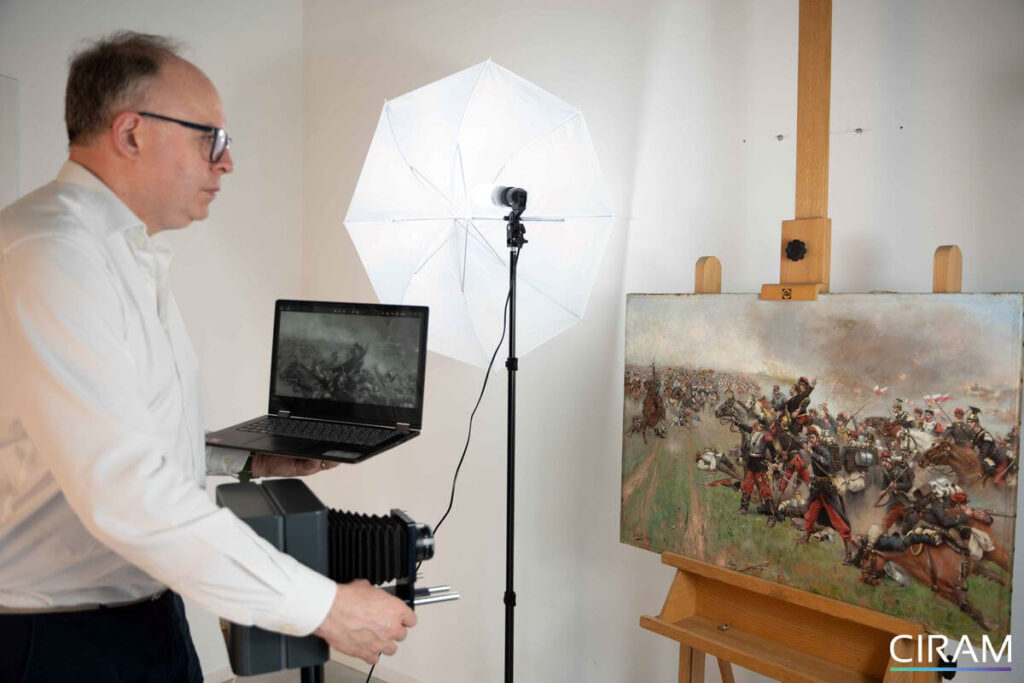
Non-destructive analyses can help characterize certain material properties, observe the structure of a work, or detect alterations. Depending on the method used, they can notably contribute to documenting the conservation status of a painting or object, observing certain structures invisible to the naked eye, or detecting modifications and restorations.
This information helps to better document the artwork and guide further investigations before potential conservation-restoration work. It is part of a broader approach to the scientific analysis of a painting, which combines different methods to study the materials, structure, and material history of the artwork.
What are the limitations of non-destructive testing?
A non-destructive method does not necessarily allow for the identification of all materials or a complete characterization of the object. The accessible information depends on the technique used, the nature of the materials, their condition, and the examination conditions.
For example, scientific imaging can reveal a structure or anomaly without precisely determining its chemical composition. Conversely, the chemical analysis of the materials in a painting aims to identify pigments, binders, varnishes, and other components of the paint layer, depending on the methods used and any sampling constraints. It is also necessary to distinguish between observing an index and demonstrating a hypothesis. The highlighting of an anomaly is not sufficient, in itself, to conclude restoration, falsification, or historical inconsistency.
When non-destructive methods do not sufficiently answer the question posed, targeted sampling or complementary analysis may be considered. This decision must take into account the scientific interest of the investigation, the condition of the object, and conservation constraints.
How to choose the appropriate method for a work of art?
The choice of an analysis method depends primarily on the objective of the study. It is not a matter of systematically mobilizing the largest number of techniques, but of selecting those that can provide the most relevant information. Several criteria must be taken into account:
- The nature of the object: a painting on canvas, a wooden panel, a sculpture, and a composite object do not present the same characteristics.
- The scientific question: observing the surface state, studying an internal structure, or characterizing a material requires different approaches.
- The state of conservation: the fragility of the work and the risks associated with its handling may limit examination possibilities.
- Intervention conditions: the dimensions of the object, its accessibility, and its storage location can influence the choice of materials and methods.
- The limits of each technique: the expected results must be compatible with the actual capabilities of the chosen method.
When several questions arise, different techniques can be combined. Cross-referencing results allows for the completion of observations and avoids drawing conclusions from a single clue. The choice of an imaging technique depends, in particular, on the information sought and the depth of observation required. To better understand the differences between optical imaging and radiography, it is useful to compare their operating principles, capabilities, and limitations.
When is further analysis necessary?
A non-destructive analysis can be a first step in the study of a work. It can sometimes clarify a hypothesis, identify an area of particular interest, or guide the choice of further investigations. Certain techniques, such as radiography, allow for example to examine the internal structure of a painting and provide complementary information on its material history. Discover in more detail what radiography reveals about the history of a painting.
However, some questions require information that cannot be obtained by non-destructive methods alone. This is particularly the case when the precise identification of a compound requires specific analysis or when the dating of an organic material is necessary. Carbon-14 dating, for example, involves organic material suitable for sampling and analysis. It should therefore not be presented as a systematically non-destructive method.
Conclusion
Non-destructive analyses play an important role in the study of works of art, as they provide scientific information while limiting interventions on the objects. An appropriate approach relies on the reasoned choice of techniques, consideration of their limitations, and interpretation of the results within their historical and material context.
Share this article

You may be asking yourself these questions about non-destructive testing?
Non-destructive testing is an examination method that makes it possible to obtain information about an object without removing material or causing intentional alteration under normal analysis conditions.
It allows for the study of certain characteristics of a work while limiting interventions on materials that are sometimes fragile, rare, or difficult to replace. It is particularly interesting when the preservation of the object is a priority.
Depending on the method used, it is possible to observe certain structures, identify alterations or modifications, and characterize certain material properties. The information obtained depends on the technique and the nature of the work.
Not necessarily. It can provide useful clues for the study of the work, but authentication relies on the cross-referencing of several pieces of information: scientific analyses, material observations, historical data, and artistic expertise.
The terms are close, but not strictly equivalent. An analysis without sampling does not remove material from the object. A method described as non-destructive aims to preserve its integrity, but its implementation conditions must be evaluated according to the technique used.
Related topics



Need more information or have a question?
Our team will get back to you as soon as possible.