
Fossil wood samples dated by the CIRAM laboratory
Reading time:
Written by:
Article Outline

The CIRAM recently dated two fossil woods: a "morta" oak and a bog yew. Both were found buried in the same location, in the marshes of Bessin and Cotentin, in Normandy (Calvados and Manche). And it must be said that the state of preservation of these two fragments is remarkable! Radiocarbon analyses place the oak between 4,344 and 4,066 BCE (Before Common Era), and the yew between 2,027 and 1,778 BCE. Despite their 6,000 and 4,000 years of age, these woods retain an almost intact structure and visual appearance.
But how to explain such preservation? And what do these ancient woods tell us about the history of landscapes? Here's a brief overview of a material as fascinating as it is precious.
In summary:
- CIRAM has dated two pieces of fossilized wood discovered in the marshes of Normandy.
- Their exceptional state of preservation is due to their having been buried in an oxygen-poor peat environment, which prevented their decomposition and led to a significant densification of the wood.
- These fossilized woods serve as a valuable record that helps us reconstruct the evolution of ancient landscapes and environments.
- Today, they are particularly popular among woodworkers.
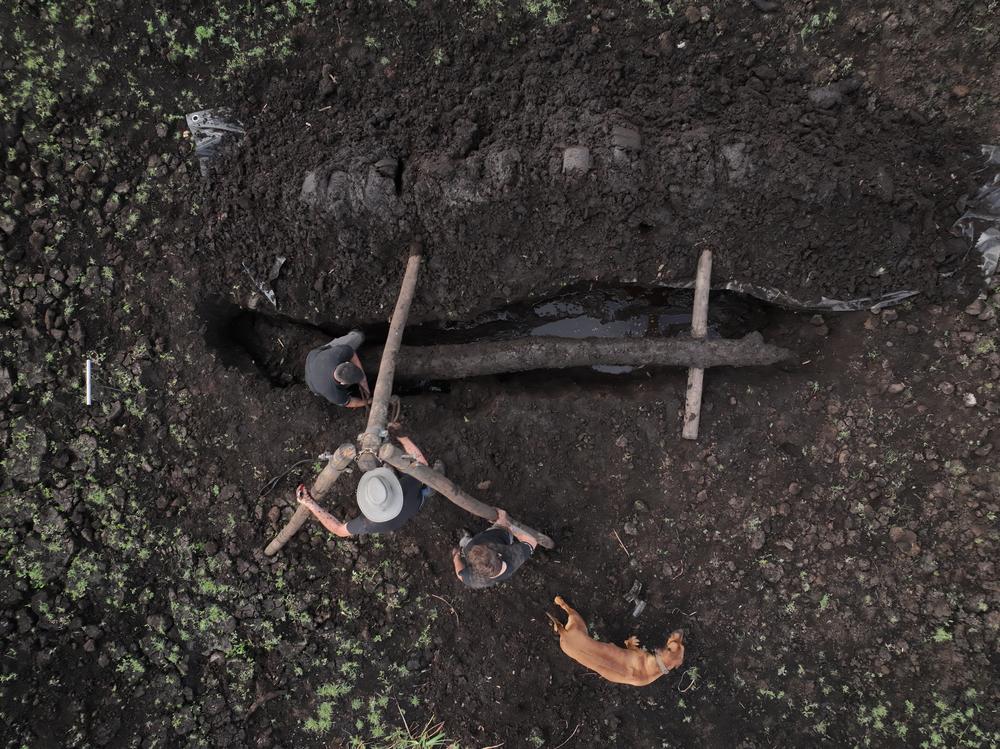
Extraction of a morta tree by Atelier JHP.
(source: Le morta – JHP Workshop)
Morta : wood from submerged forests
Morta is a particularly ancient oak species found buried in the peat of marshes. Hidden there for millennia, it now constitutes as an exceptional material at the crossroads of geoarchaeology, wood science, and fine craftsmanship.
Furthermore, the archaeological surveys carried out during the dredging of the Brière canals, undertaken by the Syndicat du Bassin Versant du Brivet (SBVB), show that the peat deposits constitute genuine environmental archives. These millennia-old plant remains make it possible, in particular, to document:
- Variations in water levels in the marshes,
- The phases of burial of ancient forests,
- Traces of ancient human activity (charcoal, detrital deposits),
- Landscapes evolution since the Neolithic period.
The woods are thus integrated into a global reading of the territory, both archaeological and paleo-environmental. Radiocarbon analyses place the origin of the morta between the end of the Neolithic and the beginning of the Bronze Age. It therefore grew about 5,000 to 7,000 years ago, in a forest environment that has since disappeared.
And indeed, this period, marked by significant hydrological changes in the marshes, led to the gradual burial of the trees under peat deposits. This burial deprived the dead trunk of oxygen, preventing its usual decomposition.
The processing and marketing of morta
The commercial harvesting of bog oak is now strictly regulated: it takes place over a short period each year, in areas defined by local authorities. In the Brière marsh, for example, harvesting is only permitted for six weeks a year, from September 15th to October 30th, when the marsh is not too flooded, and the extraction site is located in conjunction with the Brière Regional Natural Park (PNRB). The ground is probed, and any wood found is harvested without mechanical assistance to preserve the integrity of the soil; the site is then filled in after extraction. An application for Protected Geographical Indication (PGI) status for the Brière marsh holly (morta) is currently under consideration to safeguard and regulate the harvesting of this unique natural heritage as much as possible.
Nowadays, this material is particularly prized for its technical and aesthetic properties. In the past, it was used to make sturdy frames or as firewood. Today, it is no longer sold in its raw state: it is transformed into knives, pens, pipes, sculptures, or other small turned or carved objects.
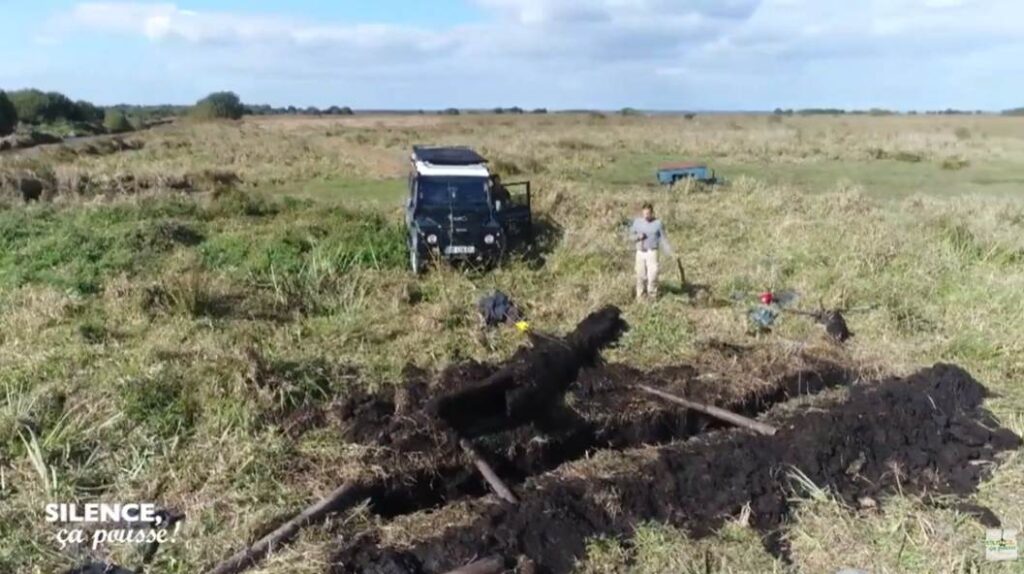
Silence, it’s growing! Video of the harvesting and processing of a morta by Atelier JHP.
(source: Le morta – JHP Workshop and Le morta – Silence, ça pousse ! – France Télévisions)
Analyses conducted by CIRAM
But let's get back to our samples: under these anoxic conditions, our two Calvados wood essences underwent a long fossilization process, making them resistant to decay in natural conditions. This anaerobic context is responsible for the exceptional preservation and the slow transformation into a dense, dark, and stabilized material. As we mentioned earlier, carbon 14 dating reveals two burial periods, even though we found our oak and yew in the same location. We can reasonably infer several phases of rising and falling water levels. These variations explain the decline of the trees and their subsequent progressive entrapment in peat deposits.
For oak essence, black is obviously not its original color, as it is a wood with originally brown and light hues. And it is this particular coloration, a testament to the chemical interactions that have occurred over millennia in humid environments, that gives it its aesthetic charm, particularly prized for art objects. Under the same conditions, yew wood (Taxus baccata) has darkened slightly, whereas it is usually rather orange-brown.
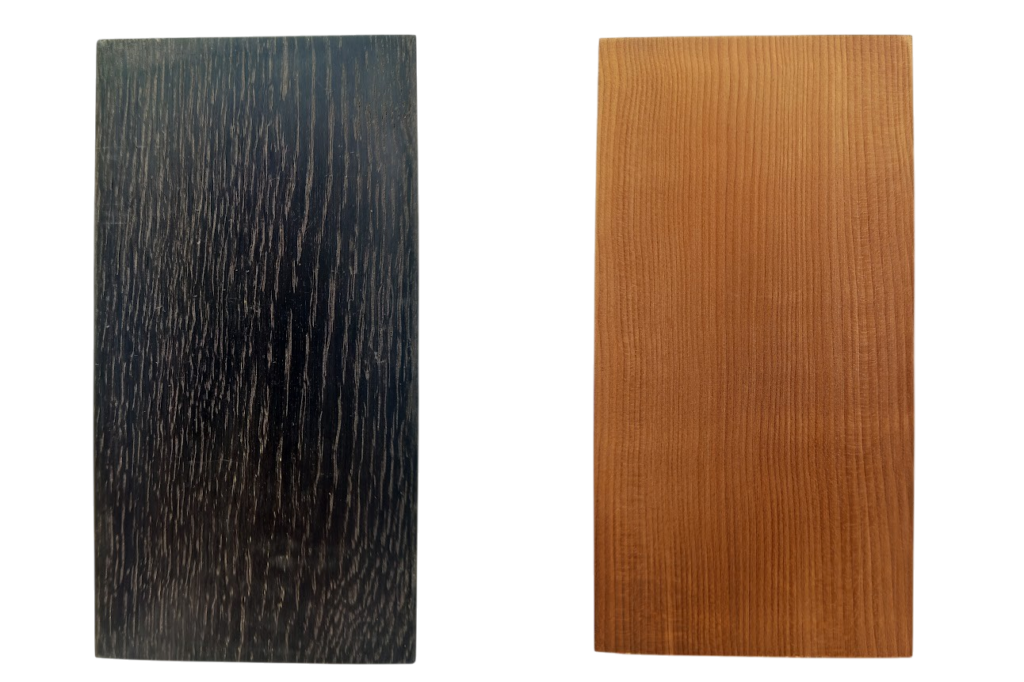
Wood species analyzed by CIRAM laboratories: "morta" oak (black) and swamp yew (brown).
Anatomical Analysis of Wood Species
Our oak sample was compared to a contemporary oak. The cross-section of this thousand-year-old oak reveals all the characteristic features of the deciduous oak genus, namely:
- A porous initial zone,
- Very wide wood rays, clearly visible to the naked eye, and others that are very thin,
- A tangential alignment of large vessels filled with tyloses in the earlywood and small vessels forming flame-like structures in the latewood.
The curvature of the growth rings is slight: the tree was therefore of large diameter and its growth was slow. Consequently, it was an old specimen. An observation that attests to the incredible preservation of the plant from its death to the present day!
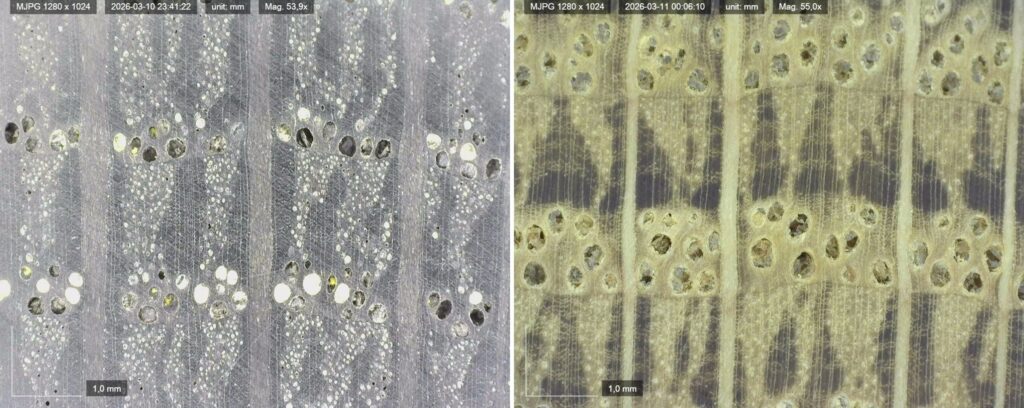
Cross-section of a Morta sample (left) and a contemporary oak (right) after fine-grit sanding (x1200).
Technological Analysis of Wood Species
The analysis of our plants presents particular mechanical characteristics. Indeed, the mineralization of the wood during burial was accompanied by a significant modification of their densities. The average measured on several samples of our "morta" oak gives us an average value of 974 kg/m³. However, according to the Tropix technical sheet published by CIRAD, the density for a sessile oak or a pedunculate oak (Quercus petraea or Quercus robur) is around 740 kg/m³, which is an increase of 31% (source: Quercus robur / petraea technical sheet).
For its part, our if has undergone an equally spectacular mineralization: measurements taken on 6 samples give an average of around 750 kg/m³, whereas the usual density is between 480 and 600 kg/m³, representing a densification of 24 to 56%! This significant increase in density reflects the physico-chemical transformations of wood in a water-saturated, oxygen-poor environment, which permanently alter its mechanical properties.
A denser wood, but more difficult to work with
This high density makes them particularly resistant materials but also demanding to work with. Working with bog oak requires specific tools and expertise, as it is very dull (carbide-bladed tools, negative cutting angles, reduced passes to limit vibrations, slow and controlled work, etc.).
Interactive experience: find the bog oak!
What if you put theory into practice? As part of a Scientific Game Jam (March 10–12, 2023), an online video game was designed in just 48 hours around bog oak. The premise: explore a marsh, probe the ground… and try to locate buried logs, just like artisans do in the field.
This serious game offers a unique immersion in prospecting methods, translating scientific data into an interactive experience accessible to everyone. We bet you'll be digging! 😉

Screenshot from Planet Bog, a serious game dedicated to the search for morta.
(source: Planet Bog and Planet Bog Tutorial)
Acknowledgments and Sources
All of the data used in this article comes from geoarchaeological research conducted by the Loire-Atlantique Archaeology Department as part of the monitoring of the dredging of the Brière Marsh by the Brivet Watershed Authority, the Grande Brière collective geoarchaeological research program (team led by Yann Le Jeune, Loire-Atlantique Archaeology Service), various journalistic articles, as well as field observations and technological analyses of the material. We also thank Jean-Henri Pagnon, the creator of Morta knives, for his valuable advice and permission to use his photographic resources
- Le Jeune, Y. (2025), Geoarchaeology of the Grande Brière marsh – PCR project, UMR 6566 CReAAH, Loire-Atlantique archaeology service, 51 p.
- Le Jeune, Y. (2024), Pays de la Loire, Donges, Saint-André-des-Eaux, Saint-Joachim, Saint-Lyphard, Saint-Nazaire (44) – Brivet Watershed Study Followed by the Dredging of the Grand Marais de Brière – Phase 3, 2023, Archaeological Assessment Report, Nantes: Loire-Atlantique Archaeology Department, 308 p.
- Ouest-France (2024), The morta, oak from the Brière marshes, candidate for PGI
- The Echo (2025), Brière. The bog oak: 10 things to know about this wood buried for 5,000 years in the marshes of Brière
- Silence, it's growing! (2022), Video – The dead
- CIRAD Tropix, technical sheet Quercus robur / petraea.
- Scientific Game Jam (2023), Serious Game "Morta " – 48-hour development (March 10–12, 2023)
- Morta knives, photos, documentation, and video
Share this article

You might be wondering about these questions regarding fossilized wood?
Fossilized wood is wood that has been buried for several thousand years in an environment conducive to its preservation, such as a peat bog or marsh. Deprived of oxygen, it does not decompose normally and gradually undergoes physical and chemical changes that alter its color, density, and mechanical properties. This is the case with morta.
The exceptional preservation of wood is primarily due to its burial in a water-saturated, oxygen-poor environment. These conditions severely limit the activity of the microorganisms responsible for decomposition and allow the wood to retain its anatomical structure for millennia.
Yes. As long as it still contains enough carbon of organic origin, fossilized wood can be dated using radiocarbon dating. This method makes it possible to estimate the time when the tree stopped exchanging carbon with its environment—that is, the time of its death.
The black color of morta oak results from chemical reactions that occur during its long stay in peat bogs. The tannins naturally present in the oak react with the minerals in the moist environment, gradually darkening the wood until it takes on its characteristic hue.
Fossilized wood serves as a true environmental archive. Dating and studying it allows us to reconstruct changes in landscapes, climate variations, fluctuations in water levels, and even the history of ancient forests and human activities.
Scientific analysis makes it possible to precisely identify the species of wood, determine its age using carbon-14 dating, assess its state of preservation, and better understand the changes it has undergone. This information is essential for research in archaeology, geoarchaeology, environmental history, and heritage preservation.
Related topics



Need more information or have a question?
Our dedicated team will get back to you as soon as possible.