
Article Outline

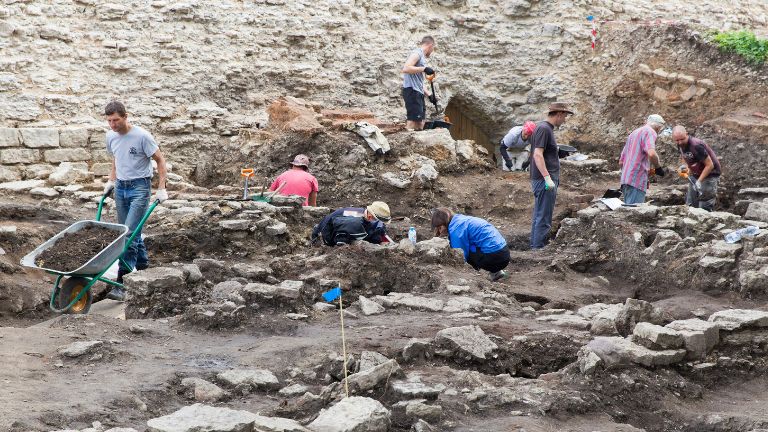
Preventive archaeology makes it possible to study archaeological remains that are likely to be threatened by development projects. To understand the history of sites and place discoveries in their chronology, archaeologists can rely on carbon-14 dating.
This method allows for the estimation of the age of organic materials from remains, such as charcoal, bones, or plant remains. Its relevance, however, depends on the choice of samples and their relationship with the archaeological structures studied.
In summary:
- Preventive archaeology studies remains threatened by development work.
- Carbon-14 dating helps establish the chronology of certain organic remains discovered during diagnostics and excavations.
- The choice of samples is based on their nature, their preservation, and their link to the archaeological event being studied.
- The results must be compared with the stratigraphy and other data from the excavations.
- A dating concerns the analyzed material: it does not necessarily correspond to the exact age of the structure or the site.
Preventive archaeology: definition and challenges
In France, preventive archaeology is governed by the law of January 17, 2001. It aims to safeguard, through scientific study, elements of archaeological heritage threatened by public or private works.
It generally takes place before the implementation of the improvements and includes two main stages:
- The archaeological diagnosis: soundings make it possible to assess the presence, nature, and state of preservation of the remains.
- The archaeological excavation: when the diagnosis reveals remains requiring in-depth study, an excavation allows for their documentation before the work begins.
These operations produce a great deal of information about past human occupations. Carbon-14 dating can complement field observations by providing chronological benchmarks, especially when discovered remains contain organic materials suitable for analysis.
Why use carbon 14 in preventive archaeology?
Carbon-14 dating helps archaeologists determine when organic material stopped exchanging carbon with its environment. It can thus help date certain occupations, structures, or human activities uncovered during diagnostics and excavations. Its use depends on the remains discovered and the scientific questions asked. It can notably contribute to:
- Dating combustion structures, from charcoal associated with a hearth or archaeological feature.
- Studying human occupations, through plant remains, bones, or other organic materials linked to an archaeological level.
- Specify the chronology of a site, by comparing several datings from distinct contexts.
- Verify chronological hypotheses, by confronting the results with stratigraphic observations and other archaeological data.
Carbon-14 dating, however, does not allow for the direct dating of all remains. It applies to materials containing carbon of biological origin and does not necessarily provide the exact age of a structure or event. The relevance of the result depends on the link between the analyzed material and the element being dated.
To understand the scientific principle of this method, its applications, and its limitations, also consult our article: How does carbon-14 dating work?.
How to choose samples for dating?
The choice of sample is a crucial step in preventive archaeology. A sample must be suitable for the dating method, sufficiently well-preserved, and relevant to answer the archaeological question. Several types of materials can be studied:
| Contributions of carbon-14 dating | |
| Charcoal | Dating a combustion structure or fire-related activity |
| Bones | Estimate the period at which an animal or individual died, if the bones are sufficiently well preserved |
| Seeds and other plant remains | Provide chronological markers on agricultural activities, food practices, or site occupation |
| Other organic matter | Dating certain organic residues, wood, or plant materials, depending on their nature and state of preservation |
The context of discovery is as important as the nature of the material. The stratigraphic position, the relationships between the remains, and any possible soil disturbances must be documented to allow for relevant interpretation.
Charcoal discovered in a structure may, for example, be older than it if the wood came from a long-dead tree or had been reused. Similarly, a material displaced after its deposition may not directly date the level in which it is found.
It is therefore essential to select samples whose link to the event studied is as direct as possible.
How to interpret the results in their archaeological context?
Carbon-14 dating provides an estimate of the age of the analyzed material. To draw conclusions about the history of a site, archaeologists must compare it with other information gathered during fieldwork.
Cross-reference datings and stratigraphic observations
Stratigraphy allows for the study of the succession of archaeological layers and structures. It helps to understand the chronological relationships between the different elements discovered.
Carbon-14 dating can complement this reading. Several samples from well-documented contexts can, in particular, help to refine the chronology of an occupation or to verify if remains are contemporary.
Results that seem contradictory do not necessarily mean that one of the dates is wrong. They may reveal the presence of residual materials, displacement of remains, or distinct occupation phases. Their interpretation therefore requires returning to the context of each sample.
Take into account the limits of the method
The reliability of a dating depends notably on the state of conservation of the material, the risks of contamination, and the quality of its preparation and analysis.
Calibration is also essential for converting radiocarbon age into calendar date intervals. The results must be interpreted taking these intervals into account, and not as a systematically determined exact year.
Finally, radiocarbon dating does not answer all chronological questions. Other methods may be more suitable for certain materials, notably thermoluminescence for mineral materials that have been heated or optically stimulated luminescence for certain sediments. The choice depends on the nature of the artifact and the event one wishes to date.
To delve deeper into the subject, also consult our article: Carbon 14, thermoluminescence TL and OSL: which dating method to choose?
Share this article

You may be asking yourself these questions about preventive archaeology?
It allows for the estimation of the age of organic materials discovered during diagnostics and excavations. The results help to refine the chronology of human occupations and activities identified on a site.
Archaeologists can date charcoal, bones, seeds, and other organic materials when their state of preservation and context allow for relevant analysis.
No. It estimates the age of the analyzed material. To link this date to a structure or an event, one must take into account the context of discovery, stratigraphy, and any possible displacement or reuse of the material.
Several datings from well-documented contexts can help to refine the chronology of different occupation phases, compare structures, and verify certain archaeological hypotheses.
No. It applies to materials containing carbon of biological origin. For mineral materials or contexts that are not suitable for this method, other dating techniques can be considered.
Related topics



Need more information or have a question?
Our team will get back to you as soon as possible.