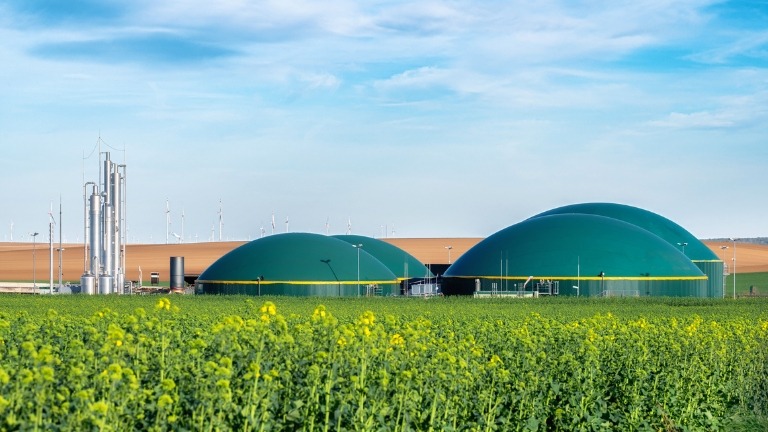

Methanization offers manufacturers a solution for optimizing their energy and recovering their waste. But while setting up such a project requires solid financial backing and rigorous technical support, what financing options are available to manufacturers?
In this article, we explore the methanization subsidies available, and the vital role of analytical laboratories in bringing these initiatives to fruition.
Biogas production and its importance for industry
Biogas production through methanization represents a strategic opportunity to diversify energy sources and reduce the carbon footprint of industrial activities. However, it requires appropriate support to maximize benefits and ensure integration into production processes.
Biogas production and methanization: what are they?
Methanization is a biological process that transforms organic matter into biogas, composed mainly of methane and carbon dioxide. The latter can be used as a renewable energy source to produce electricity, heat or fuel. For manufacturers, biogas represents a solution for the future, enabling them to valorize the organic waste from their production while meeting energy transition targets.
Biogas production requires facilities that vary in size and capacity. Processing facilities must be carefully optimized to ensure efficient, cost-effective biogas production. To achieve this, it is crucial to control every stage of the production project, from the choice of raw materials to the management of by-products.
Biogas: what are the strategic advantages for manufacturers?
Biogas production offers several significant benefits for manufacturers. It helps reduce energy costs by enabling the on-site generation of renewable energy, thereby reducing dependence on fossil fuels. Manufacturers can also recover value from their organic waste (food waste, sewage sludge, etc.), which would otherwise be costly to dispose of.
However, biogas production can be a heavy investment. That's why biogas subsidies and other support schemes have been set up to help manufacturers overcome the financial challenges of initial investment in biogas plants.
Financial schemes to support biogas production
Industry professionals wishing to embark on biogas production projects need to be aware of the many support schemes available to cushion investment costs. Subsidies and other financial assistance are available to help secure the project's financial package and increase its chances of success.
Methanization subsidies available to manufacturers
Subsidies generally account for 10% of the funding for an industrial biogas project. Among existing subsidies, the methanization subsidy is one of the main ways of supporting biogas production. Offered by various bodies, includingADEME and local authorities, it covers part of the investment involved in setting up methanization units. Since the launch of methanization in France, ADEME has provided financial support for over 150 projects. In 2020, ADEME introduced a lump-sum approach to standardize access to its support. In 2023, flat-rate support for biomethane injection projects will be €45/MWh, with a ceiling of €700,000 per project.
Specific criteria such as a prior feasibility study, minimum energy efficiency and Qualimétha certification are required to qualify for these grants. To obtain these subsidies, manufacturers must put together detailed technical files demonstrating the project's economic and environmental viability.
Finally, some regions also offer specific subsidies for projects located in rural or industrial areas. These subsidies can often be combined with national subsidies, significantly reducing the cost of setting up a biogas plant.
Optimizing financing and preparing applications
A number of financing options are available to support a methanization project. These are generally distributed as follows: 80% bank loans, 10% equity capital and 10% subsidies. To maximize access to subsidies, it's crucial to structure the project's financial package properly. A common strategy is to combine several sources of financing: methanization subsidies, regional grants and soft loans. For example, some banks offer specific loans for methanization projects, with preferential interest rates.
In partnership with Bpifrance, ADEME is offering an unsecured loan of up to €1 million for methanization projects meeting strict agri-environmental criteria. This loan enables projects to be co-financed alongside conventional bank financing. A practical guide and financial simulation tools are also available to help project developers build their financing plans.
Preparing a project file is a key step in convincing funding bodies. It must include a detailed study of the return on investment, taking into account initial costs, expected energy production and long-term savings. The ability to demonstrate the profitability of the project, while complying with environmental standards, is crucial to obtaining grants. The support of experts, such as specialized consultants or laboratories, may be essential to ensure that the application complies with technical and regulatory requirements.
The key role of analytical laboratories in the success of biogas projects
Financial schemes, while central, are not enough to guarantee the success of a biogas production project. The quality of raw materials, process optimization and compliance with standards are also decisive factors. This is where analysis laboratories like CIRAM come in, to support manufacturers.
The importance of analysis for optimizing anaerobic digestion projects
The efficiency of the anaerobic digestion process relies heavily on the quality of the organic materials used and the precise management of process parameters. Analytical laboratories specialized in the biobased industry carry out detailed studies of raw materials, to assess their biogas production potential and detect any contaminants that could affect the performance of anaerobic digestion units.
Several analysis methods can be used in a project. Radiocarbon analysis of biogas enables the proportion of biogenic carbon to fossil carbon to be determined. This distinction is essential for manufacturers wishing to prove the proportion of biomass used in their energy production process, particularly to meet environmental requirements and benefit from methanization subsidies. The measurement is based on carbon-14 concentration, a key indicator for assessing the biobased content of gases emitted or biogas produced, in accordance with standards such asASTM D6866.
These analyses are essential for anaerobic digestion projects. They enable industry professionals to demonstrate the compliance of their facilities with financial aid eligibility criteria, by proving significant biomass use. Analysis of biogas samples also helps optimize production processes by adjusting the feedstock mix. This maximizes energy efficiency while minimizing environmental impact. Biogas and flue gas analysis laboratories can therefore intervene at various stages of a project to assess its profitability and identify possible optimizations.
Technical support from laboratories for biosourced industry professionals
Analytical laboratories such as CIRAM can assist manufacturers in drawing up the technical documents required to obtain methanization subsidies. Their role is to ensure a smoother transition between project development stages, by verifying that the analytical results comply with the requirements of the funding bodies.
Technical support includes recommendations on equipment selection and plant configuration. A well-designed anaerobic digestion project is based on an understanding of the interactions between materials, technology and environmental parameters. The analysis laboratory plays a key role in providing manufacturers with precise data and advice based on concrete results. This ensures that anaerobic digestion plants are optimally integrated into production activities.
The laboratory's support not only secures financing, but also ensures that the anaerobic digestion plants operate at full capacity, with optimum energy yields.
This collaboration between manufacturers and specialized laboratories is therefore a key factor in the success of biogas production projects. It ensures that the former have the data and support they need to overcome technical and financial obstacles, while benefiting from available support mechanisms.
Biogas production therefore represents a strategic opportunity for manufacturers seeking to reduce their energy costs and valorize their waste while meeting the requirements of the energy transition. Thanks to methanization subsidies and other financial schemes, methanization projects can become profitable, provided they are properly structured in terms of financing and implementation.
Analytical laboratories such as CIRAM play an essential role in ensuring success. By offering raw materials analysis services, CIRAM supports you at every critical stage of your anaerobic digestion project.
If you are planning a biogas production project or need to guarantee the quality of your products, ask CIRAM for a study.