
Thermoluminescence dating TL/ OSL

TL/ OSL luminescence dating

Luminescence dating, including thermoluminescence (TL) and optically stimulated luminescence (OSL), can be used to date materials that have been heated or exposed to natural light.

Contact our teams
DSC00561

The principles of luminescence dating

Luminescence dating is a method of dating method based on the measurement of energy accumulated in quartz or feldspar crystals present in certain materials. This energy comes from natural exposure to environmental radioactivity and is released when heat (TL) or light (OSL) is applied. It can be traced back to the last "instant zero" undergone by the material:

  • For thermoluminescence (TL): this is the last firing or heating (hearth, oven, fire),
  • ForOSL: from last exposure to daylight (sedimentary deposit).

This method makes it possible to date materials over periods of up to 700,000 years, depending on sediment type and conservation conditions. CIRAM rigorously adapts its protocols according to the context (museum or excavation), the type of object, and the method chosen (TL test, TL or OSL dating).

Contact our teams
img scientific imagery

Thermoluminescence dating: state-of-the-art analysis

The quality of TL or OSL dating rests on three pillars:

  1. Rigorous sampling, carried out according to scientific protocols to preserve sample integrity;
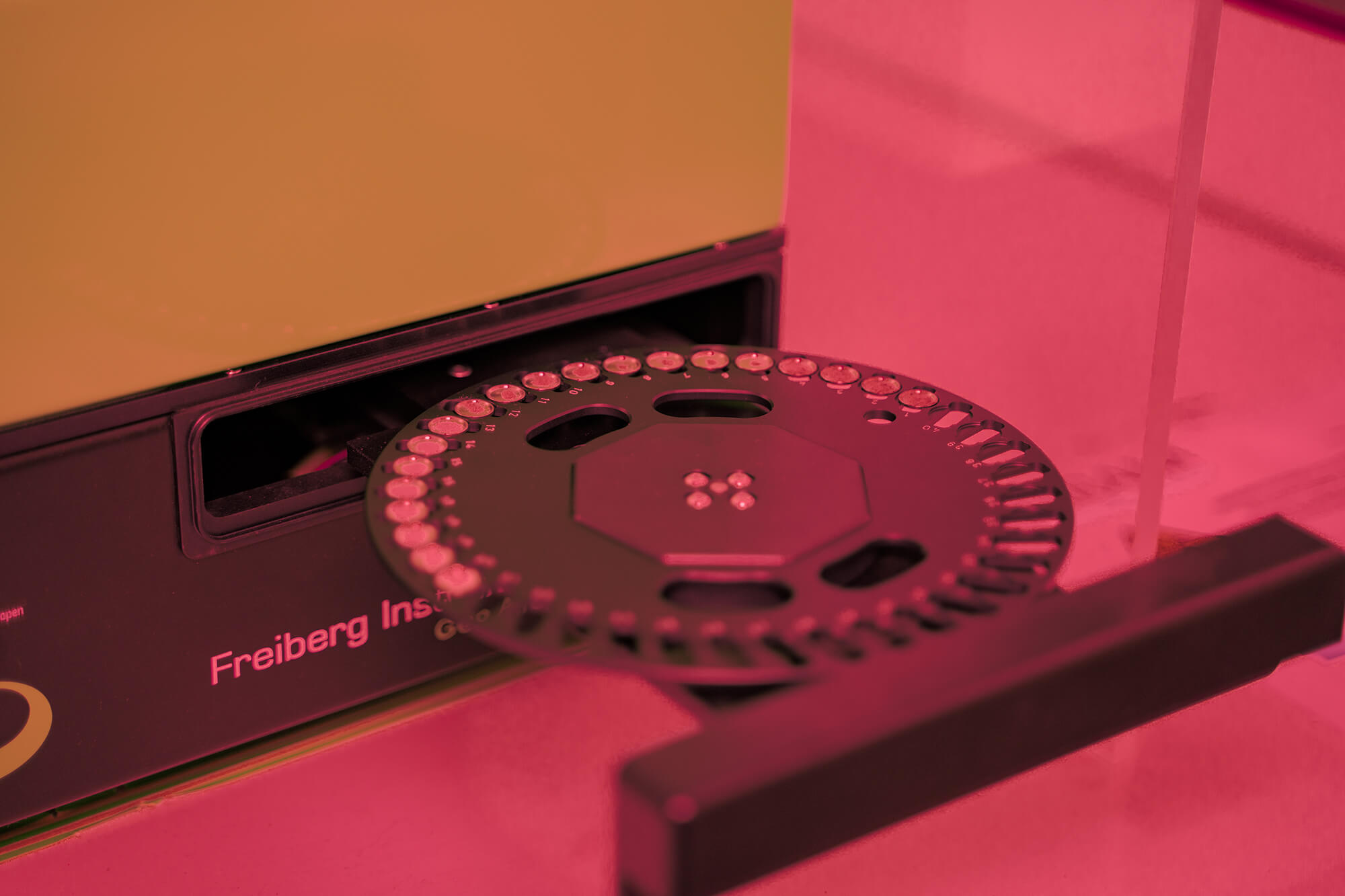
  2. Highly specialized instrumentation, including the LexsygSmart system, for accurate and reliable analysis;
  3. A methodology in line with public laboratory standards, guaranteeing results that can be used for research or heritage appraisal.

CIRAM is currently the only private laboratory in Europe to offer TL/OSL dating comparable to the protocols used by public research centers.

Request a quote

What are the differences between TL dating and TL testing?

01 - Measuring the archaeological dose

The archaeological dose, or equivalent dose, corresponds to the energy accumulated since the last heating or exposure. This measurement is carried out in our laboratories using the LexsygSmart system, after rigorous sample processing.

  • TL test: the sample is subjected to a standard chemical treatment. Only 4 aliquots (sub-samples) are analyzed. The test gives an age index for detecting modern objects.
  • TL dating : a precise granulometric sorting (40-120 µm) is carried out and at least 40 aliquots are measured. This approach provides reliable absolute dating.

02 - Annual radiation dose

To obtain absolute dating, we need to know not only the equivalent dose, but also the annual dose of irradiation received by the object. This dose comes from three sources: the object itself (self-irradiation), its surroundings (up to 1 metre away), and cosmic radiation.

  • In TL/OSL dating, our scientists analyze the concentration of radioelements (uranium, thorium, potassium) in the object and its environment, in order to calculate the precise annual dose.
  • In a TL test, this value is estimated (often between 3 and 5 mGy/year), which gives an approximation of age, but not an absolute dating.

03 - X-rays, CT scans and carbon-14 to complement thermoluminescence

CIRAM combines complementary methods with TL/OSL dating, depending on the case:

  • In artX-rays and computed tomography (CT) reveal restorations, internal structures and manufacturing processes in terracotta, ceramic and porcelain objects.
  • In archaeology, a cross-analysis with carbon-14 can be carried out on the organic materials present, enabling a more complete and reliable dating of the context studied.

CIRAM, a reference in TL/OSL luminescence dating

Thanks to its scientific expertise and rigorous protocols, CIRAM has become a benchmark for radiocarbon datingbut also in luminescence dating. And with good reason: CIRAM is one of the few private laboratories to offer a complete range of TL and OSL dating services, with protocols as rigorous as those applied in public laboratories.

Our expertise lies in two main areas:

Contact our teams

Are you asking yourself these questions?

What's the difference between a TL test and TL dating?

The TL test is a preliminary examination to assess whether a sample is old or not. TL dating, on the other hand, involves in-depth analysis with a rigorous protocol, including the precise calculation of archaeological dose and annual dose to provide a reliable absolute age.

How accurate is thermoluminescence dating?

Accuracy depends on the context and condition of the sample. In general, it varies between 5 and 10% of the estimated age.

What objects can be dated using thermoluminescence?

TL is used to date heated ceramics, terracotta, porcelain and minerals. OSL is used for sediments and minerals exposed to light.

How long does it take to obtain the results of a TL/OSL test and dating?

A TL test takes a maximum of 2 weeks, whereas TL or OSL dating takes 4 to 6 months. Turnaround times may vary according to the type of sample, the complexity of the analysis and the volume of requests.

How much does TL/OSL dating cost?

The cost of TL/OSL dating depends on the nature of the sample, the complexity of the analysis and the number of samples to be analyzed. Please contact us for a personalized quotation.

Make an appointment with an expert

Get all the answers to your questions!

Make an appointment

Explore our dating and analysis resources

Archaeology
Comparison between carbon-14, TL, and OSL: which method should you choose?

Comparison between carbon-14, TL, and OSL: which method should you choose?

Choosing the right dating method in archaeology is not just a technical issue: it is a key decision that guides the entire interpretation of a site. Which technique to choose...

Read the article

Carbon 14
How carbon-14 analysis helps preserve biodiversity

How carbon-14 analysis helps preserve biodiversity

How can we retrace the invisible history of ecosystems and better understand the dynamics of biodiversity? Thanks to carbon-14 dating, researchers now have a scientific tool that they can use to...

Read the article

Art market
How to recognize bronze and differentiate it from brass?

How to recognize bronze and differentiate it from brass?

Distinguishing a work of art in bronze from one in brass is not possible at a glance, however expert. Deceptive patinas, invisible restorations, sophisticated forgeries...

Read the article

Archaeology
The limits of carbon-14 dating: when should we turn to other methods?

The limits of carbon-14 dating: when should we turn to other methods?

How do you know whether a work of art, an archaeological object or a heritage item is really as old as it claims to be? Carbon-14 dating is often the method of choice, but it can also be used to...

Read the article

Art market
How to recognize a forged signature on a painting?

How to recognize a forged signature on a painting?

A simple signature can make the difference between an anonymous work and a masterpiece valued in the millions on the art market. But what happens when that signature is...

Read the article

Archaeology
What role does anthracology play in preventive excavations?

What role does anthracology play in preventive excavations?

Anthracology plays a key role in preventive excavations: by studying archaeological coals, it sheds light on past human practices and paves the way for carbon dating...

Read the article

Request a quote