

Article Outline
- Understanding carbon-14 dating: principles and operation
- The basic principle of carbon-14 dating
- From the measurement of carbon 14 to dating
- From laboratory to analysis: how does carbon-14 dating work?
- Applications and limitations of carbon-14 dating
- What objects and materials can be carbon-14 dated?
- Reliability, precision and limitations of the method
- When to supplement carbon-14 dating with another method?
- Why use a specialized laboratory?

Precisely dating an object or a work involves much more than a simple chronological measurement. Indeed, this approach enriches knowledge, confirms authenticity, and enhances the value of the work. Carbon-14 dating, a technique used for over 70 years, remains the reference method today for analyzing organic materials, whether they are archaeological remains or ancient works of art.
But how does this method actually work? Which objects can really be dated? And above all, what guarantees does carbon-14 dating offer in terms of scientific reliability?
In this article, we propose to explore the fundamentals of carbon-14 dating, its fields of application, its process, and its limitations.
In summary:
- Carbon-14 makes it possible to reliably date organic materials used in archaeology and in works of art.
- The accuracy of the results depends on the quality of the sample, the analyses, and their interpretation.
- The expertise of a specialized laboratory is essential for obtaining reliable and usable dating results.
Understanding carbon-14 dating: principles and operation
Often used as a tool for authentication or absolute dating, carbon-14 dating relies on a physical principle that is as robust as it is precise. It offers professionals an essential scientific method for dating organic materials.
The basic principle of carbon-14 dating
Carbon-14 dating was developed in the 1940s by American chemist Willard F. Libby, and rapidly revolutionized the human sciences. Libby achieved the first radiocarbon dating in 1949, a breakthrough that earned him the Nobel Prize in Chemistry a year later.
The principle of carbon-14 dating is based on the natural decay of a radioactive isotope of carbon: carbon-14 (14C). This radioactive isotope of carbon is present in infinitesimal quantities in the upper atmosphere. It is formed by the interaction of cosmic rays with nitrogen-14, causing a transformation into carbon-14. It is then absorbed by the biosphere (plants, animals, humans).
Upon the death of an organism, it ceases to exchange carbon with the environment, and the radioactive decay of 14C can begin. This phenomenon allows for the precise dating of the organism's death. The "half-life of carbon 14" is the time required for half of the 14C to decay, which is estimated at 5,730 ± 40 years. It is important to note that early dating used a conventional value of 5,568 years, which explains some differences in interpretation in older literature.
From the measurement of carbon 14 to dating
This enables scientists to measure the ratio between residual 14C and 12C in a sample (wood, bone, textile, ivory...). They also apply isotopic fractionation corrections (natural variations in the 12C/13C ratio) to standardize results.
Unlike relative dating techniques, which establish chronological relationships between objects, radiocarbon dating provides absolute dating, with an accuracy of only a few decades.
The method has been greatly refined since its formulation by Libby, notably with the advent of accelerator mass spectrometry (AMS). The results are then expressed in years "Before Present (BP)", with "present" conventionally set at 1950, the scientific reference date.
From laboratory to analysis: how does carbon-14 dating work?
Carbon-14 analysis follows a rigorous and codified protocol. First, the laboratory carries out a controlled sampling. The sample is then purified to eliminate any contamination (glues, varnishes, preservatives, etc.).
The most widely used technique today is accelerator mass spectrometry (AMS). It allows for the direct counting of carbon 14 atoms, even in minute samples of a few milligrams. Before this step, the material must be converted into pure graphite, then ionized and accelerated for analysis with extreme sensitivity. This technical step requires precise know-how and highly specialized equipment, which only laboratories specializing in carbon 14 dating possess (with a few exceptions).
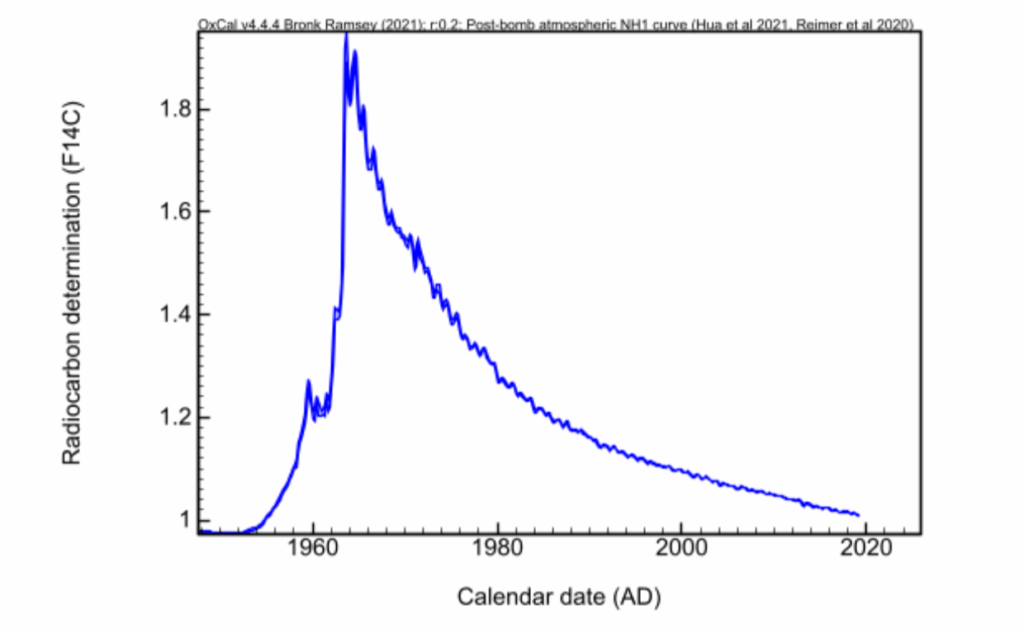
After measurement, the raw results are adjusted using international calibration curves (like IntCal20) to compensate for variations in the atmospheric radiocarbon rate over time. Indeed, natural phenomena such as solar activity, magnetic fields, or anthropogenic emissions can influence this calibration.
Please note that certain contexts require special precautions, such as the effects of marine or river reservoirs (concentration of old carbon in water), or the phenomenon of old wood, when the material used in a work is older than its creation. These specificities are taken into account by the analysis laboratory to enable precise dating of the sample analyzed.
Applications and limitations of carbon-14 dating
Carbon-14 dating is not applicable to all objects. Indeed, before initiating a dating process, the applicant must know which materials are compatible, over what periods this method is reliable, and how to interpret its results within the framework of a professional assessment.
What objects and materials can be carbon-14 dated?
The carbon-14 dating method can only be applied to organic materials: wood, bone, ivory, teeth, plant textiles (linen, cotton), leather, charcoal, plant fibers, pigments containing organic binders, and so on.
This analysis is essential in archaeology, for several applications such as dating habitats, burials, ancient structures, or everyday objects. Indeed, in the archaeological field, the choice of material to be dated depends on the scientific question and the discovery context. Archaeologists can date charcoal from a hearth, plant remains, or bones to establish the chronology of a site, provided a sufficiently well-preserved and relevant sample is selected with regard to the event being studied. For bones, the laboratory specifically analyzes specific fractions, such as collagen, when it is sufficiently preserved. The choice of sample and the assessment of its preservation state are therefore essential steps before any analysis.
In the field of art, it makes it possible to verify the authenticity of works from the dating of wooden sculptures to ethnographic objects, icons, musical instruments, or even canvases.
It is also invaluable for identifying counterfeits, since it can detect modern copies or undocumented restorations.
Reliability, precision and limitations of the method
The reliability of carbon-14 dating results depends on several criteria:
- Condition of sample
- Sample quality (representativeness, absence of contaminants)
- Method used
- Rigorous chronological calibration
In an archaeological context, the relevance of a dating also depends on the link between the analyzed sample and the event one is trying to date. A material may date from a period prior to the construction of a structure or the formation of the archaeological layer in which archaeologists discover it, particularly if it was reused or moved. The laboratory and archaeologists must therefore interpret the results by taking into account stratigraphic data, the sampling context, and other available information about the site.
The accuracy of dating can reach a few decades for the last two millennia. But it can extend over several centuries for very old objects. The method reaches a theoretical limit of about 60,000 years. In practice, however, scientists cautiously interpret results obtained beyond 45,000 years, as the residual signal becomes extremely weak.
Finally, it is important to keep in mind that the method dates the death of the organism (felling of the tree, harvesting of flax, death of the animal) and not that of the object's manufacture. Cross-referencing with stylistic, historical, and technological data is therefore essential. The laboratory can also combine radiocarbon dating with other analysis methods to supplement the results.
When to supplement carbon-14 dating with another method?
Carbon-14 dating is not suitable for all materials or all periods. For certain archaeological remains, other methods can provide complementary information. Thermoluminescence (TL) notably allows dating certain mineral materials that have been heated, such as ceramics, while optically stimulated luminescence (OSL) can be used to date the burial of certain sediments.
The choice of method depends on the nature of the material, the event to be dated, and the archaeological context. When several methods are considered, it is essential to verify that the dated events are comparable in order to interpret the results coherently.
To learn more, consult our article: "Carbon 14, thermoluminescence TL and OSL: which dating method to choose?"
Why use a specialized laboratory?
Obtaining a carbon-14 dating is not just about measuring the age of a sample. The laboratory interprets the results based on several elements: the material analyzed, its state of preservation, possible contaminations, the study context, and data calibration.
This is why choosing a specialized laboratory is essential. Its role goes beyond simple measurement: the laboratory verifies the suitability of the sample, applies appropriate analytical protocols, and assists in the interpretation of results to ensure reliable and usable dating.
Carbon-14 dating remains a benchmark method today for dating organic materials used in archaeology and the art market. A thorough understanding of its functioning, its fields of application, and its limitations allows for the selection of the most relevant analysis strategy for each object.
To go further, a specialized laboratory like CIRAM can assist you in choosing the method, collecting samples, and interpreting the results in order to adapt the analysis to your specific problem.
Share this article

You might be asking yourself these questions about carbon-14 dating?
Before the analysis, the laboratory checks the nature and condition of the material as well as its context. Carbon-14 dating requires organic matter, in which case another analysis method will be considered.
Carbon-14 dating provides a probable period rather than an exact year, due to natural variations in atmospheric carbon-14 and measurement uncertainties. Scientists calibrate the results using international curves to obtain a reliable chronological estimate.
Carbon-14 dating helps authenticate a work, but is not sufficient on its own. Experts supplement the material analysis with a stylistic, technical, and historical study to reach a reliable conclusion.
Related topics



Need more information or have a question?
Our team will get back to you as soon as possible.