
Carbon-14 dating of peat and organic sediments: method and applications
Reading time:
Written by:
Article Outline
- Why date peat with carbon 14?
- What types of peat and organic sediments can be dated?
- Fibrous peats
- Muddy peat
- Silty peats
- How to prepare peat samples for carbon-14 dating?
- How to interpret the results of a carbon-14 dating?
- From radiocarbon age to calibrated date
- Given the phrasing, "Place the date in its scientific context" seems the most natural and direct translation.

Carbon-14 dating makes it possible to determine the age of organic matter and to trace the chronology of its formation. Applied to peat and organic sediments, it helps to reconstruct the evolution of natural environments, landscapes, and ancient ecosystems.
Thanks to its laboratory specialized in accelerator mass spectrometry (AMS) dating, CIRAM performs carbon 14 analyses on various organic materials, including wood, bones, charcoals, peats, and organic sediments.
In summary:
- Reconstruct the evolution of environments: peat dating contributes to paleoenvironmental studies and the understanding of ancient landscapes.
- Adapt the preparation to the sample: the nature of the peat and the organic fraction studied determine the preparation protocol.
- Obtain an actionable timeline: the results are calibrated to obtain an age estimate expressed in calendar dates.
- Interpreting the results in their context: dates should be compared with archaeological, geomorphological, and paleoecological data.
Why date peat with carbon 14?
Peatlands formed over sometimes very long periods, dating back more than 10,000 years in some regions. They preserve valuable information on the evolution of environmental and climatic conditions, as well as on the interactions between human societies and their environment.
Carbon-14 dating makes it possible, among other things, to determine when peat formation began or to which period a studied layer of organic sediment relates. It thus provides useful chronological markers for the reconstruction of ancient environments. Combined with geomorphological, paleoecological, or archaeological data, the dates obtained help to trace the evolution of landscapes and human occupations.
However, the reliability of dating depends on several factors: the nature of the material analyzed, its state of preservation, the selection of the organic fraction, and its preparation before analysis. The choice of sample must therefore be adapted to the research question.
What types of peat and organic sediments can be dated?
Different types of peat and organic sediments can be dated using carbon 14. Their composition and degree of decomposition influence the choice of sample to be analyzed.
Fibrous peats
Fibrous peats contain more or less decomposed plant remains. These organic materials constitute potential substrates for radiocarbon dating and can provide information on peatland formation and environmental evolution.
Muddy peat
Muddy peats generally present organic matter that is finer and less easily identifiable than the plant remains found in fibrous peats. Their dating helps establish a chronology of organic deposit formation.
Silty peats
Silty peats also constitute samples that can be studied by carbon-14 dating. As with other types of peat, the nature of the organic matter and the sampling context must be taken into account to interpret the results.
How to prepare peat samples for carbon-14 dating?
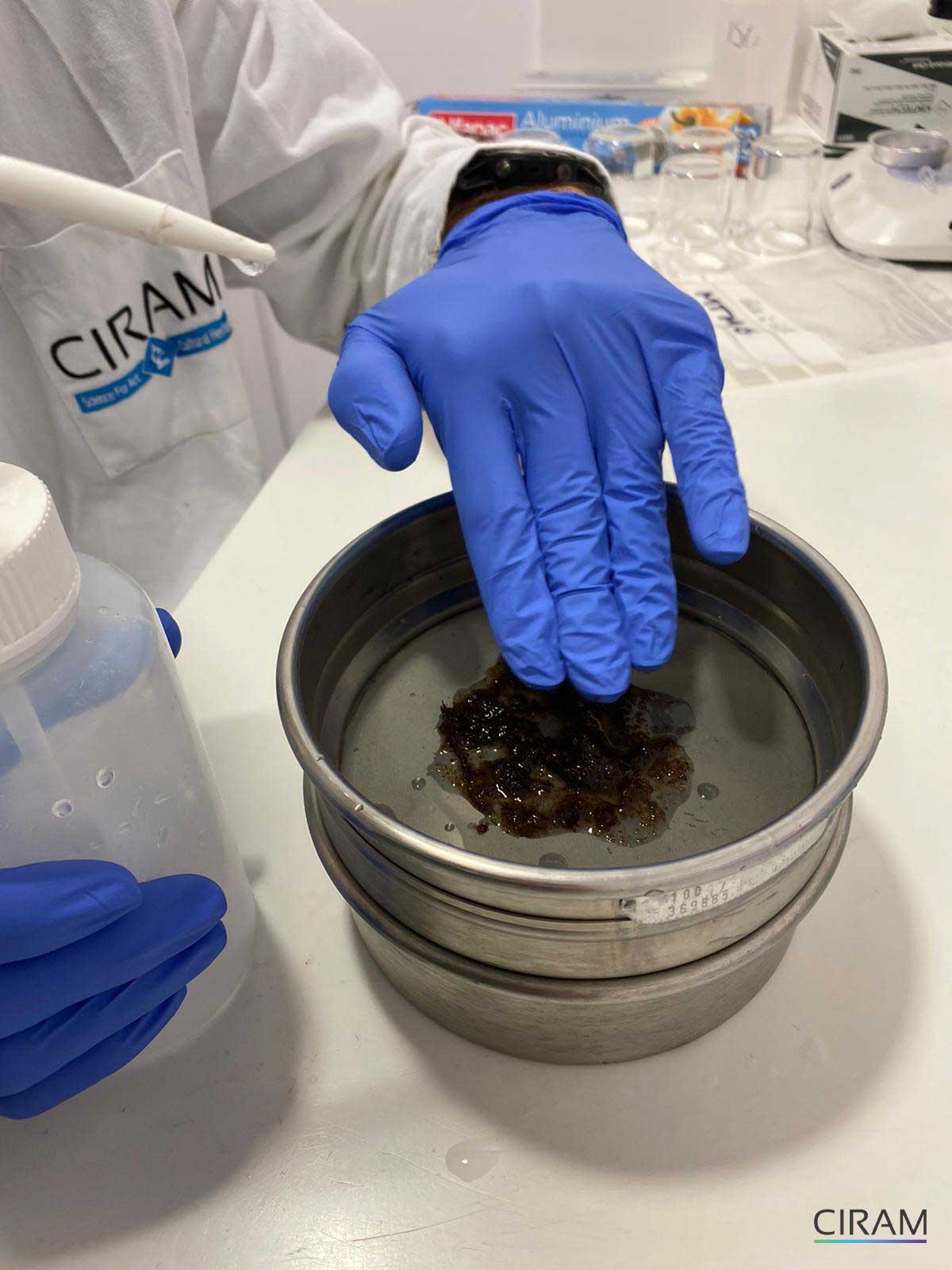
The preparation of peat samples before carbon-14 dating depends on their composition and the organic fraction to be analyzed. It aims to eliminate contaminants that could interfere with the measurement and to isolate the material suitable for dating.
The main preparation steps vary depending on the type of peat:
| Sample preparation | Objective | |
| Fibrous peat | Selection of the relevant fraction, then acid-base-acid (ABA) treatment | Eliminate carbonates as well as certain humic and fulvic compounds likely to contaminate the sample |
| Muddy peat | Sieving to 100 µm to remove micro-residues, then acid treatment to remove carbonates, according to the chosen protocol | Prepare the organic fraction for dating |
| Silty peat | Preparation adapted to the sample composition and the desired organic fraction | Eliminate unwanted elements and isolate the material suitable for analysis |
For certain humic sediments, preparation may also require separating the soluble and insoluble fractions. Sieving, filtration, centrifugation, or precipitation steps can then be implemented according to the protocol applied.
The choice of preparation is essential to limit the risks of contamination and obtain a usable result. It depends on the nature of the sample, its state of preservation, and the scientific question.
How to interpret the results of a carbon-14 dating?
From radiocarbon age to calibrated date
The measurement of carbon 14 provides a conventional radiocarbon age, generally expressed in years BP (Before Present), with "present" conventionally set to the year 1950. This age does not directly correspond to a calendar date. To obtain an estimate of the age in calendar years, a suitable calibration curve must be used. This conversion takes into account variations in the concentration of carbon 14 in the environment over time.
The result is therefore generally expressed in the form of one or more calibrated date ranges, accompanied by their probability level.
Given the phrasing, "Place the date in its scientific context" seems the most natural and direct translation.
A radiocarbon date must be interpreted taking into account the nature of the sample, the fraction analyzed, and the sampling context. For peat and organic sediments, it is particularly important to determine whether the dated material corresponds to the event one is trying to date.
Comparing the results with geomorphological, paleoecological, and archaeological data allows for the construction of a more complete chronology and a better understanding of the evolution of the studied environment.
Share this article

Related topics


Need more information or have a question?
Our team will get back to you as soon as possible.