
Article Outline
- Why calibration is essential
- Overview of archaeological dating methods: between relative and absolute dating
- The challenges of a reliable chronology for archaeological interpretation
- Chronological calibration: central to the adjustment of absolute dates
- Why calibrate radiocarbon dating? Calibration principles and curves
- From theory to practice: protocols, limits and interpretation of calibrated results
- Specialized laboratories and best practices for reliable calibrated dating
- The importance of specialized laboratories for calibration and interpretation of results
- Best practices and advice for archaeologists: selection, deadlines and integration of results

In the context of archaeological studies, raw radiocarbon dating is not sufficient to establish a reliable chronology. Chronological calibration transforms raw results into usable calendar dates. It also improves their interpretation through recognized calibration curves and a rigorous analytical protocol.
In summary:
- Calibration is essential for converting a raw carbon-14 date into a reliable and usable calendar date.
- Calibration curves correct for natural variations in radiocarbon to improve the accuracy of the results.
- The quality of the dates depends on the sample collection, the analytical protocol, and the interpretation of the calibrated data.
Why calibration is essential
Evaluating the age of remains is not just about choosing a dating method. It also requires considering the nature of the materials, the objectives of the excavation, and the integration of the results into a coherent chronology.
Overview of archaeological dating methods: between relative and absolute dating
Dating methods fall into two main complementary categories. Relative dating, which is based on stratigraphy, typochronology, or seriation, allows an artifact to be placed in a sequence without determining its exact age. It remains essential for interpreting contexts. However, archaeologists often supplement it with absolute dating to refine their hypotheses.
Among absolute techniques, carbon-14 dating (or radiocarbon dating) is the most used for organic materials such as bones, wood, seeds, or textiles. However, it requires chronological calibration to convert radiocarbon ages into calendar years. Other methods complement this approach, notably dendrochronology, thermoluminescence (TL), and OSL.
The choice of method depends on the material studied, its state of preservation, the excavation context, and the desired precision. The support of a specialized laboratory allows this choice to be guided from the beginning of the project.
The challenges of a reliable chronology for archaeological interpretation
A reliable timeline allows for an understanding of occupation dynamics, construction sequences, and human interactions. Raw dating, obtained after analysis, is not sufficient: only calibrated dating allows an event to be placed within an archaeologically usable chronological framework.
The accuracy of a dating depends on the quality of the sample, the collection, the method used, and the calibration. IntCal curves correct for natural variations in carbon 14, thus improving the reliability of the results.
From the very beginning of the project, a specialized laboratory like CIRAM helps to ensure the consistency of dating. It also limits biases related to sampling or the choice of method.
Chronological calibration: central to the adjustment of absolute dates
All radiocarbon dating needs to be calibrated before it can be used archaeologically. This operation, still sometimes underestimated, directly conditions the accuracy and reliability of chronologies.
Why calibrate radiocarbon dating? Calibration principles and curves
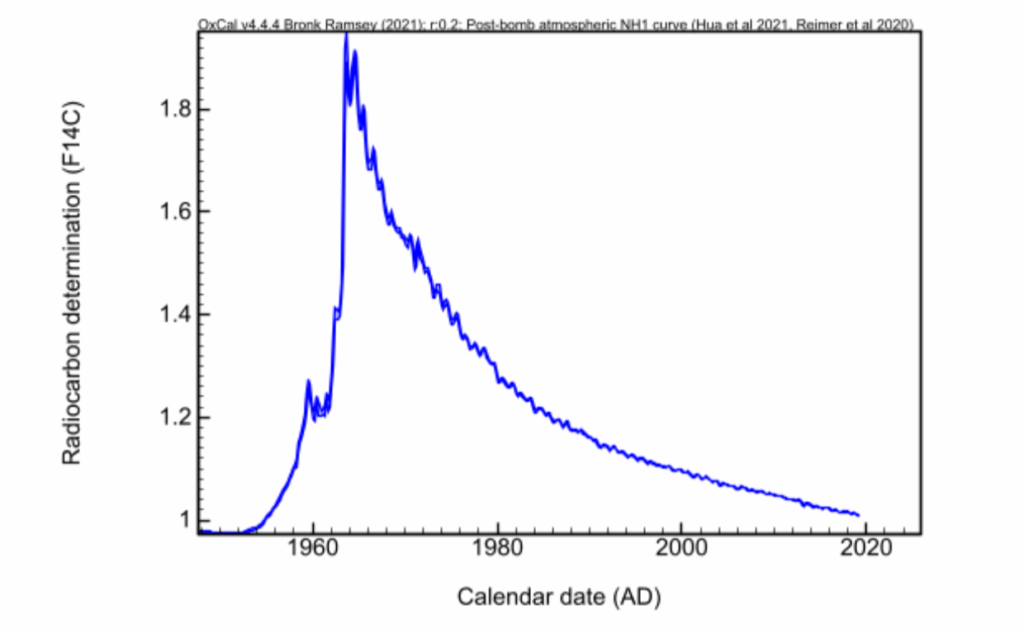
Carbon 14 has never been present in constant quantities in the atmosphere. Natural variations in C14 levels over time distort the raw results, expressed in BP (Before Present) years. This is why it is essential to use a calibration curve to convert the raw radiocarbon age into reliable calibrated calendar dates.
Carbon-14 calibration curves rely notably on tree rings, corals, and certain sediments. They convert radiocarbon ages into calendar dates and reduce uncertainties related to natural variations in carbon-14.
From theory to practice: protocols, limits and interpretation of calibrated results
It is essential to follow a rigorous calibration-dating protocol from the sampling phase onwards to ensure the quality of chronological calibration. Several factors can distort the analysis. Poor sampling, contamination, or an inappropriate method choice can compromise the result, even with a reliable calibration curve.
Furthermore, any interpretation of a radiocarbon calibration curve requires expertise: the plateaus on the curve can generate extended chronological ranges, and statistical integration (Bayesian models, for example) may be necessary to refine the results. It is also possible to cross-reference multiple methods to strengthen the reliability of the results. This approach is moreover recommended in the most complex chrono-stratigraphic contexts.
Finally, it is crucial to identify the limits of calibration curves as a function of period and location. The support of a laboratory specializing in archaeometry enables you to navigate with precision in this demanding technical field, which is in constant need of improvement.
Specialized laboratories and best practices for reliable calibrated dating
The effectiveness of dating and calibration methods depends as much on the quality of the analysis as on the dialogue between archaeologists and the laboratory. Close collaboration is essential to secure the entire dating chain.
The importance of specialized laboratories for calibration and interpretation of results
Engaging a specialized laboratory is not just a technical step. This choice allows for the construction of a more robust and easily usable timeline. From the excavation phase, a partner like CIRAM can intervene to advise on the sampling strategy, identifying the most suitable archaeological dating method for the nature of the remains (bone, wood, mortar, organic materials, bricks, sediments).
A laboratory like CIRAM does not limit itself to producing a dating. It also interprets the results, explains the calibrated dates, and assists archaeologists in their analysis. This expert approach avoids frequent errors such as poorly parameterized calibration or erroneous reading of calibration curves.
Since calibration protocols are sometimes specific to different materials, it is strongly recommended to establish a collaboration plan as soon as the first surveys are carried out. This also enables you to anticipate the time and costs associated with the analysis.
Best practices and advice for archaeologists: selection, deadlines and integration of results
To ensure the reliability of chronological calibration methods, several best practices must be observed:
- Select uncontaminated and representative samples of the context studied,
- Precisely document the stratigraphic provenance,
- Transmit all useful data to the laboratory (relative dating, typology, sequence).
Once the dates have been obtained and calibrated, it is essential to integrate them into the overall chronology of the operation. This means working to ensure consistency with field data and, ideally, support from the laboratory to avoid misinterpretation and optimize scientific output.
Chronological calibration is therefore an essential step to guarantee the reliability of carbon 14 dating. An adapted method, a rigorous sampling protocol, and calibration using a reference curve make it possible to establish a reliable and usable chronology.
Share this article

Related topics


Need more information or have a question?
Our team will get back to you as soon as possible.