
Article Outline
- How does the post-bomb effect work?
- Why did nuclear tests alter carbon 14?
- What materials can be dated using the post-bomb effect?
- What are the limitations of this method?
- How is the post-bomb effect measured?
- The AMS method: the benchmark for measuring carbon 14
- How to interpret the results?
- Post-bomb effect and the art market

Atmospheric nuclear tests conducted in the 1950s and 1960s profoundly altered the amount of carbon 14 present in the atmosphere. This increase, known as the bomb effect or bomb peak, now constitutes a particularly valuable chronological marker for dating recent organic materials.
In the field of art and heritage, this isotopic signature makes it possible to identify materials manufactured after 1954, to detect certain restorations, or even to reveal recent forgeries.
In this article, we explain how the post-bomb effect works, the materials involved, the measurement methods used, and practical applications for artwork authentication.
In summary:
- The bomb pulse corresponds to the increase in atmospheric carbon 14 caused by nuclear testing. This isotopic signature allows for highly precise dating of organic materials produced after 1954.
- In the art market, it helps detect restorations, recent fakes, or chronological inconsistencies.
How does the post-bomb effect work?
Why did nuclear tests alter carbon 14?
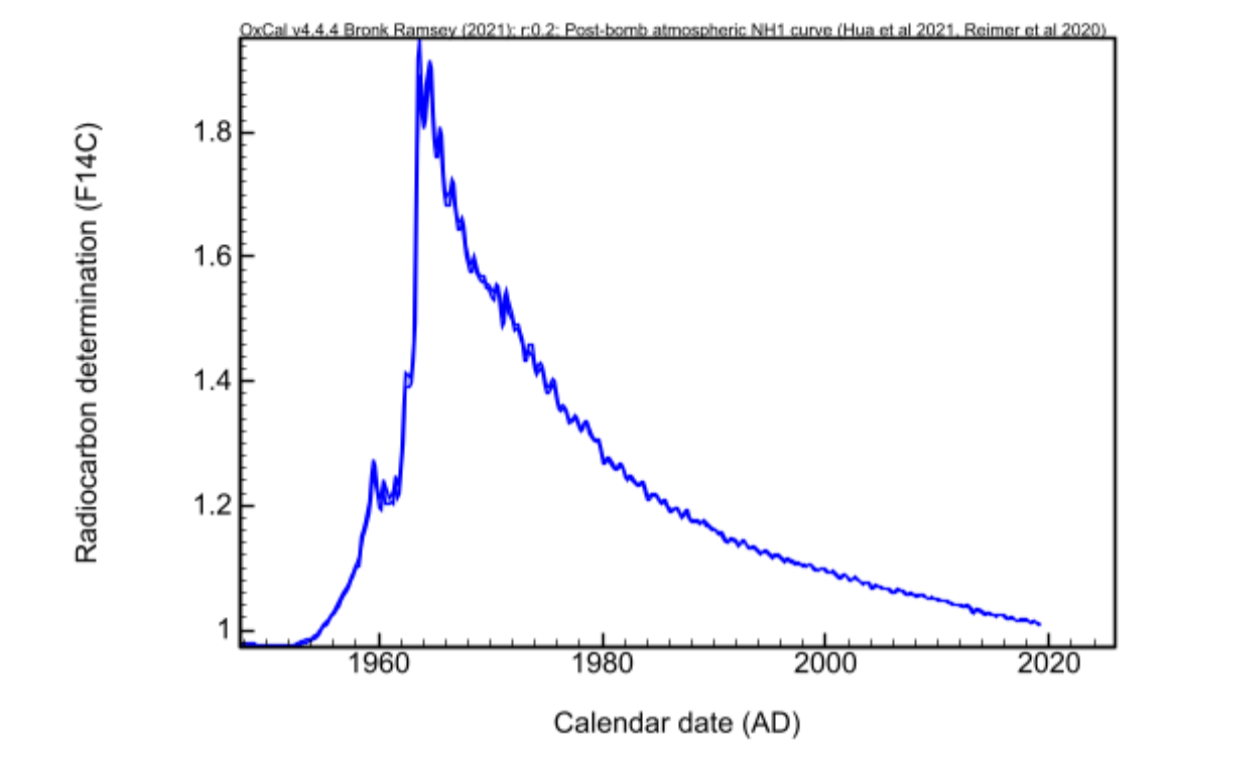
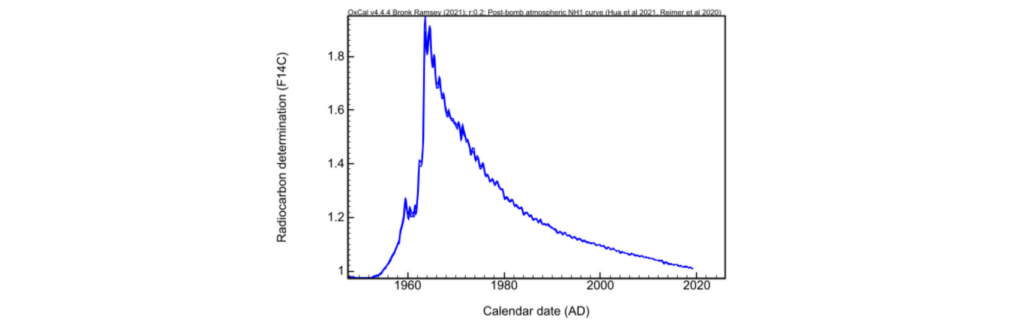
Atmospheric nuclear tests conducted between the 1950s and 1960s profoundly altered the concentration of carbon 14 in the atmosphere. This sudden increase generated a very characteristic radiocarbon curve, known as the "bomb peak" or post-bomb effect.
From 1954 onwards, nuclear explosions led to a massive production of carbon-14. Its concentration reached a peak in 1963-1964, before gradually decreasing due to exchanges with the oceans and the biosphere. This evolution now constitutes a particularly precise chronological marker for dating recent organic materials.
Two phenomena influence the concentration of atmospheric carbon 14:
- The Suess effect: the combustion of fossil fuels, which are devoid of carbon 14, progressively dilutes its concentration in the atmosphere.
- The post-bomb effect: atmospheric nuclear tests, on the contrary, cause a rapid increase in carbon 14, with a peak observed between 1963 and 1964.
Unlike classic carbon-14 dating, whose precision is limited to recent periods, the bomb pulse signal allows certain organic materials to be dated with a precision of one to two years between 1954 and 2020. This resolution is particularly useful for identifying materials incompatible with the announced period of a work. Thus, the bomb pulse effect allows for:
- Determine if a material is prior to or later than 1954;
- Check the chronological consistency of a work attributed to the 1950s to 1970s;
- Distinguish old ivory from ivory from a more recent harvest.
What materials can be dated using the post-bomb effect?
The post-bomb effect applies only to materials of organic origin that incorporated atmospheric carbon after 1954. It is used, in particular, for dating:
| The wood (supports, frames, sculptures) | Plant fibers (linen, paper, textiles) | Ivory, bones, and teeth |
| Allows identification of modern wood, a replaced frame, or a restored element | Allows dating the support and verifying its consistency with the claimed period | Allows to distinguish old materials from more recent samples |
Carbon-14 dating only analyzes the sampled material. It does not directly date the object as a whole. A canvas can be later than the painting it supports, just as a stretcher can have been replaced during a restoration.
What are the limitations of this method?
Like any scientific method, post-bomb analysis has certain limitations and requires precautions in interpretation.
Carbon-14 dating only applies to the sample taken. Dating a canvas does not mean dating the paint, just as dating a piece of wood does not directly date a sculpture.
Restorations also constitute a potential source of contamination. Glues, varnishes, or consolidants can alter the measured signal if they are not removed before analysis. This is why laboratories implement preparation protocols adapted to each material, such as alpha-cellulose extraction for plant fibers or collagen purification for bone and ivory.
Finally, some materials may have been reused. Although infrequent, the use of old wood in a more recent work remains possible. In this type of situation, radiocarbon dating must be supplemented by other approaches, such as dendrochronology, xylology, scientific imaging, or provenance studies.
Each object therefore requires a tailored sampling strategy to ensure reliable interpretation of the results.
How is the post-bomb effect measured?
The AMS method: the benchmark for measuring carbon 14
Accelerator Mass Spectrometry (AMS) is the reference method for post-bomb art. It directly measures the ¹⁴C, ¹³C, and ¹²C carbon ratios with excellent sensitivity from micro-quantities (discrete samples, not visible after intervention).
The AMS method allows for the analysis of extremely small quantities of material, sometimes only a few milligrams. It can be applied to plant fibers as well as wood, paper, or ivory. The results are expressed in percent Modern Carbon (pMC), then converted into a chronological interval using post-bomb calibration curves.
The analysis takes place in five steps:
- Withdrawal targeted (masked area, edge, wire excess)
- Pretreatment: mild/strong solvents depending on matrix, alpha-cellulose extraction (fibers/paper), collagen purification (bone/ivory), varnish/glue removal.
- Graphitizationto isolate pure carbon
- AMS measurement with isotope correction via δ¹³C
- Interpretation according to the post-bomb reference framework (North or South) and delivery of a documented scientific report.
How to interpret the results?
After AMS measurement, the results do not directly correspond to a date. They must be compared to post-bomb calibration curves, established from the evolution of atmospheric carbon-14 since the 1950s. These references allow the measured amount of carbon-14 to be converted into a probable chronological period.
This step is essential to answer questions such as:
- Was the work created before or after 1954?
- Is the material consistent with the stated creation period?
- Can one distinguish an original piece from a more recent reproduction?
Specialized laboratories use calibration curves adapted to the material's original hemisphere (NH or SH), apply international standards, and interpret the results taking into account the analyzed support, its geographical origin, and its restoration history.
At CIRAM, this interpretation is based on calibration reference standards recognized by the scientific community, as well as quality control protocols that guarantee the reliability of the results.
Post-bomb effect and the art market
In the art market, the post-bomb effect addresses several expertise issues. It can notably be used to:
- Authentication of modern works: this can prove, for example, that a material actually dates from the 1960s-1970s.
- Detection of fakes or imitations: this identifies materials that are too recent to be consistent with the advertised attribution.
- Regulatory compliance (CITES): this differentiates pre-1975 ivory (legal) from more recent ivory (prohibited).
- Litigation or insurance: it is used to establish scientific evidence that can be invoked in case of dispute or claim.
Here are some examples of concrete applications of post-bomb analysis in the field of art.
- 19th century " painting on canvas: with linen dating. If a bomb-pulse is detected, then the canvas is post-1954. We can therefore consider a replacement canvas, an apocryphal work, or a copy.
- Drawing on paper: the absence or presence of a post-bomb signal can validate or disqualify an alleged dating. This analysis is particularly useful in the case of contested archives or manuscripts.
- Assemblies, collages, marouflages: cross-dating (support, lining, adhesive) makes it possible to reconstruct the chronology of interventions. This analysis is essential for insurance claims.
In the end, a post-bomb analysis transforms a doubt (stylistic incoherence, incomplete provenance, contentious signatures) into an objective scientific element that can be understood by a committee, a court or an auction house.
Share this article

You may be asking yourself these questions about the post-bomb effect?
Post-bomb analysis alone does not prove a work is fake. However, it can detect inconsistencies between the age of a material and the announced period, in addition to other expertises.
Classic carbon-14 dating mainly studies ancient organic materials. Post-bomb analysis uses the increase in carbon-14 linked to nuclear tests to date recent materials, produced after 1954.
The geographical origin allows for the selection of the appropriate calibration curve, as the concentration of atmospheric carbon 14 varies by region of the world.
Related topics



Need more information or have a question?
Our team will get back to you as soon as possible.