

Laboratory technician preparing samples for the graphitization process

The multiple uses of carbon-14 dating

The multiple uses of carbon-14 dating

Reading time:

2–3 minutes

Reading time:


Carbon-14 dating is today much more than a method used by archaeologists. Thanks to advances in analytical techniques, it is used in many fields: study of archaeological remains, authentication of works of art, control of bio-based materials, protection of biodiversity, and scientific research.

Its principle remains the same: measuring the amount of carbon 14 present in an organic material. However, its applications vary depending on the objectives sought and the materials analyzed.

In this article, discover the main fields of application of carbon 14 on which the CIRAM laboratory works, as well as the specific challenges of each.

In summary:

  • Carbon-14 has numerous applications in archaeology, the art market, industry, and the environment.
  • The same scientific method addresses very different problems depending on the field of application.

The main applications of carbon 14

In archaeology: establishing the chronology of remains

Carbon-14 is one of the main dating methods in archaeology. It allows for the dating of many organic materials such as charcoal, bones, teeth, seeds, textiles, or peat, in order to place discoveries within their chronological context.

Combined with other approaches such as thermoluminescence (TL), OSL, or isotopic analyses, this method helps reconstruct the history of archaeological sites and ancient populations.

To discover:

To authenticate works of art

In the field of heritage, carbon 14 allows for the dating of organic supports of a work: wood, canvas, paper, ivory, or textile. The results help to verify the consistency between the material and the announced period of creation.

Furthermore, for materials produced after the 1950s, the post-bomb effect offers particularly high precision and facilitates the detection of recent fakes.

To delve deeper into the subject:

To analyze bio-based materials

Carbon-14 is not only used for dating. In industry, it also makes it possible to measure the proportion of carbon of biological origin and to distinguish bio-based materials from those of fossil origin. This analysis meets the requirements of many standards and certifications applicable to plastics, paints, cosmetics, fuels, or combustibles.

Here are some examples:

Share this article

Avatar by Olivier Bobin

Need more information or have a question?

Our team will get back to you as soon as possible.

How does carbon-14 dating work?

Reading time:

7–10 minutes

Written by:

Precisely dating an object or a work involves much more than a simple chronological measurement: this process enriches knowledge, confirms authenticity, and enhances the value of the work. Carbon-14 dating, a technique used for over 70 years, remains the reference method today for analyzing organic materials, whether they are archaeological remains or ancient works of art.

But how does this method actually work? Which objects can really be dated? And above all, what guarantees does carbon-14 dating offer in terms of scientific reliability?

In this article, we invite you to explore the fundamentals of carbon-14 dating, its fields of application, its process, its limitations, and the elements that condition the reliability of the results.

In summary:

  • Carbon-14 makes it possible to reliably date organic materials used in archaeology and in works of art.
  • The accuracy of the results depends on the quality of the sample, the analyses, and their interpretation.
  • The expertise of a specialized laboratory is essential for obtaining reliable and usable dating results.

Understanding carbon-14 dating: principles and operation

Often used as a tool for authentication or absolute dating, carbon-14 dating is an analytical technique based on a physical principle that is as robust as it is precise. It offers professionals an essential scientific method for reliably and documentably dating organic materials.

The basic principle of carbon-14 dating

Carbon-14 dating was developed in the 1940s by American chemist Willard F. Libby, and rapidly revolutionized the human sciences. Libby achieved the first radiocarbon dating in 1949, a breakthrough that earned him the Nobel Prize in Chemistry a year later.

The principle of carbon-14 dating is based on the natural decay of a radioactive carbon isotope: carbon-14 (14C). This radioactive carbon isotope is present in minute quantities in the upper atmosphere. It is formed by the interaction of cosmic rays with nitrogen 14, causing a transformation into carbon 14. It is then absorbed by the biosphere (plants, animals, humans).

Upon the death of an organism, it ceases to exchange carbon with the environment, and the radioactive decay of 14C can begin. This phenomenon allows for the precise dating of the organism's death. The "half-life of carbon 14" is the time required for half of the 14C to decay, which is estimated at 5,730 ± 40 years. It is important to note that early dating used a conventional value of 5,568 years, which explains some differences in interpretation in older literature.

From the measurement of carbon 14 to dating

This enables scientists to measure the ratio between residual 14C and 12C in a sample (wood, bone, textile, ivory...). They also apply isotopic fractionation corrections (natural variations in the 12C/13C ratio) to standardize results.

Unlike relative dating techniques, which establish chronological relationships between objects, radiocarbon dating provides absolute dating, with an accuracy of only a few decades.

The method has been greatly refined since its formulation by Libby, notably with the advent of accelerator mass spectrometry (AMS). The results are then expressed in years "Before Present (BP)", with "present" conventionally set at 1950, the scientific reference date.

From laboratory to analysis: how does carbon-14 dating work?

Carbon-14 analysis follows a rigorous and codified protocol. First, the laboratory carries out a controlled sampling. The sample is then purified to eliminate any contamination (glues, varnishes, preservatives, etc.).

The most widely used technique today is gas pedal mass spectrometry (AMS). It enables carbon-14 atoms to be counted directly, even on minute samples of the order of a few milligrams. Before this step can be carried out, the material must be converted to pure graphite, then ionized and accelerated for extremely sensitive analysis. This technical step requires precise know-how and highly specialized equipment, which only laboratories specializing in carbon-14 dating possess (with a few exceptions).

After measurement, the raw results are adjusted using international calibration curves (like IntCal20) to compensate for variations in the atmospheric radiocarbon rate over time. Indeed, natural phenomena such as solar activity, magnetic fields, or anthropogenic emissions can influence this calibration.

Please note that certain contexts require special precautions, such as the effects of marine or river reservoirs (concentration of old carbon in water), or the phenomenon of old wood, when the material used in a work is older than its creation. These specificities are taken into account by the analysis laboratory to enable precise dating of the sample analyzed.

Applications and limitations of carbon-14 dating

Carbon-14 dating is not applicable to all objects. Indeed, before initiating a dating process, the applicant must know which materials are compatible, over what periods this method is reliable, and how to interpret its results within the framework of a professional assessment.

What objects and materials can be carbon-14 dated?

The carbon-14 dating method can only be applied to organic materials: wood, bone, ivory, teeth, plant textiles (linen, cotton), leather, charcoal, plant fibers, pigments containing organic binders, and so on.

This analysis is essential in archaeology, for several applications such as dating habitats, burials, ancient structures, or everyday objects. In the field of art, it allows for verifying the authenticity of works from dating wooden sculptures to ethnographic objects, icons, musical instruments, or even canvases.

It is also invaluable for identifying counterfeits, since it can detect modern copies or undocumented restorations.

Reliability, precision and limitations of the method

The reliability of carbon-14 dating results depends on several criteria:

  • Condition of sample
  • Sample quality (representativeness, absence of contaminants)
  • Method used
  • Rigorous chronological calibration

The accuracy of dating can reach a few decades for the last two millennia. But it can extend over several centuries for very old objects. The method reaches a theoretical limit of about 60,000 years. In practice, however, scientists cautiously interpret results obtained beyond 45,000 years, as the residual signal becomes extremely weak.

Finally, it is important to keep in mind that the method dates the death of the organism (felling of the tree, harvesting of flax, death of the animal) and not that of the object's manufacture. Cross-referencing with stylistic, historical, and technological data is therefore essential. The laboratory can also combine radiocarbon dating with other analysis methods to supplement the results.

Why use a specialized laboratory?

Obtaining a carbon-14 dating is not just about measuring the age of a sample. The laboratory interprets the results based on several elements: the material analyzed, its state of preservation, possible contaminations, the study context, and data calibration.

This is why choosing a specialized laboratory is essential. Its role goes beyond simple measurement: the laboratory verifies the suitability of the sample, applies appropriate analytical protocols, and assists in the interpretation of results to ensure reliable and usable dating.

Carbon-14 dating remains a benchmark method today for dating organic materials used in archaeology and the art market. A thorough understanding of its functioning, its fields of application, and its limitations allows for the selection of the most relevant analysis strategy for each object.

To go further, a specialized laboratory like CIRAM can assist you in choosing the method, collecting samples, and interpreting the results in order to adapt the analysis to your specific problem.

Share this article

Avatar by Olivier Bobin

You might be asking yourself these questions about carbon-14 dating?

How can you tell if an object can be dated using carbon-14?

Before any analysis, a specialized laboratory examines the nature of the material, its state of preservation, and the context of the object's discovery or manufacture. Not all ancient objects are necessarily datable by carbon 14: the method requires the presence of organic matter containing carbon. This preliminary step makes it possible to determine whether radiocarbon dating is relevant or if another analysis method should be considered.

Why are carbon-14 dating results expressed as a date range?

Radiocarbon dating does not provide an exact year, but a probable period. This uncertainty is linked to natural variations in the atmospheric carbon-14 rate over time and the statistical limits of measurement. Scientists then calibrate the results using international curves to obtain a chronological estimate with a level of scientific confidence.

Can carbon-14 dating alone prove the authenticity of a work of art?

Carbon-14 dating is a major scientific element, but it is not always sufficient to authenticate a work on its own. It allows for the dating of the analyzed material. Experts then supplement this dating with stylistic analysis, a study of materials, examination of the historical context, and manufacturing techniques. A multidisciplinary approach is often essential to establish a reliable conclusion.

Need more information or have a question?

Our team will get back to you as soon as possible.

The limits of carbon-14 dating: when should we turn to other methods?

Reading time:

5–8 minutes

Written by:

Scientific dating plays an essential role in the fields of art and archaeology, whether for heritage preservation or concerning financial stakes (sales, insurance). It allows for the validation of an object's age, shedding light on its provenance, or authenticating a work.

Among the most used techniques is radiocarbon dating, commonly called carbon-14 dating, which remains an essential reference. This technique is very useful when it comes to dating organic materials such as wood, bones, or textiles. But this method, however effective it may be, cannot be suitable for all types of materials or all historical periods.

In this article, we explore the limits of carbon-14 dating and the complementary methods implemented according to the materials and study contexts.

In summary:

  • Carbon-14 dating is an essential method, but it does not address all dating issues.
  • Depending on the material and context, other techniques may be necessary to obtain reliable results.
  • Combining different analytical methods helps ensure the authenticity and dating of the works.

What carbon-14 dating can and cannot do

Although radiocarbon dating remains an essential reference in the study of ancient organic materials, it doesn't meet all requirements, especially as objects become more complex. It is therefore crucial to understand the context in which it is applied, in order to choose the most appropriate method for each case.

The principles and benefits of carbon-14 dating

Carbon-14 dating is based on a well-established principle: measuring the amount of the radioactive isotope ¹⁴C still present in an organic sample, and then deducing its age. This method is effective for dating formerly living materials: wood, bone, shells, textiles, leather, paper, or even charcoal that can be found in the analyzed object.

In most contexts, its reliability is beyond question. The method can generally provide a coherent chronological range, extending to around 60,000 years, with relatively controlled margins of error. This is particularly the case when conservation conditions are good and sampling is carried out using optimized protocols.

This dating method is particularly prized for validating a period hypothesis, building a conservation strategy, or simply consolidating the historical traceability of an object. When appraising a work of art, such as a medieval parchment or a fragment of funerary cloth, ¹⁴C dating offers a legible, documented scientific argument.

The technical, material and temporal limits of carbon 14

Despite its many advantages, radiocarbon dating has significant limitations in its applicability. First and foremost, it is exclusively reserved for organic materials. Metals, ceramics, mineral pigments, glass, or stone cannot be dated directly by this method.

Then, its precision decreases as one moves away from its optimal study window. Beyond 60,000 years, there is no longer enough ¹⁴C to obtain a usable dating. Conversely, objects that are too recent can pose problems, particularly due to the effects induced by human activity (e.g., nuclear tests due to the post-bomb effect) on atmospheric radiocarbon content.

Other factors can skew the results, such as, for example, poorly documented restoration, contaminated sampling, or a sample that has undergone aggressive chemical cleaning. Finally, a crucial point must be emphasized: carbon 14 dates the raw material, not necessarily the use or manufacture of the object. Furniture made from old wood, or a painting made on a reused support, can thus lead to a biased reading if the analysis is poorly contextualized.

In such cases, it is essential to call on the expertise of a specialized laboratory, which can use other analytical tools to cross-reference data and guarantee reliable dating.

When should other dating or analysis techniques be preferred to carbon-14 dating?

In certain situations, the limitations of carbon-14 dating mean that other approaches are required to obtain a reliable reading of the object studied. This is particularly the case when the materials are not organic, or when a more complete analysis of the context is required.

Alternatives for inorganic and complex materials

When the objects to be studied are made of ceramic, glass, stone, metal, or inorganic pigments, radiocarbon dating cannot be used to date them, for lack of organic matter to analyze. Other dating techniques are then used, chosen according to the specific characteristics of each material:

The thermoluminescence (TL)Electron spin resonance (ESR)Optically Stimulated Luminescence (OSL)
Given the last firing of a ceramic, thus revealing the manufacturing periodUsed on certain minerals, such as quartz or fossilized bones, to obtain datings beyond the chronological limits of carbon 14Exposure of sediments or mineral materials to light

Other approaches, such as uranium-thorium dating, can be considered depending on the specific materials and the context of the intervention. In parallel, more in-depth physico-chemical investigations make it possible to study the patina layers, corrosion, or material composition to guide indirect dating.

Crossing methods: the key to reliable, interpretable dating

When carbon 14 cannot be applied or when its interpretation remains insufficient, a specialized laboratory may recommend a complementary method adapted to the material studied, such as thermoluminescence, OSL, or ESR.

The combination of several dating methods, coupled with an interdisciplinary reading (materials science, art history, archaeology) is often essential in complex cases, such as with composite objects, restorations, or multiple materials.

This cross-referencing of analytical methods consolidates results and avoids misinterpretations: it is not just about dating a material, but about understanding when and how the object took its current form.

Discover our article on this subject: Why cross-reference multiple dating methods in archaeology?

Share this article

Avatar by Olivier Bobin

You may be wondering about these questions regarding carbon-14 dating and its limitations.

Why can't carbon-14 be used to date all objects?

Carbon-14 dating only works on materials containing carbon of organic origin (wood, bones, leather, textiles, or paper). Therefore, it cannot be applied to metals, ceramics, glass, or stone because they do not contain organic carbon.

Why does carbon-14 sometimes date a material rather than the object itself?

Carbon-14 measures the age of the organic matter analyzed. It corresponds to the moment when it stopped exchanging carbon with the atmosphere, i.e., at its death. This date does not always correspond to the object's manufacture.

Can multiple dating methods be used on the same object?

Yes. When an object is made up of several materials or has undergone restorations, it is often necessary to cross-reference different analytical methods.

Can restoration affect the results of a dating analysis?

Yes, in some cases. The addition of recent materials, such as glues, consolidants, or replacement parts, can contaminate the sample.

How can you determine which dating method is best suited for a particular object?

The choice of method depends on several criteria. The nature of the materials, their state of conservation, the presumed age of the object, and the objective of the study are taken into account.

Need more information or have a question?

Our team will get back to you as soon as possible.
The importance of calibration in carbon-14 dating

Reading time:

5–8 minutes

Reading time:

In the context of archaeological studies, raw radiocarbon dating is not sufficient to establish a reliable chronology. Chronological calibration transforms raw results into usable calendar dates. It also improves their interpretation through recognized calibration curves and a rigorous analytical protocol.

In summary:

  • Calibration is essential for converting a raw carbon-14 date into a reliable and usable calendar date.
  • Calibration curves correct for natural variations in radiocarbon to improve the accuracy of the results.
  • The quality of the dates depends on the sample collection, the analytical protocol, and the interpretation of the calibrated data.

Why calibration is essential

Evaluating the age of remains is not just about choosing a dating method. It also requires considering the nature of the materials, the objectives of the excavation, and the integration of the results into a coherent chronology.

Overview of archaeological dating methods: between relative and absolute dating

Dating methods fall into two main complementary categories. Relative dating, which is based on stratigraphy, typochronology, or seriation, allows an artifact to be placed in a sequence without determining its exact age. It remains essential for interpreting contexts. However, archaeologists often supplement it with absolute dating to refine their hypotheses.

Among absolute techniques, carbon-14 dating (or radiocarbon dating) is the most used for organic materials such as bones, wood, seeds, or textiles. However, it requires chronological calibration to convert radiocarbon ages into calendar years. Other methods complement this approach, notably dendrochronology, thermoluminescence (TL), and OSL.

The choice of method depends on the material studied, its state of preservation, the excavation context, and the desired precision. The support of a specialized laboratory allows this choice to be guided from the beginning of the project.

The challenges of a reliable chronology for archaeological interpretation

A reliable timeline allows for an understanding of occupation dynamics, construction sequences, and human interactions. Raw dating, obtained after analysis, is not sufficient: only calibrated dating allows an event to be placed within an archaeologically usable chronological framework.

The accuracy of a dating depends on the quality of the sample, the collection, the method used, and the calibration. IntCal curves correct for natural variations in carbon 14, thus improving the reliability of the results.

From the very beginning of the project, a specialized laboratory like CIRAM helps to ensure the consistency of dating. It also limits biases related to sampling or the choice of method.

Chronological calibration: central to the adjustment of absolute dates

All radiocarbon dating needs to be calibrated before it can be used archaeologically. This operation, still sometimes underestimated, directly conditions the accuracy and reliability of chronologies.

Why calibrate radiocarbon dating? Calibration principles and curves

Carbon 14 has never been present in constant quantities in the atmosphere. Natural variations in C14 levels over time distort the raw results, expressed in BP (Before Present) years. This is why it is essential to use a calibration curve to convert the raw radiocarbon age into reliable calibrated calendar dates.

Carbon-14 calibration curves rely notably on tree rings, corals, and certain sediments. They convert radiocarbon ages into calendar dates and reduce uncertainties related to natural variations in carbon-14.

From theory to practice: protocols, limits and interpretation of calibrated results

It is essential to follow a rigorous calibration-dating protocol from the sampling phase onwards to ensure the quality of chronological calibration. Several factors can distort the analysis. Poor sampling, contamination, or an inappropriate method choice can compromise the result, even with a reliable calibration curve.

Furthermore, any interpretation of a radiocarbon calibration curve requires expertise: the plateaus on the curve can generate extended chronological ranges, and statistical integration (Bayesian models, for example) may be necessary to refine the results. It is also possible to cross-reference multiple methods to strengthen the reliability of the results. This approach is moreover recommended in the most complex chrono-stratigraphic contexts.

Finally, it is crucial to identify the limits of calibration curves as a function of period and location. The support of a laboratory specializing in archaeometry enables you to navigate with precision in this demanding technical field, which is in constant need of improvement.

Specialized laboratories and best practices for reliable calibrated dating

The effectiveness of dating and calibration methods depends as much on the quality of the analysis as on the dialogue between archaeologists and the laboratory. Close collaboration is essential to secure the entire dating chain.

The importance of specialized laboratories for calibration and interpretation of results

Engaging a specialized laboratory is not just a technical step. This choice allows for the construction of a more robust and easily usable timeline. From the excavation phase, a partner like CIRAM can intervene to advise on the sampling strategy, identifying the most suitable archaeological dating method for the nature of the remains (bone, wood, mortar, organic materials, bricks, sediments).

A laboratory like CIRAM does not limit itself to producing a dating. It also interprets the results, explains the calibrated dates, and assists archaeologists in their analysis. This expert approach avoids frequent errors such as poorly parameterized calibration or erroneous reading of calibration curves.

Since calibration protocols are sometimes specific to different materials, it is strongly recommended to establish a collaboration plan as soon as the first surveys are carried out. This also enables you to anticipate the time and costs associated with the analysis.

Best practices and advice for archaeologists: selection, deadlines and integration of results

To ensure the reliability of chronological calibration methods, several best practices must be observed:

  • Select uncontaminated and representative samples of the context studied,
  • Precisely document the stratigraphic provenance,
  • Transmit all useful data to the laboratory (relative dating, typology, sequence).

Once the dates have been obtained and calibrated, it is essential to integrate them into the overall chronology of the operation. This means working to ensure consistency with field data and, ideally, support from the laboratory to avoid misinterpretation and optimize scientific output.

Chronological calibration is therefore an essential step to guarantee the reliability of carbon 14 dating. An adapted method, a rigorous sampling protocol, and calibration using a reference curve make it possible to establish a reliable and usable chronology.

Share this article

Avatar by Patrick Rossetti

Need more information or have a question?

Our team will get back to you as soon as possible.

Carbon-14: what is the post-bomb effect?

Reading time:

6–9 minutes

Written by:

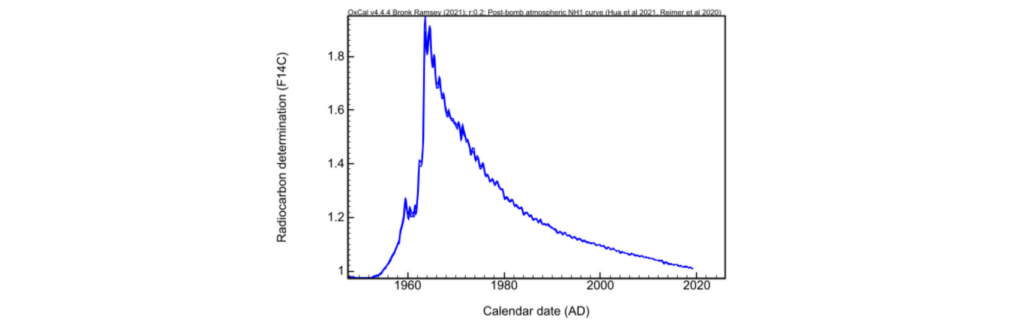
Atmospheric nuclear tests conducted in the 1950s and 1960s profoundly altered the amount of carbon 14 present in the atmosphere. This increase, known as the bomb effect or bomb peak, now constitutes a particularly valuable chronological marker for dating recent organic materials.

In the field of art and heritage, this isotopic signature makes it possible to identify materials manufactured after 1954, to detect certain restorations, or even to reveal recent forgeries.

In this article, we explain how the post-bomb effect works, the materials involved, the measurement methods used, and practical applications for artwork authentication.

In summary:

  • The bomb pulse corresponds to the increase in atmospheric carbon 14 caused by nuclear testing. This isotopic signature allows for highly precise dating of organic materials produced after 1954.
  • In the art market, it helps detect restorations, recent fakes, or chronological inconsistencies.

How does the post-bomb effect work?

Why did nuclear tests alter carbon 14?

Atmospheric nuclear tests conducted between the 1950s and 1960s profoundly altered the concentration of carbon 14 in the atmosphere. This sudden increase generated a very characteristic radiocarbon curve, known as the "bomb peak" or post-bomb effect.

From 1954 onwards, nuclear explosions led to a massive production of carbon-14. Its concentration reached a peak in 1963-1964, before gradually decreasing due to exchanges with the oceans and the biosphere. This evolution now constitutes a particularly precise chronological marker for dating recent organic materials.

CIRAM lab bomb effect

Two phenomena influence the concentration of atmospheric carbon 14:

  • The Suess effect: the combustion of fossil fuels, which are devoid of carbon 14, progressively dilutes its concentration in the atmosphere.
  • The post-bomb effect: atmospheric nuclear tests, on the contrary, cause a rapid increase in carbon 14, with a peak observed between 1963 and 1964.

Unlike classic carbon-14 dating, whose precision is limited to recent periods, the bomb pulse signal allows certain organic materials to be dated with a precision of one to two years between 1954 and 2020. This resolution is particularly useful for identifying materials incompatible with the announced period of a work. Thus, the bomb pulse effect allows for:

  • Determine if a material is prior to or later than 1954;
  • Check the chronological consistency of a work attributed to the 1950s to 1970s;
  • Distinguish old ivory from ivory from a more recent harvest.

What materials can be dated using the post-bomb effect?

The post-bomb effect applies only to materials of organic origin that incorporated atmospheric carbon after 1954. It is used, in particular, for dating:

The wood
(supports, frames, sculptures)
Plant fibers
(linen, paper, textiles)
Ivory, bones, and teeth
Allows identification of modern wood, a replaced frame, or a restored elementAllows dating the support and verifying its consistency with the claimed periodAllows to distinguish old materials from more recent samples

Carbon-14 dating only analyzes the sampled material. It does not directly date the object as a whole. A canvas can be later than the painting it supports, just as a stretcher can have been replaced during a restoration.

What are the limitations of this method?

Like any scientific method, post-bomb analysis has certain limitations and requires precautions in interpretation.

Carbon-14 dating only applies to the sample taken. Dating a canvas does not mean dating the paint, just as dating a piece of wood does not directly date a sculpture.

Restorations also constitute a potential source of contamination. Glues, varnishes, or consolidants can alter the measured signal if they are not removed before analysis. This is why laboratories implement preparation protocols adapted to each material, such as alpha-cellulose extraction for plant fibers or collagen purification for bone and ivory.

Finally, some materials may have been reused. Although infrequent, the use of old wood in a more recent work remains possible. In this type of situation, radiocarbon dating must be supplemented by other approaches, such as dendrochronology, xylology, scientific imaging, or provenance studies.

Each object therefore requires a tailored sampling strategy to ensure reliable interpretation of the results.

How is the post-bomb effect measured?

The AMS method: the benchmark for measuring carbon 14

Accelerator Mass Spectrometry (AMS) is the reference method for post-bomb art. It directly measures the ¹⁴C, ¹³C, and ¹²C carbon ratios with excellent sensitivity from micro-quantities (discrete samples, not visible after intervention).

The AMS method allows for the analysis of extremely small quantities of material, sometimes only a few milligrams. It can be applied to plant fibers as well as wood, paper, or ivory. The results are expressed in percent Modern Carbon (pMC), then converted into a chronological interval using post-bomb calibration curves.

The analysis takes place in five steps:

  1. Withdrawal targeted (masked area, edge, wire excess)
  2. Pretreatment: mild/strong solvents depending on matrix, alpha-cellulose extraction (fibers/paper), collagen purification (bone/ivory), varnish/glue removal.
  3. Graphitizationto isolate pure carbon
  4. AMS measurement with isotope correction via δ¹³C
  5. Interpretation according to the post-bomb reference framework (North or South) and delivery of a documented scientific report.

How to interpret the results?

After AMS measurement, the results do not directly correspond to a date. They must be compared to post-bomb calibration curves, established from the evolution of atmospheric carbon-14 since the 1950s. These references allow the measured amount of carbon-14 to be converted into a probable chronological period.

This step is essential to answer questions such as:

  • Was the work created before or after 1954?
  • Is the material consistent with the stated creation period?
  • Can one distinguish an original piece from a more recent reproduction?

Specialized laboratories use calibration curves adapted to the material's original hemisphere (NH or SH), apply international standards, and interpret the results taking into account the analyzed support, its geographical origin, and its restoration history.

At CIRAM, this interpretation is based on calibration reference standards recognized by the scientific community, as well as quality control protocols that guarantee the reliability of the results.

Post-bomb effect and the art market

In the art market, the post-bomb effect addresses several expertise issues. It can notably be used to:

  • Authentication of modern works: this can prove, for example, that a material actually dates from the 1960s-1970s.
  • Detection of fakes or imitations: this identifies materials that are too recent to be consistent with the advertised attribution.
  • Regulatory compliance (CITES): this differentiates pre-1975 ivory (legal) from more recent ivory (prohibited).
  • Litigation or insurance: it is used to establish scientific evidence that can be invoked in case of dispute or claim.

Here are some examples of concrete applications of post-bomb analysis in the field of art.

  • 19th century " painting on canvas: with linen dating. If a bomb-pulse is detected, then the canvas is post-1954. We can therefore consider a replacement canvas, an apocryphal work, or a copy.
  • Drawing on paper: the absence or presence of a post-bomb signal can validate or disqualify an alleged dating. This analysis is particularly useful in the case of contested archives or manuscripts.
  • Assemblies, collages, marouflages: cross-dating (support, lining, adhesive) makes it possible to reconstruct the chronology of interventions. This analysis is essential for insurance claims.

In the end, a post-bomb analysis transforms a doubt (stylistic incoherence, incomplete provenance, contentious signatures) into an objective scientific element that can be understood by a committee, a court or an auction house.

Share this article

Avatar by Olivier Bobin

You may be asking yourself these questions about the post-bomb effect?

Does the post-bomb effect make it possible to detect a forged work?

Post-bomb analysis alone does not prove a work is fake. However, it can detect inconsistencies between the age of a material and the announced period, in addition to other expertises.

What is the difference between classic carbon-14 dating and post-bomb analysis?

Classic carbon-14 dating mainly studies ancient organic materials. Post-bomb analysis uses the increase in carbon-14 linked to nuclear tests to date recent materials, produced after 1954.

Why is it necessary to know the geographical origin of the analyzed material?

The geographical origin allows for the selection of the appropriate calibration curve, as the concentration of atmospheric carbon 14 varies by region of the world.

Need more information or have a question?

Our team will get back to you as soon as possible.

Preserving biodiversity is not limited to protecting visible species. To be effective, it is also necessary to study invisible mechanisms, natural cycles, and slow transformations that have affected environments for millennia. In this quest for knowledge, dating sciences play a key role. Among them, carbon-14 analysis stands out as a valuable tool for tracing the history of organic matter in soils, sediments, or biological samples.

Carbon-14 dating, the reference method in specialized laboratories, allows for the establishment of reliable chronologies, the identification of ecological ruptures, and the measurement of the impact of climate change on ecosystems. It thus offers researchers, ecologists, and environmental managers tangible, verifiable, and scientifically usable data.

In this article, we'll first look at how this method works and why it's particularly well-suited to the study of ecosystems. We will then explore its practical applications to better understand and preserve biodiversity. Finally, we will explain why calling on the services of a laboratory specialized in carbon-14 analysis, such as CIRAM, is an essential step in guaranteeing the reliability and scientific value of the results obtained.

Understanding carbon-14 dating and its relevance to the study of ecosystems

Having precise temporal markers has become essential for analyzing the evolution of natural environments as ecological stakes become increasingly complex. Carbon-14 dating is now an indispensable method for environmental and biodiversity research, beyond its sole archaeological application.

What is carbon-14 dating and how does it work in ecosystems?

The carbon-14 dating method is based on a simple, yet remarkably powerful analytical principle: all living organisms integrate carbon-14 throughout their lives. When they die, this radioactive isotope begins to decay at a known rate, with a half-life of 5,730 years. Scientists can therefore estimate the age of an object with great precision by measuring the amount of residual carbon 14 in its sample.

This approach allows for the dating of organic matter contained in soils, peat, lacustrine or fluvial sediments within an environmental framework. It then plays a key role in reconstructing past ecological dynamics, by providing reliable chronological data on climatic events, vegetation changes, or past anthropogenic disturbances.

Gas pedal mass spectrometry (AMS) can also be used to refine the analysis. This complementary method enables the dating of very small samples, while guaranteeing high precision, even for low-carbon materials.

Why carbon-14 dating is essential for environmental and biodiversity research

When applied to biological samples such as pollen, charcoal, plant remains or bones, carbon-14 dating can document the temporal structure of ecosystems. It reveals the lifespan of habitats, the frequency of disturbances, and the appearance or disappearance of species.

It also sheds light on organic matter degradation processes and soil carbon flows. These are crucial indicators of ecosystem health. From a conservation perspective, this data can be used to identify the most resilient areas, to better target conservation actions or to quantify the past impacts of human activity.

Radiocarbon dating is therefore an extremely relevant decision-making tool for researchers and managers of natural environments alike.

Practical applications of radiocarbon analysis to preserve biodiversity

Carbon-14 dating proves to be very useful in the field. It is indeed used in concrete environmental monitoring projects, ecological resilience analysis, and natural habitat management, providing them with reliable data. However, its true contribution is only realized if its uses and limitations are well understood, as well as its implementation conditions.

Measuring the evolution and resilience of natural environments using carbon-14 dating

The chronologies constructed in environmental studies, based on radiocarbon dating, make it possible to place events in their temporal context. This enables us to understand, for example, the factors behind the draining of a wetland, reforestation or changes in agricultural practices. This historical perspective is invaluable for interpreting current ecosystem dynamics.

In this context, sediments are often used as natural archives. By analyzing their composition at different depths (by coring) and dating them precisely, it becomes possible to reconstruct ecological trajectories over several centuries. The data extracted can be used to identify breaking points, regeneration rhythms and periods of high anthropogenic pressure.

Isotope analysis (carbon 13 / carbon 12) also plays a role in tracing carbon flows. This is central to understanding the carbon cycle and modeling climate change. For researchers, this approach offers concrete indicators of an ecosystem's capacity to store or release carbon.

Limits and precautions: towards a reliable interpretation of radiocarbon data

Like all scientific methods, carbon-14 dating has its limitations. These include sample contamination, calibration errors and the presence of materials that are too old. Only rigorous preparation can limit the risk of error. This begins with the selection of the sample, right through to its processing in the laboratory.

The use of accelerator mass spectrometry (AMS) is now the standard in specialized laboratories, as it allows for high precision even on samples of a few milligrams. But the rigor of processing does not stop at the measurement: the interpretation of the results also requires an interdisciplinary reading, combining ecology, geochemistry, and paleoenvironment.

The data produced by carbon-14 dating should never be considered in isolation: they take on their full meaning when integrated into a coherent scientific protocol, where each result sheds light on a facet of the ecological prism.

The role of laboratories specializing in carbon-14 dating for environmental research professionals

Environmental research departments regularly work with laboratories specializing in carbon-14 dating, with a simple aim: to guarantee the robustness of their analyses. But what to expect? What does this collaboration entail, and what are the criteria for selecting the most efficient analytical laboratory to carry out reliable, rigorous and documented studies?

Why use an analysis laboratory like CIRAM for your environmental studies?

The quality of results from biodiversity-related projects depends to a large extent on the accuracy of measurements and the rigor of protocols. CIRAM, an independent French laboratory, works hand in hand with scientists, providing them with proven expertise in radiocarbon dating. This methodology, combined with our mastery of isotope analysis and organic material preparation techniques, guarantees clear, usable results.

CIRAM is able to process complex, very small samples, while guaranteeing high sensitivity. This level of performance enables researchers to work on fragile matrices, often difficult to exploit in an environmental context (coals, sediments, plant remains).

Beyond the technical aspects, the value of working with a laboratory specialized in 14-dating for environmental research lies in the quality of the support provided. Each project benefits from personalized follow-up, with direct exchanges between the scientific team and the professionals carrying out the study. The ultimate aim is to produce usable, documented results that are fully integrated into the client's research approach.

Integrating carbon-14 dating results into a biodiversity conservation strategy

Environmental teams need to be able to effectively mobilize the analyses delivered by the laboratory. CIRAM provides clear, structured reports, including raw data, uncertainties, methods used and possible interpretations. These documents can be easily integrated into an interdisciplinary research project, an ecological expertise mission or a conservation program.

The dating results obtained can also enrich databases, model climate scenarios or guide environmental management decisions. To achieve this, CIRAM does more than just produce figures: the laboratory works alongside biodiversity stakeholders to provide solid scientific evidence that is understandable and useful for action.

Ultimately, carbon-14 dating offers much more than a simple measure of age: it provides crucial information on how ecosystems have evolved, how they react to climatic or human pressures, and reveals the invisible dynamics of biodiversity. Thanks to this dating method, environmental professionals have a reliable tool for placing their observations in a long-term time perspective, essential to any conservation strategy.

We have seen how radiocarbon dating can be used to document the transformation of natural environments, analyze carbon fluxes in soils and build robust ecological chronologies. These valuable data, however, require specialized expertise to be obtained and interpreted rigorously.

This is precisely what CIRAM offers, a recognized analysis laboratory in France and internationally for the quality of its work in carbon 14 dating, in both environmental and archaeological fields. Thanks to state-of-the-art equipment and its rigorous scientific approach, CIRAM supports researchers, institutions, and public stakeholders in understanding and preserving living things.

Do you have a project requiring carbon 14 analysis?
Request a study on our website and talk directly to our experts.

Request a quote