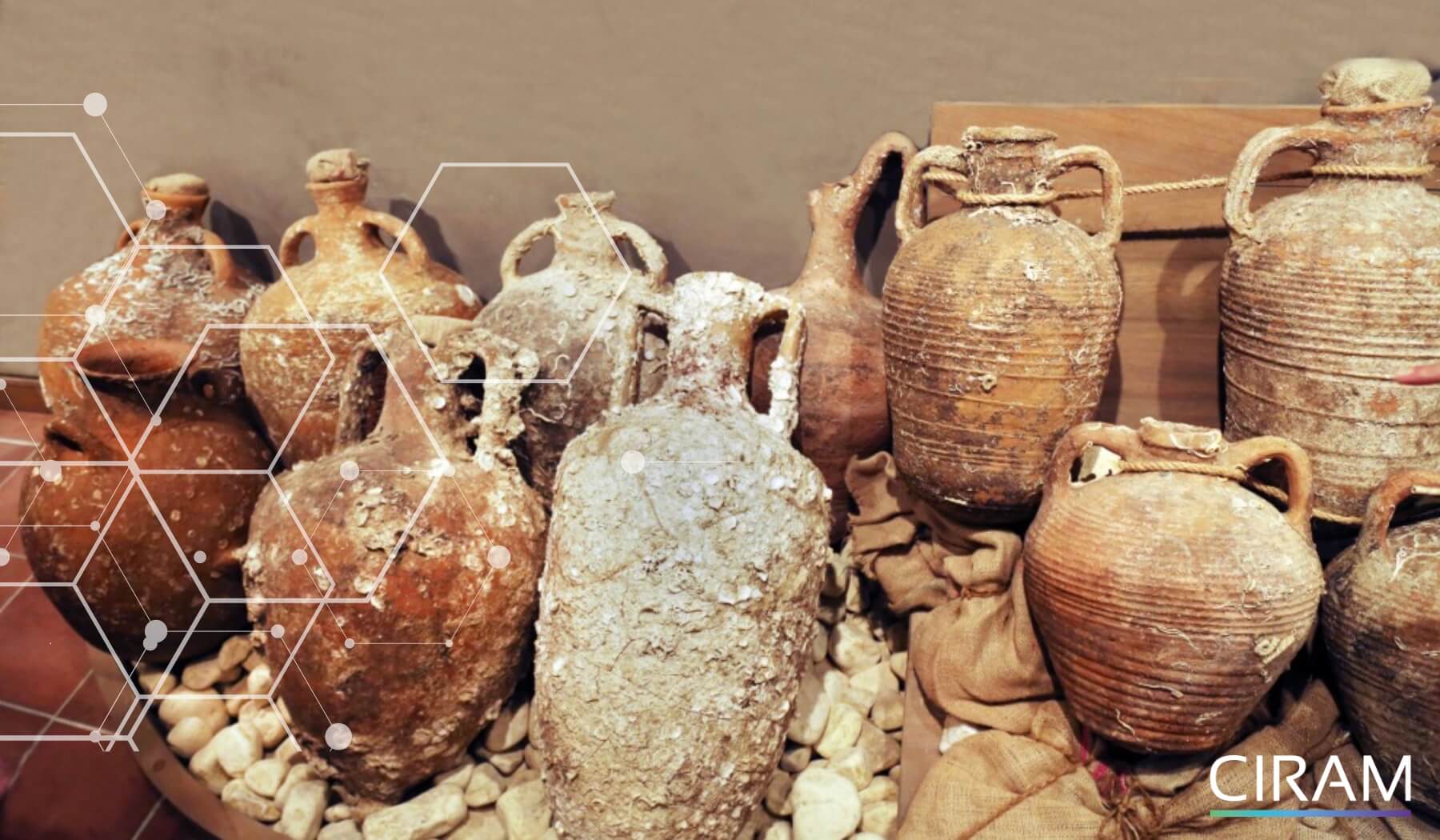

By combining cutting-edge technologies such as infrared spectrometry, Raman spectrometry and chromatography, our scientists are able to detect and identify the organic remains found in ancient amphorae and pottery. The techniques developed by CIRAM enable us to characterize oils, fermented beverages, resins, fats and perfumes, so as to understand the dietary and cosmetic habits of ancient peoples.
Organic residues: understanding old habits and practices
Organic residues found in dishes, vases and flasks provide clues to food customs and ancient cooking methods, for example. But they can also provide information about trade in Antiquity or the Middle Ages, as well as ancestral burial practices. CIRAM laboratories have an analytical network that covers a wide spectrum of investigations, from the identification of major product families (oil, fat, resin, etc.) to the discovery, in the best of cases, of ancient cooking recipes.
Organic residue analysis methods
Fourier transform infrared spectroscopy, in ATR mode or under microscopy, is used to identify the major families of organic compounds. For example, the presence of oil, animal fat or natural resin can be characterized. Mineral matter, however, can provide a spurious signal, preventing identification of the organic compounds present. For this reason, infrared spectrometry will usually be used as a preliminary step. CIRAM teams will generally couple FTIR spectrometry with other analysis techniques, such as chromatography or Raman spectrometry.
GC-MS coupling to locate and identify substances
Gas chromatography (GC) coupled with mass spectrometry (MS) is the technique dedicated to the study of organic compounds. Chromatography separates compounds in a sample, while mass spectrometry identifies compounds according to their mass. This GC-MS coupling enables the precise identification and quantification of many substances present in very small quantities, or even in trace amounts. Using GC-MS analysis, our scientists can characterize most of the molecules present in an archaeological mixture or organic residue. It is the nature of these molecules, combined with their concentration, that enables us to trace them back to the material used: olive oil, walnut starch, animal fat, tannin...
Complementary analytical techniques for the analysis of certain residues
Although Raman spectrometry is more suited to the study of mineral matter, it is nonetheless an interesting method for archaeometry, as it is non-invasive and requires no sample pre-treatment.
This analysis provides very good spatial resolution, making it possible to study samples on a very small scale (spots of a few µm). Raman spectrometry can be used on its own, or in conjunction with FTIR spectrometry or GC-MS chromatography. In fact, the residues found in ancient pottery are so complex that it is generally necessary to use different complementary analytical techniques.
Carpology for the study of seeds and fruits that have been discovered
Carpology is the study of seed and fruit remains found in ancient containers or archaeological sediments. Analysis of these plant residues provides information on human activities and ancestral lifestyles. Even when charred, CIRAM scientists are able to identify the nature of these seeds, and thus understand their use and reconstruct environments.
Palynology, the study of pollen and spores
Palynology is the study of pollen and spores released by plant species. Coupled with carpology and anthracology, these techniques enable us to reconstruct environments and climates. Observations made using light microscopy or electron microscopy will make it possible to determine the size and shape of pollen grains or spores, the number and shape of apertures, ornamentation, wall structure... and thus define the plant family, genus and, in the best case, species.
CIRAM laboratories, specialists in carbon-14 dating and archaeometric analysis.
CIRAM, a specialist in carbon-14 dating and archaeomaterials analysis, offers a meticulous examination of organic residues. To deliver relevant and accurate results, we interpret the results and remain at your disposal to discuss hypotheses according to your needs.