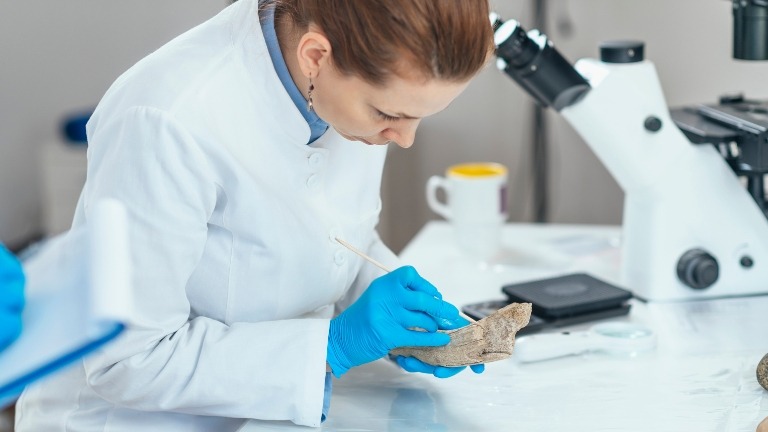

Mass spectrometry has become an essential tool in archaeology, both for carbon-14 dating and for the analysis of organic or isotopic materials. However, mass spectrometry has long been confined to fundamental research laboratories, despite the many advantages it can offer archaeological study teams. Today, its precision and sensitivity enable it to reveal information invisible to the naked eye, on sometimes minute samples.
But to master this technology, it is still necessary to understand which type of spectrometry to use on which materials, and above all, how to interpret the results in an archaeological context.
In this article, we explore how mass spectrometry works and its various variants (AMS, IRMS, GC-MS). We will then detail its concrete applications for archaeological artifacts. Finally, we analyze how a specialized archaeology laboratory like CIRAM can support archaeologists, from sampling to interpreted analysis.
Understanding mass spectrometry in archaeology: principles and techniques
Mass spectrometry is an essential tool in archaeological analysis, for carbon-14 dating, isotopic studies and the identification of complex organic molecules.
The principle of mass spectrometry applied to the analysis of archaeological materials
The principle of mass spectrometry is based on the separation and identification of ions produced from a sample subjected to an ionization source. This technique makes it possible to determine the elemental, isotopic or molecular composition of a material, even when the quantity is minute. In archaeology, the ability to detect isotopic or organic traces even at very low concentrations opens the way to non-destructive, precise and contextualized analyses.
However, mass spectrometry for archaeology is not a single method, but rather a set of specialized protocols, tailored to the scientific questions posed. AMS (Accelerator Mass Spectrometry) analyses are distinguished by their ability to measure carbon-14 isotopes directly. The result is more reliable dating, on smaller samples, and better calibration than with conventional methods (such as LSC).
The main mass spectrometry techniques: AMS, IRMS and spectrometry coupled with chromatography
When applied to the archaeological context, mass spectrometry is combined with three analysis techniques:
Gas pedal Mass Spectrometry (AMS): the standard for carbon-14 dating. It achieves extreme sensitivity while reducing margins of error. It is particularly useful for dating fragile or precious archaeological material (textile fibers, bones, charcoal in funerary contexts).
Isotope ratio mass spectrometry (IRMS): IRMS enables the analysis of light isotopes (13C, 15N, 18O, 34S...), which are indicators of diets, geographical origins or cultural practices. It is essential for any stable isotope analysis.
Coupled chromatography-mass spectrometry (GC-MS or LC-MS) enables the identification of organic molecules such as lipids, proteins or substance residues (wax, oil, wine, etc.). These methods are at the heart of biomarker studies in archaeological artifacts.
The combination of these techniques means that mass spectrometry can be used in archaeology not only to date, but also to understand the function, provenance and context of the remains studied.
Practical applications and interpretations: how spectrometry sheds light on the history of artefacts
Beyond the instrumental performance of this technique, the challenge of mass spectrometry lies in its ability to interpret analytical results in order to refine archaeological hypotheses, contextualize remains and reconstruct past practices.
Dating, reconstruction, identification: what each method reveals
Gas pedal Mass Spectrometry, or AMS, remains the reference method for carbon-14 dating in archaeology. Unlike conventional techniques, it enables samples weighing just a few milligrams to be dated with extreme precision, thanks to direct measurement of the 14C/12C ratio. C14 dating by AMS is therefore the preferred method for analyzing delicate objects or those of great heritage value (human bones, funerary textiles, charcoal in enclosed contexts). It provides precise archaeological dating, while limiting bias due to contaminants or sample size.
IRMS stable isotope analysis opens up a whole new field of interpretation in archaeological contexts. The study of stable isotopes of carbon, nitrogen, oxygen or sulphur makes it possible to trace diets, identify areas of origin, and even distinguish social practices (e.g., identifying diets differentiated by status or gender).
Chromatography coupled with mass spectrometry (GC-MS or LC-MS) can be used to explore organic molecules trapped in artifacts: food lipids, resin or wine residues, degraded proteins, etc. These analyses provide functional information on the use of artifacts (containers, tools, ornaments) and are invaluable for paleoenvironmental studies or proteomic approaches.
Limits, precautions and interpretation of results in an archaeological context
While the possibilities offered by mass spectrometry in archaeology are vast, they nevertheless require the implementation of rigorous study protocols. Samples must be taken in advance of the excavation in order to understand the nature of the material, its conservation conditions and any possible risks of contamination. Reliable interpretation depends on close collaboration between the field teams and the analysis laboratory specialized in archaeological studies.
Finally, the results cannot be read in isolation from the research context: dating, isotope analysis or organic identification, these techniques do not deliver absolute truths, but their results offer powerful indicators when cross-referenced with archaeological data.
Choosing the right scientific partner: the key role of specialized laboratories like CIRAM
For archaeologists, using mass spectrometry is not a choice based on technical performance: it relies above all on the expertise of the laboratory in charge of analysis, from sampling to interpretation of results.
Why rely on an expert mass spectrometry laboratory?
Archaeologists call on specialized archaeology laboratories like CIRAM to benefit from their complete mastery of analytical protocol, directly linked to archaeological issues. For example, the CIRAM laboratory has three complementary platforms:
- AMS for carbon-14 dating of organic materials
- IRMS for stable isotope analysis
- GC-MS/LC-MS for mass chromatography (analysis of organic molecules)
This positioning enables high-quality monitoring upstream and downstream of archaeological excavations, with the benefit of an interdisciplinary team (archaeologists, physical chemists, isotope engineers). The laboratory must also be able to contribute its expertise in sample selection, analytical strategy and scientific interpretation, in a spirit of co-construction with field teams.
For project leaders wondering how to choose a specialized laboratory for mass spectrometry analysis in archaeology, the selection criteria are clear:
- benefit from recognized industry expertise
- offer traceability of protocols
- state-of-the-art technologies
- provide advice on the upstream (sampling) and downstream (results) phases.
It is therefore crucial for field teams to select a nationally (as well as internationally) recognized player to ensure that artifacts are properly studied.
Methodology, deadlines, costs: what a laboratory like CIRAM can do for excavation teams
Anticipation by archaeological teams is a key factor here. An experienced laboratory can assist archaeologists right from the diagnosis or excavation phase, by specifying the precautions to be taken before taking samples:
- avoid modern contamination
- adapt the method to the nature of the material (bones, charcoal, textiles, organic residues)
- ensure optimal preservation of samples until analysis
As far as lead times are concerned, an AMS or IRMS analysis generally takes 2 to 6 weeks, depending on the laboratory's workload and the type of processing required. Prices vary according to the type of analysis, number of samples and calibration requirements, but remain manageable with a view to enhancing the value of scientific data.
Finally, a laboratory like CIRAM plays an advisory role in interpreting results and integrating data into a solid chronological or functional framework, a decisive factor for publications, excavation reports or collaborative research projects.
Mass spectrometry in archaeology is becoming an essential analytical tool for archaeologists wishing to reveal the invisible information contained in their artifacts. Whether it's AMS for precise dating, IRMS for reconstructing lifestyles, or GC-MS for deciphering the use of artifacts, these techniques offer a fine scientific reading of the past. However, their effectiveness depends on the choice of an expert laboratory, able to guarantee rigor, advice and support.
The CIRAM laboratory puts its expertise in radiocarbon, isotopic and organic analysis at the service of those involved in preventive, programmed or research archaeology. Do you need dating or analysis of your artifacts? Tell our specialists what you need. We're with you every step of the way, from sampling to interpretation of results.