

The limits of carbon-14 dating: when should we turn to other methods?
Reading time:
Written by:
Article Outline
- What carbon-14 dating can and cannot do
- The principles and benefits of carbon-14 dating
- The technical, material and temporal limits of carbon 14
- When should other dating or analysis techniques be preferred to carbon-14 dating?
- Alternatives for inorganic and complex materials
- Crossing methods: the key to reliable, interpretable dating

Scientific dating plays an essential role in the fields of art and archaeology, whether for heritage preservation or concerning financial stakes (sales, insurance). It allows for the validation of an object's age, shedding light on its provenance, or authenticating a work.
Among the most used techniques is radiocarbon dating, commonly called carbon-14 dating, which remains an essential reference. This technique is very useful when it comes to dating organic materials such as wood, bones, or textiles. But this method, however effective it may be, cannot be suitable for all types of materials or all historical periods.
In this article, we explore the limits of carbon-14 dating and the complementary methods implemented according to the materials and study contexts.
In summary:
- Carbon-14 dating is an essential method, but it does not address all dating issues.
- Depending on the material and context, other techniques may be necessary to obtain reliable results.
- Combining different analytical methods helps ensure the authenticity and dating of the works.
What carbon-14 dating can and cannot do
Although radiocarbon dating remains an essential reference in the study of ancient organic materials, it doesn't meet all requirements, especially as objects become more complex. It is therefore crucial to understand the context in which it is applied, in order to choose the most appropriate method for each case.
The principles and benefits of carbon-14 dating
Carbon-14 dating is based on a well-established principle: measuring the amount of the radioactive isotope ¹⁴C still present in an organic sample, and then deducing its age. This method is effective for dating formerly living materials: wood, bone, shells, textiles, leather, paper, or even charcoal that can be found in the analyzed object.
In most contexts, its reliability is beyond question. The method can generally provide a coherent chronological range, extending to around 60,000 years, with relatively controlled margins of error. This is particularly the case when conservation conditions are good and sampling is carried out using optimized protocols.
This dating method is particularly prized for validating a period hypothesis, building a conservation strategy, or simply consolidating the historical traceability of an object. When appraising a work of art, such as a medieval parchment or a fragment of funerary cloth, ¹⁴C dating offers a legible, documented scientific argument.
The technical, material and temporal limits of carbon 14
Despite its many advantages, radiocarbon dating has significant limitations in its applicability. First and foremost, it is exclusively reserved for organic materials. Metals, ceramics, mineral pigments, glass, or stone cannot be dated directly by this method.
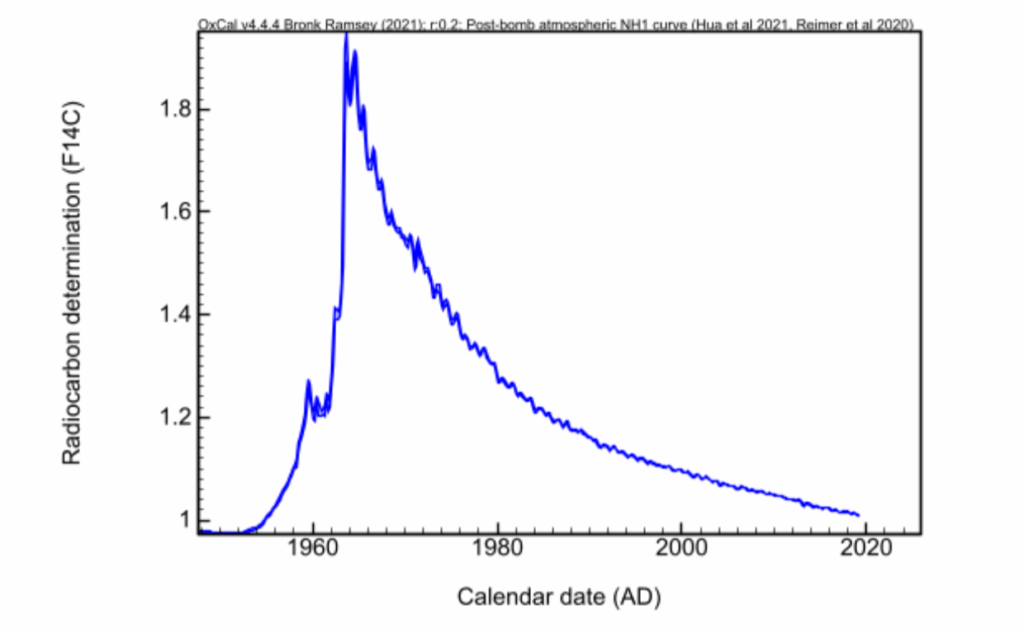
Then, its precision decreases as one moves away from its optimal study window. Beyond 60,000 years, there is no longer enough ¹⁴C to obtain a usable dating. Conversely, objects that are too recent can pose problems, particularly due to the effects induced by human activity (e.g., nuclear tests due to the post-bomb effect) on atmospheric radiocarbon content.
Other factors can skew the results, such as, for example, poorly documented restoration, contaminated sampling, or a sample that has undergone aggressive chemical cleaning. Finally, a crucial point must be emphasized: carbon 14 dates the raw material, not necessarily the use or manufacture of the object. Furniture made from old wood, or a painting made on a reused support, can thus lead to a biased reading if the analysis is poorly contextualized.
In such cases, it is essential to call on the expertise of a specialized laboratory, which can use other analytical tools to cross-reference data and guarantee reliable dating.
When should other dating or analysis techniques be preferred to carbon-14 dating?
In certain situations, the limitations of carbon-14 dating mean that other approaches are required to obtain a reliable reading of the object studied. This is particularly the case when the materials are not organic, or when a more complete analysis of the context is required.
Alternatives for inorganic and complex materials
When the objects to be studied are made of ceramic, glass, stone, metal, or inorganic pigments, radiocarbon dating cannot be used to date them, for lack of organic matter to analyze. Other dating techniques are then used, chosen according to the specific characteristics of each material:
| The thermoluminescence (TL) | Electron spin resonance (ESR) | Optically Stimulated Luminescence (OSL) |
| Given the last firing of a ceramic, thus revealing the manufacturing period | Used on certain minerals, such as quartz or fossilized bones, to obtain datings beyond the chronological limits of carbon 14 | Exposure of sediments or mineral materials to light |
Other approaches, such as uranium-thorium dating, can be considered depending on the specific materials and the context of the intervention. In parallel, more in-depth physico-chemical investigations make it possible to study the patina layers, corrosion, or material composition to guide indirect dating.
Crossing methods: the key to reliable, interpretable dating
When carbon 14 cannot be applied or when its interpretation remains insufficient, a specialized laboratory may recommend a complementary method adapted to the material studied, such as thermoluminescence, OSL, or ESR.
The combination of several dating methods, coupled with an interdisciplinary reading (materials science, art history, archaeology) is often essential in complex cases, such as with composite objects, restorations, or multiple materials.
This cross-referencing of analytical methods consolidates results and avoids misinterpretations: it is not just about dating a material, but about understanding when and how the object took its current form.
Discover our article on this subject: Why cross-reference multiple dating methods in archaeology?
Share this article

You may be wondering about these questions regarding carbon-14 dating and its limitations.
Carbon-14 dating only works on materials containing carbon of organic origin (wood, bones, leather, textiles, or paper). Therefore, it cannot be applied to metals, ceramics, glass, or stone because they do not contain organic carbon.
Carbon-14 measures the age of the organic matter analyzed. It corresponds to the moment when it stopped exchanging carbon with the atmosphere, i.e., at its death. This date does not always correspond to the object's manufacture.
Yes. When an object is made up of several materials or has undergone restorations, it is often necessary to cross-reference different analytical methods.
Yes, in some cases. The addition of recent materials, such as glues, consolidants, or replacement parts, can contaminate the sample.
The choice of method depends on several criteria. The nature of the materials, their state of conservation, the presumed age of the object, and the objective of the study are taken into account.
Related topics




Need more information or have a question?
Our team will get back to you as soon as possible.