
Carbon-14 is a radioactive isotope present in all living organisms. This isotope can be used to date a large number of organic materials found in archaeological contexts.
Specialists in AMS carbon-14 dating, our scientists perform laboratory analysis of materials such as wood, bone and charcoal, as well as peat and other organic sediments. Discover our peat analysis methods for precise dating of all your organic residues.
Valuable information thanks to C14 peat analysis
Peat bogs, which have been present in some areas for over 10,000 years, provide valuable information on environmental changes such as climate and anthropological changes.
For example, it is important to be able to define chronologically the start of turfigenesis on an archaeological site in order to carry out a paleo-environmental reconstruction.
Thanks to the distribution of the dates obtained and their comparison with geomorphological, paleoecological and archaeological data, it is possible to trace the evolution and changes in landscapes and societies.
While radiocarbon dating is the most suitable method for the chronological setting of peat bogs and other sediments, there are several methodological problems.
Different types of peat
We can analyze and date many types of peat and organic sediments. For accurate results, we take care to eliminate macro-rests.
For silty peats that do not contain macro-rests, we use organic sediment.
Fibrous peat (the most common in the samples we analyze) is a mixture of decomposing plant remains and silty peat. For this type of peat, we extract the fibrous part, which undergoes ABA (acid-base-acid) treatment to eliminate carbonates and humic and fulmic acids.
Sediment and peat analysis methods
Methods differ between silty peats and fibrous peats.
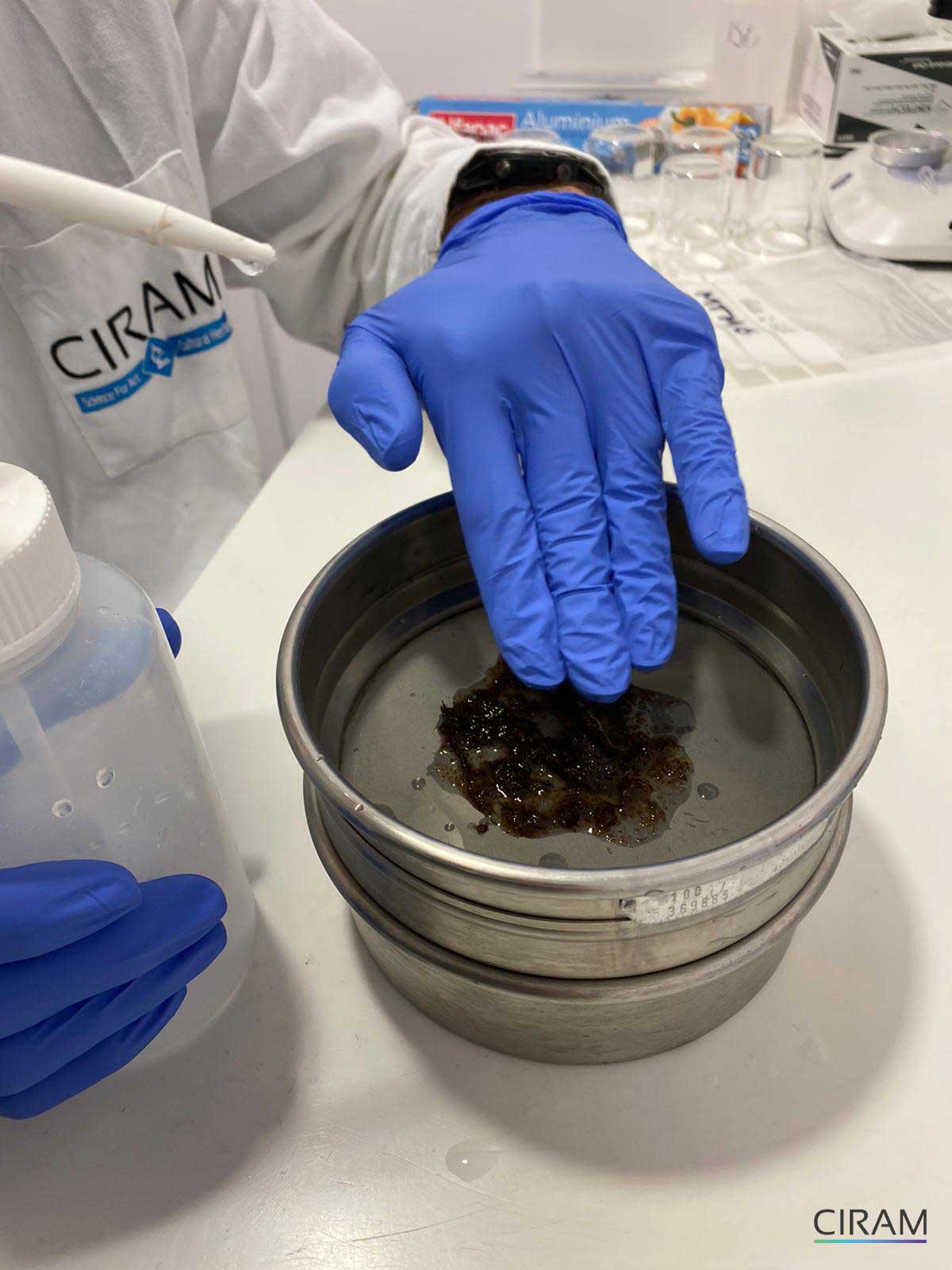
Silty peat is first sieved to 100 microns to remove micro-rests. Silty peats and the insoluble fraction of humic sediments are treated exclusively with acid to remove carbonates.
Fibrous peats are first treated with acid, then alkaline and finally washed with acid to remove carbonates and humic acids.
It is also necessary to sieve the soluble fraction of humic sediments to remove macro-rests. Once the fraction is clean, we use a hot acid treatment, repeated if effervescence persists, followed by an alkaline treatment. Our scientists recover only the alkaline solution by centrifugation or filtration. Finally, an acid treatment is applied until precipitation.
As a general rule, the acid-washed and sieved organic sediment fraction will give a more accurate dating.
Results and calibration
Our scientists systematically calibrate the analyses using international standards. There is a difference between the gross age and the calibrated dates, depending on the data and the estimated age of the peat. Gross age is expressed in BP years, i.e. before 1950. We always convert raw ages into calibrated dates, which are corrected by the calibration curve.
CIRAM laboratories can help you interpret your results
CIRAM's laboratories are committed to delivering results that are in line with the realities of the field, and always provide a detailed commentary to address your specific issues. We are also at your service to provide additional information and discuss the results in order to advance your research and meet your needs in relation to the archaeological context.
Follow-up of results, dialogue between professionals and proximity, CIRAM laboratories deliver serious expertise in collaboration with you.