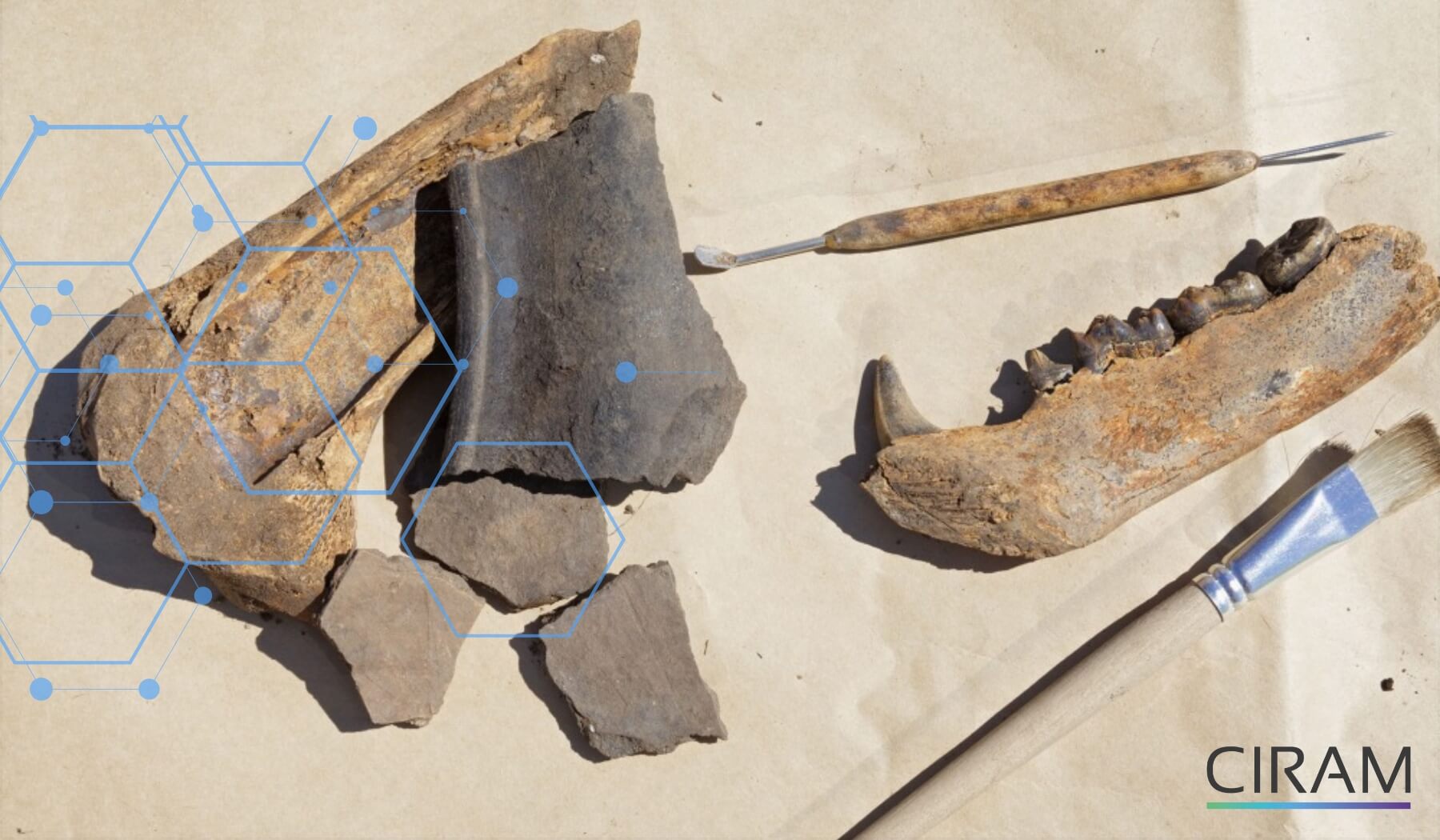

While Carbon-14 dating is the ideal method for analyzing bones found in archaeological contexts, the method differs for calcined bones or bones found in arid regions or acidic environments.
How to date bones using Carbon 14?
C14 dating is the most common and effective method for dating all organic matter. This technique, developed in the 1940s, relies on the radioactivity of carbon 14 (instability of carbon 14, which changes over time) contained in every organism. By measuring the concentration of carbon 14, it is possible to determine the time elapsed since the death of a living organism. But while Carbon-14, or radiocarbon, dating is relevant for conventional bones, the method differs for charred bones or bones found in arid environments. As the latter are damaged, alternative protocols will have to be used to obtain relevant dating.
What's the difference between bones and burnt bones?
Conventional" bones contain 10-20% of their mass in collagen, whereas burnt bones contain almost none at all, or the collagen has been severely degraded. It's precisely this protein that we analyze when we carbon-14 date bones.
For bones that have been calcined or preserved in an arid and/or acidic environment, collagen is either of "poor quality" or too low in quantity. The C/N (carbon/nitrogen) ratio provides the collagen quality index. This atomic ratio must be between 2.9 and 3.6 for reliable collagen dating. If this is not the case, our scientists use an alternative protocol and date the mineral part of the bone, the bioapatite.
Treatment and extraction of charred bones
For radiocarbon dating, we always prefer white bones burnt at over 500° C, as the structural carbonates are more resistant to soil contamination.
To avoid the presence of impurities in the samples, it is imperative to use an acid-etch purification method. The reaction of carbonates with phosphoric acid releases CO2, which is then absorbed in a column filled with zeolitic material and graphitized with hydrogen and an iron catalyst. This method is recognized, as studies attest to the agreement between Carbon-14 dating on bioapatite and C14 dating on associated coals.
C14 dating method and calibration
In order to deliver accurate measurements, we systematically validate our analytical protocols through the analysis of international standards (OxII, IAEA-C7, IAEA-C5). They serve as calibration and enable us to assess our uncertainties at around 0.5 pMC, and between 0.1 and 0.2‰ for δ¹³C and δ¹5N.
Finally, our scientists separate the different carbon isotopes using particle gas pedal mass spectrometry (AMS) and measure the concentration of Carbon 14, 13 and 12.
Conventional age is expressed in years before 1950 (BP = before present). 1950 is the reference year for carbon-14 dating. The conventional age, or gross age, is then calibrated, using OxCal v4.4 software. The calibrated dates obtained are expressed within two sigmas, i.e. 95.4% of solutions are presented.
While preparation prior to measurement differs from that for "conventional" bones, CIRAM laboratories have the resources and know-how to date calcined, collagen-poor bones.