
A brief history of metallurgy
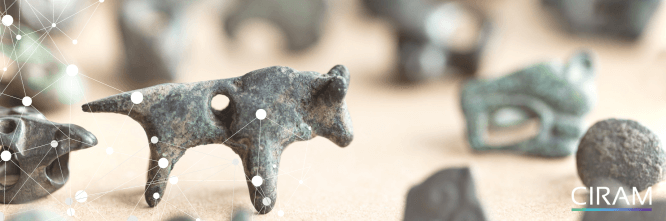
Still widely used today, copper was one of the first metals to be mined in prehistoric times. Indeed, copper metallurgy began as early as the third millennium BC. Later, the Bronze Age defined the production of an alloy of copper and tin. We can't talk about metal in general, as there are many differences between bronze (an alloy of copper and tin), brass (an alloy of copper and zinc), cast iron, silver and gold. Copper alloys are particularly interesting, as their use dates back to the origins of our civilizations, and continues to the present day.
Study of chemical composition by optical microscopy and scanning electron microscopy
As bronzes cannot be dated directly, we have to look for usable chronological markers, such as technical clues, the degree of corrosion and the composition of corrosion products.
The most relevant approach for bronze objects remains the observation and study of chemical composition by optical microscopy and scanning electron microscopy (SEM-SEM).
Study of metal microstructure
The first step is to study the metal's microstructure, which will provide information on manufacturing techniques. For example:
- The presence of dendrites characterizes a melt;
- Flattened and aligned inclusions are evidence of hammering;
- A very regular alignment corresponds to lamination.
Metal composition study
The second step is to study the metal's chemical composition. Elemental analysis of concentrations of major and minor elements, and possibly the presence of traces, enables the nature of the alloy to be identified. The main major elements are copper, tin, zinc and lead. Minor elements are iron, arsenic, antimony, nickel, etc. Trace elements are numerous and vary in space and time.
Characterization of metal objects and corrosion analysis
The final stage in the characterization of a metal object is the analysis of its corrosion. This is called patina. While this term implies a surface approach, the study of corrosion is concerned in particular with the nature of surface corrosion products (the patina proper), but also with the development of corrosion processes within the alloy.
A copper alloy that is hundreds or thousands of years old will have undergone numerous attacks from the environment: humidity, temperature variations, the development of micro-organisms... These elements lead to the degradation of the metal and therefore to corrosion. The most characteristic signs of natural corrosion include the following:
- Grain boundary alterations ;
- Dendritic, inter-granular or trans-granular corrosion ;
- Mineralization.
Corrosion products come in many forms, depending on the composition of the metal and the nature of the environment. They include cuprite (copper oxide), azurite and malachite (copper carbonates), atacamite, paratacamite and nantokite (copper chlorides), tin oxides, lead salts... Associated with these corrosion products, we can also detect landfill sediments, plant residues, microorganisms...
It is crucial to bear in mind that the study of a metal's chemical composition and degree of weathering provides indirect technical and chronological clues. It is impossible to obtain quantifiable chronological information on metal.
CIRAM laboratories, specialists in materials authentication
CIRAM, a specialist in the dating and analysis of archaeomaterials, offers a comprehensive interpretation. We share our results and discuss their interpretation with you, to explain the relevance of our research, particularly for metal objects.