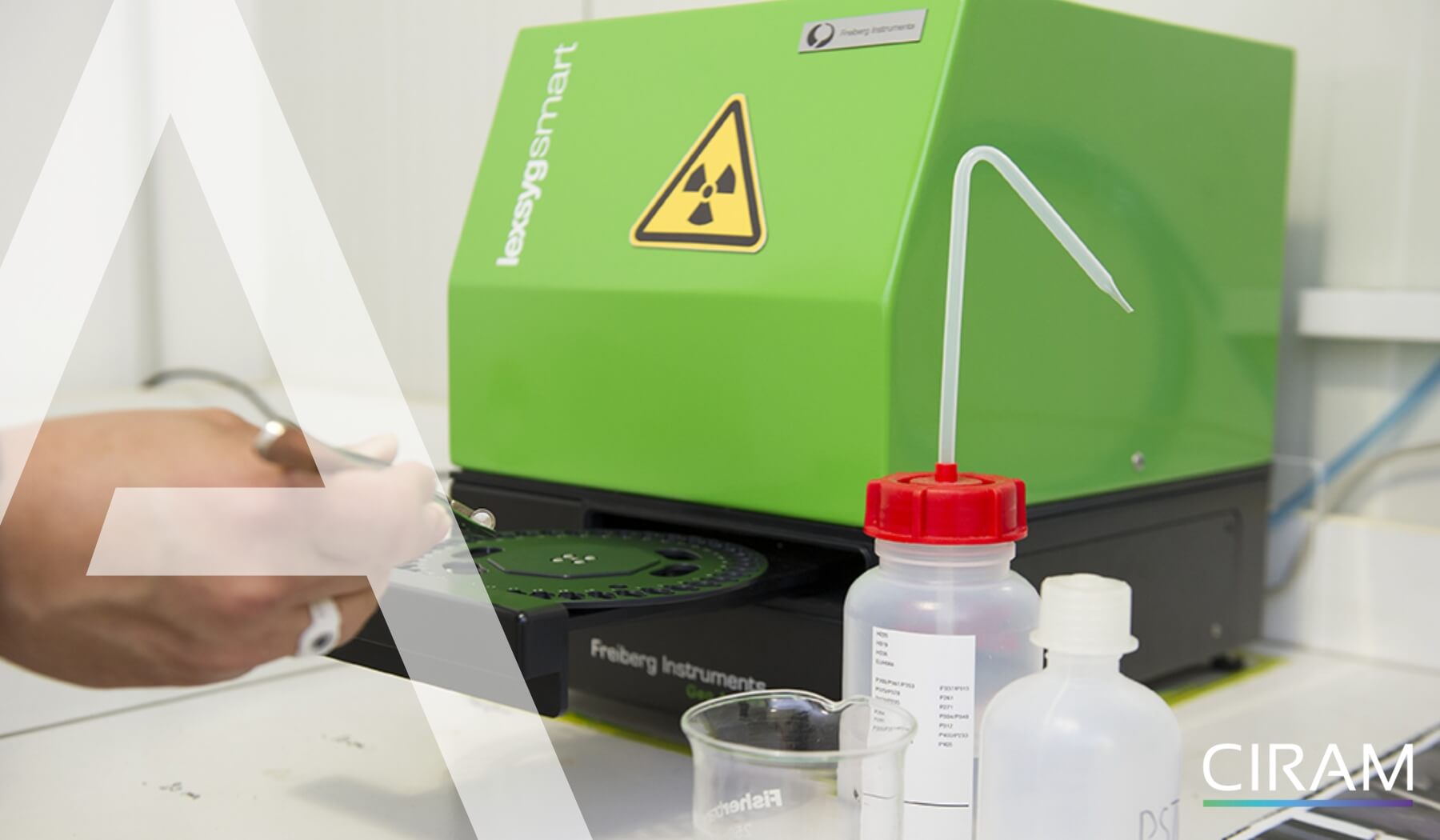

We are well aware of the time constraints to which archaeologists are subject, which is why we propose standard turnaround times of 3 months for TL (depending on the laboratory's production load) and try to keep OSL turnaround times as short as possible. Luminescence dating methods are less well known than carbon 14, and their use remains limited in historical archaeology. They mainly refer to thermoluminescence (TL) and optically stimulated luminescence (OSL) dating.
TL dating, to date the last heating of materials
TL (thermoluminescence) is used to date the last heating of a material, whether clay or hearthstone (quartzite, flint, sandstone, etc.). This method is frequently used in prehistoric times, when other types of remains are less abundant.
However, applications have also been tested on materials more closely related to historical issues, such as architectural terracotta. One of the most frequent uses is in kiln dating, where TL is one of the most suitable methods, along with archaeomagnetism.
A complementary study using OSL dating
As a complement to thermoluminescence dating, OSL offers additional possibilities. In fact, this method makes it possible to date the last exposure of a material to light. It's not hard to imagine how interesting it can be to date a stratigraphic sequence on a site. Numerous applications have been developed in response to problems associated with the archaeology of historic and protohistoric periods. For example, OSL is used to date the installation layer of a megalith, the sealing of mortar in masonry...
The chronological range of these methods extends from a few hundred to a million years, enabling them to be used on any type of archaeological site.
The basic principles of luminescence dating
Luminescence dating methods are based on common principles. They rely on the ability of minerals (mainly quartz and feldspars) to record ambient radioactivity over time. The radioactivity absorbed comes from the earth's surface, essentially from the decay of three radioelements:
- Potassium (K);
- Uranium (U) series;
- Thorium (Th).
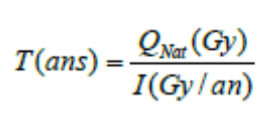
The emission of particles (alpha and beta) and gamma radiation from these three elements occurs regularly over time, and constitutes what is known as the dose rate. This annual dose (I) is supplemented by the effects of cosmic radiation, which vary according to burial depth, altitude and latitude. The quantity of radioactivity absorbed at the moment of measurement is called the archaeological dose (Qnat) or equivalent dose (De).
It is the ratio of these two quantities (Qnat and I) that gives the age between the last heating of the object and its study in the laboratory:
When measured in the laboratory, the crystals under study emit light (or luminescence). The amount of luminescence emitted is proportional to the amount of radiation absorbed by the sample since it was last heated. For OSL, thermal stimulation is replaced by optical stimulation. Our laboratory scientists measure luminescence emissions by illuminating the crystals.
From field to laboratory: analysis by CIRAM laboratories
As explained above, it's important to measure two quantities to obtain luminescence dating: the archaeological dose and the annual dose. To do this, several steps are required, starting in the field in the best of cases.
Operational procedure in the field, meticulous sampling for accurate results
During the excavation operation, several samples and measurements are taken. It's important to sample what you want to date: sediment from a stratigraphic sequence, hearth hearth, heated flints... the sampling is substantial, around 1kg.
Then, to calculate the annual dose, two alternatives are possible:
- Gamma and cosmic radiation can be measured at the sampling point using a gamma probe;
- Or the radioactive environment can be "reconstructed" in the laboratory, using sediments collected within a 30 cm radius of the sample.
The depth of burial of the sample must also be available to enable dosimetry calculations to be carried out as accurately as possible.
Laboratory operating procedures
The first step is to choose (if possible) the material on which to carry out the experiment. The abundance and granulometry of the crystalline species used (mainly quartz and feldspar) need to be determined, in order to choose which protocol to use.
Based on this determination, CIRAM scientists choose either the large quartz inclusion technique or the small polymineral inclusion technique. This choice determines the material preparation stages, which can last from a few days to several weeks.
Thermoluminescence measurements involve three steps for optimal dating (Qnat and I measurements):
- Measurement of natural luminescence, Q nat, with the addition of laboratory-controlled irradiation doses, also known as first reading;
- Measuring the radiochemical composition of sediment using low background gamma-ray spectrometry;
- Determination of the annual irradiation dose, I, by a posteriori reconstruction.
Once the operational procedure is complete, our scientists process and interpret the results.
Processing TL and OSL results
TL and OSL provide dates that are independent of any external reference. The only factors influencing uncertainty are intrinsic to the measurements and the quality of the initial sample. In the case of TL, the optimum uncertainty can be as low as 5%, and 3.5% for OSL. Whether used alone or in conjunction with other methods, luminescence dating, despite its high accuracy, does not always enable two distinct archaeological facts to be finely discriminated.
In this context, the use of statistical processing methods seems particularly appropriate.
These allow :
- To propose a more precise chronological phasing of the sequence of archaeological structures,
- Propose average phase dates with reduced uncertainties,
- But also to refine each individual dating.
To optimize these treatments, the stratigraphic relationships observed in the field are of prime importance. Indeed, if two datings present partial overlaps and belong to stratigraphic units associated by a relationship of anteriority/posteriority, these overlaps are considered impossible.
The chronological model is based on Bayesian statistics, and the date probability fitting functions are determined by Monte-Carlo simulation.
Efficient analysis and comprehensive critical synthesis with CIRAM
The analytical team's university training, dedicated to the physical and chemical analysis of archaeological materials and in particular to luminescence dating, provides a solid basis for experimentation. In addition, CIRAM's technological autonomy is guaranteed by its ownership of equipment for measuring TL and OSL. This, combined with CIRAM's high level of responsiveness and availability, means that TL dates can be obtained within 3 months, depending on the laboratory's production load.
CIRAM has also developed a scientific partnership with a nuclear research center (University and CNRS), for the analysis of the radiochemical composition of materials. CIRAM goes beyond simply obtaining dates, and is committed to providing a complete critical synthesis of the results and proposing the best possible archaeological exploitation.