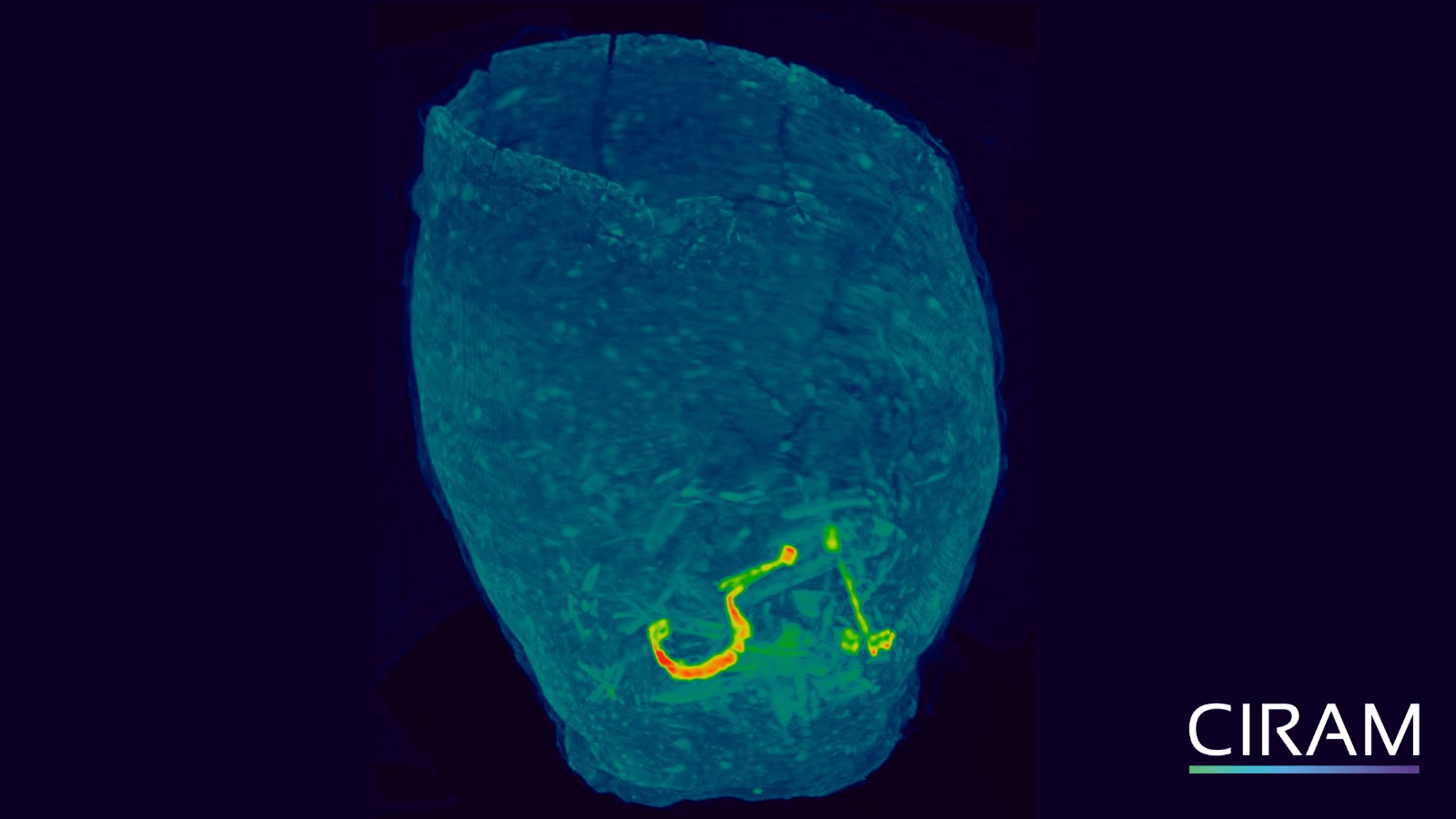

This is why the use ofscientific X-ray imaging(radiography and tomodensitometry) has become essential for the study of closed forms or archaeological artifacts trapped in their gangue of sediments. By offering both laboratory and on-site analyses, CIRAM provides complete coverage of archaeological artifacts, and enables virtual excavations that do not damage these heritage remains in any way.
Reveal the inner structure of objects with high-definition scientific imaging
Thanks to high-definition scientific imaging techniques, we will be able to reveal the internal structure of objects, identify the nature and use of the artifact, define the degree of corrosion of metal alloys and the resulting degree of conservation.
Portable digital X-ray radiography
Our X-ray radiography equipment is digital and portable. With this latest-generation tool, we can take images in situ, without moving the objects in the storerooms, and therefore without risking damaging them. Our digital acquisition system also enables us to obtain X-ray images in real time. These snapshots enable us to adapt observation modes and viewing angles to obtain an optimum view of the objects.
Large digital detector for simultaneous examination of multiple objects
We also have a large digital detector, with a sensitive surface area of 1600 cm² (40 x 40 cm). This enables us to examine several objects at the same time, thereby reducing the cost of analysis. Our X-ray sensitive plate has a resolution of 5.5 million pixels, generating high-definition images. Last but not least, the study of large objects is entirely possible thanks to the digital reconstruction we carry out in post-production.
CT scan for 3D visualization
CT scanning complements X-ray radiography by adding a third dimension. This type of imaging enables 3D visualization, revealing the internal structure of objects without the need for sampling or invasive techniques. CT scans can also provide information on the techniques used to manufacture objects, or on the degree of conservation of materials.
Optimizing the use of CT scans for virtual excavations
By optimizing the use of CT scans, it will be possible to carry out virtual excavations and discover the contents and stratigraphy of a cinerary urn, for example. Image processing in contrast, false color, MIP or surface mode enhances visualization of the internal structure and identification of the elements present. Finally, video files can be extracted to make the most of these virtual excavations.
Scientific imaging and CT scans for heritage preservation and enhancement
Scientific imaging methods and CT scans are part of the overall approach to the study of archaeological artifacts, and contribute to their preservation, conservation and enhancement.
Complementary characterization for dating
Characterization (chemical, physical and imaging) of archaeological objects is a complementary approach to carbon-14 or thermoluminescence dating.
Since 2005, CIRAM has specialized in the analysis and dating of archaeological artifacts, art and heritage objects and historic monuments.