

In summary:
- Carbon-14 dating is the gold standard method for dating bones through collagen analysis.
- When collagen is insufficient or degraded, particularly for calcined bones, dating can be carried out using bioapatite.
- The dating of bones also provides information about the diet of individuals through the analysis of stable isotopes.
Why is C14 used to date bones?
Carbon-14 dating, or radiocarbon dating, is the most well-known dating method to the general public. It is above all the most relevant technique for dating organic materials, particularly bones. Carbon-14 dating was developed in the 1940s and is based, like most dating methods, on radioactivity.
In living organisms, the amount of carbon remains stable. Carbon 14 decays constantly, but it is continuously renewed by respiration or photosynthesis. This is why C14 dating will date the death of the individual or plant, and the remaining amount of C14 will allow the date of death to be estimated.
Collagen extraction and dating
Why date collagen?
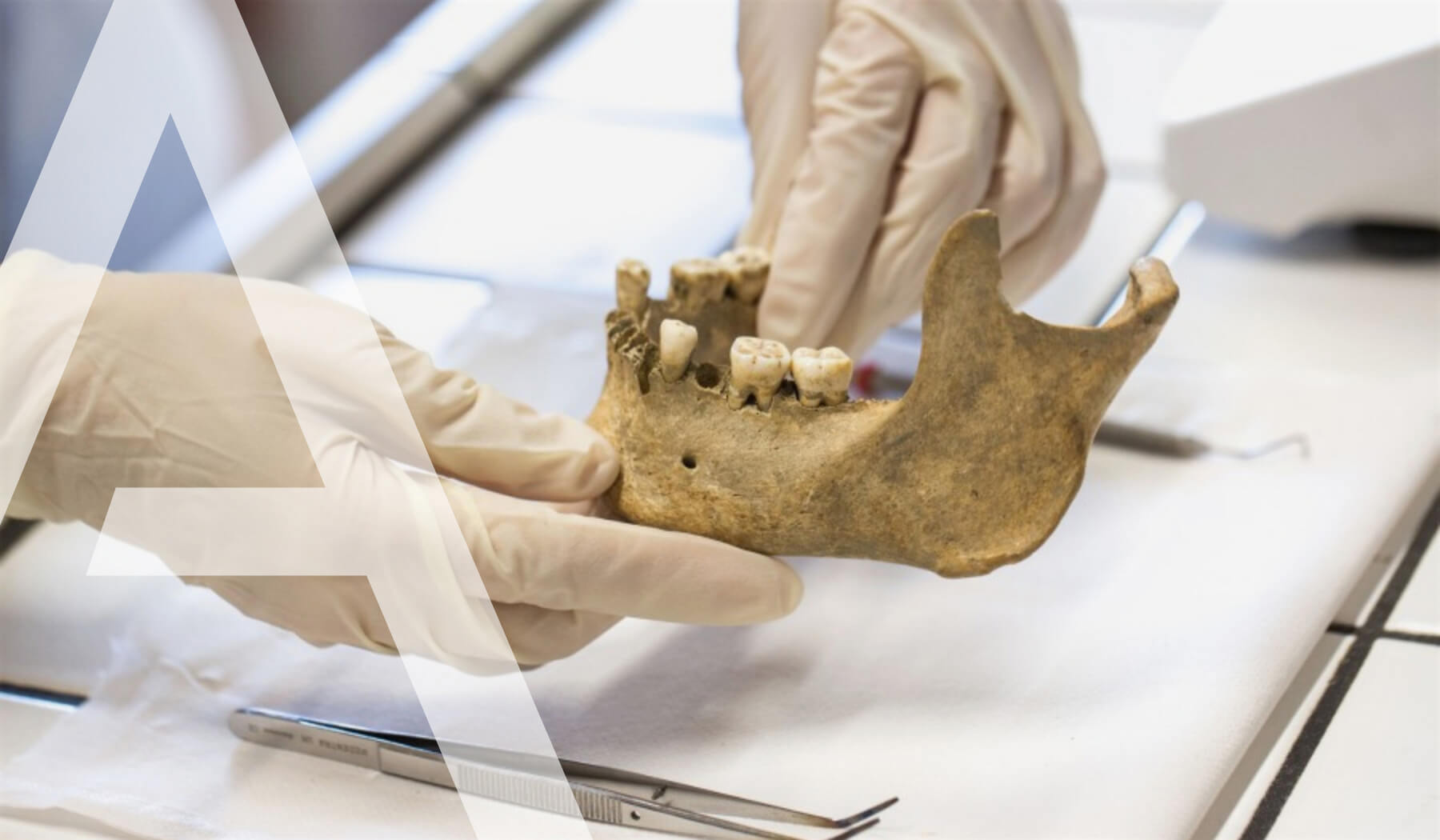
Bones are very good chronological markers in an archaeological dig, as they are closely linked to the stratigraphy in which they are found. A bone is composed of a mineral part, bioapatite, and an organic part, collagen. Collagen is the most suitable fraction, and is normally used for radiocarbon dating.
Extraction of collagen
The preliminary step to dating will therefore be collagen extraction. For this purpose, the bones are treated with hydrochloric acid (HCl, 1 M) at cold temperature for 24 hours, in order to eliminate all surface contaminations and partially degrade the mineral part of the bone, thus making collagen extraction more efficient. The samples are then treated with sodium hydroxide (0.1 M) at room temperature and once again treated with cold hydrochloric acid, to avoid the absorption of atmospheric carbon dioxide. After washing with demineralized water, scientists bring the samples to a boil to dissolve the collagen, and then recover it.
Quality control before dating
The collagen thus extracted undergoes combustion at 920°C and is transformed into gas. During this step, a first check of the C/N ratio is carried out using an elemental analyzer (Elementar Vario ISOTOPE Select). This step is crucial as it constitutes a quality control. Indeed, a C/N ratio value between 2.9 and 3.6 indicates that the collagen is well preserved and will provide reliable dating. If the C/N ratio is outside this range, C14 dating of the collagen will not be performed. In this case, the mineral part of the bone will have to be used and the bioapatite dated.
Next, stable isotopes of carbon and nitrogen will be analyzed by IRMS. These values will provide information on the diet of the individuals. At the same time, carbon dioxide from combustion is separated from other residues using a zeolite trap. This carbon dioxide is then catalytically converted into graphite using an automated system (AGE 3, Ion Plus).
C14 dating and calibration
In order to validate our analytical protocols, it is essential to first verify the accuracy of our measurements, as well as their reproducibility. To do this, we analyze international standards whose values are known and recognized. We use these values to evaluate our uncertainties, approximately 0.5 pMC, and 0.1 to 0.2‰ for δ¹³C and δ¹5N. Real-time verification of measured values for standards allows us to identify and resolve potential problems related to contamination, graphitization, and measurements.
Accelerator Mass Spectrometry (AMS) separates different carbon isotopes. Then, the 14C concentration is determined by simultaneously comparing 14C, 13C, and 12C measurements with those contained in international standards (oxalic acid, standard CO2, charcoal). We then calculate the conventional radiocarbon age according to the method described by Stuiver and Polach. It takes into account the correction for isotopic fractionation.
The results are calibrated using OxCal v4.4 software. The measurement taken is expressed in two different ways: part of Modern Carbon (or pMC) and conventional age. Conventional age is expressed in years before 1950 (BP standing for before present), which is the reference year. Age is expressed to one standard deviation. The dating intervals reflect a two-sigma distribution, i.e. 95.4% of all solutions. The dated event can be found in any interval, regardless of the probability distribution, which is given for information only.
How to date calcified bones or bones poor in collagen?
It sometimes happens that certain bones no longer contain enough collagen to allow for reliable dating. This is particularly the case for calcined bones, but also for certain bones from arid or acidic environments, where the protein has been heavily degraded over time.
Before any analysis, scientists assess the quality of collagen using the atomic carbon-to-nitrogen (C/N) ratio. When it falls between 2.9 and 3.6, the collagen is considered well enough preserved for dating. Conversely, if the ratio is outside this range or the amount of collagen is insufficient, another approach is necessary.
Biapatite as an alternative to collagen
When collagen cannot be used, dating is carried out using bioapatite, which is the mineral fraction of bone. This method requires a specific preparation protocol to eliminate contaminants that could alter the results.
For calcined bones, laboratories prefer fully bleached bones. They have generally been exposed to temperatures above 500 °C. At this stage of calcination, the structural carbonates of bioapatite are generally more resistant to chemical exchange with the soil, which improves the reliability of dating.
After an acid attack purification step, the released carbon dioxide is recovered, purified, and then transformed into graphite before being analyzed by accelerator mass spectrometry (AMS), according to the same principle as for other carbon-14 dated samples.
Thanks to these specific protocols, it is possible to obtain reliable dating even when collagen is absent or highly degraded. This approach thus makes it possible to extend dating possibilities to bone remains that would previously have been considered unusable.
Share this article

You may be asking yourself these questions about bone dating?
Bones discovered in the same archaeological layer are not necessarily contemporary. They may come from successive deposits, having been moved naturally or by human activities. Dating makes it possible to verify their chronological consistency with the excavation context.
The analysis of several individuals confirms the chronology of a site. This identifies potential reuse, stratigraphic disturbances, or distinct occupation phases. This approach strengthens the reliability of the archaeological interpretation.
Thanks to current accelerator mass spectrometry (AMS) techniques, a few tens to a few hundred milligrams may suffice depending on the preservation state of the sample. The laboratory determines the minimum quantity required before sampling.
Yes. Teeth can be dated when their collagen is sufficiently preserved. As with bones, the laboratory first assesses the quality of the organic matter before choosing the most suitable analytical protocol. Teeth often constitute an excellent alternative when bones are too degraded.
Related topics

Need more information or have a question?
Our team will get back to you as soon as possible.