

In summary:
- Carbon-14 dating is the gold standard method for dating bones through collagen analysis.
- Quality controls and rigorous calibration ensure the reliability of the results.
- This method makes it possible to determine the age of skeletal remains and provides additional information about the individuals' diet.
Why is C14 used to date bones?
Carbon-14, or radiocarbon, dating is the most widely known dating method, but it is above all the most relevant technique for dating organic materials, particularly bones. Carbon-14 dating was developed in the 1940s and, like most dating methods, is based on radioactivity.
The quantity of carbon is stable for living beings, because on the one hand, carbon 14 disintegrates, but on the other hand, it is reintegrated by respiration or photosynthesis. This is why C14 dating will date the death of the individual or plant, and the remaining quantity of C14 will enable us to assess the date of death.
Collagen extraction and dating
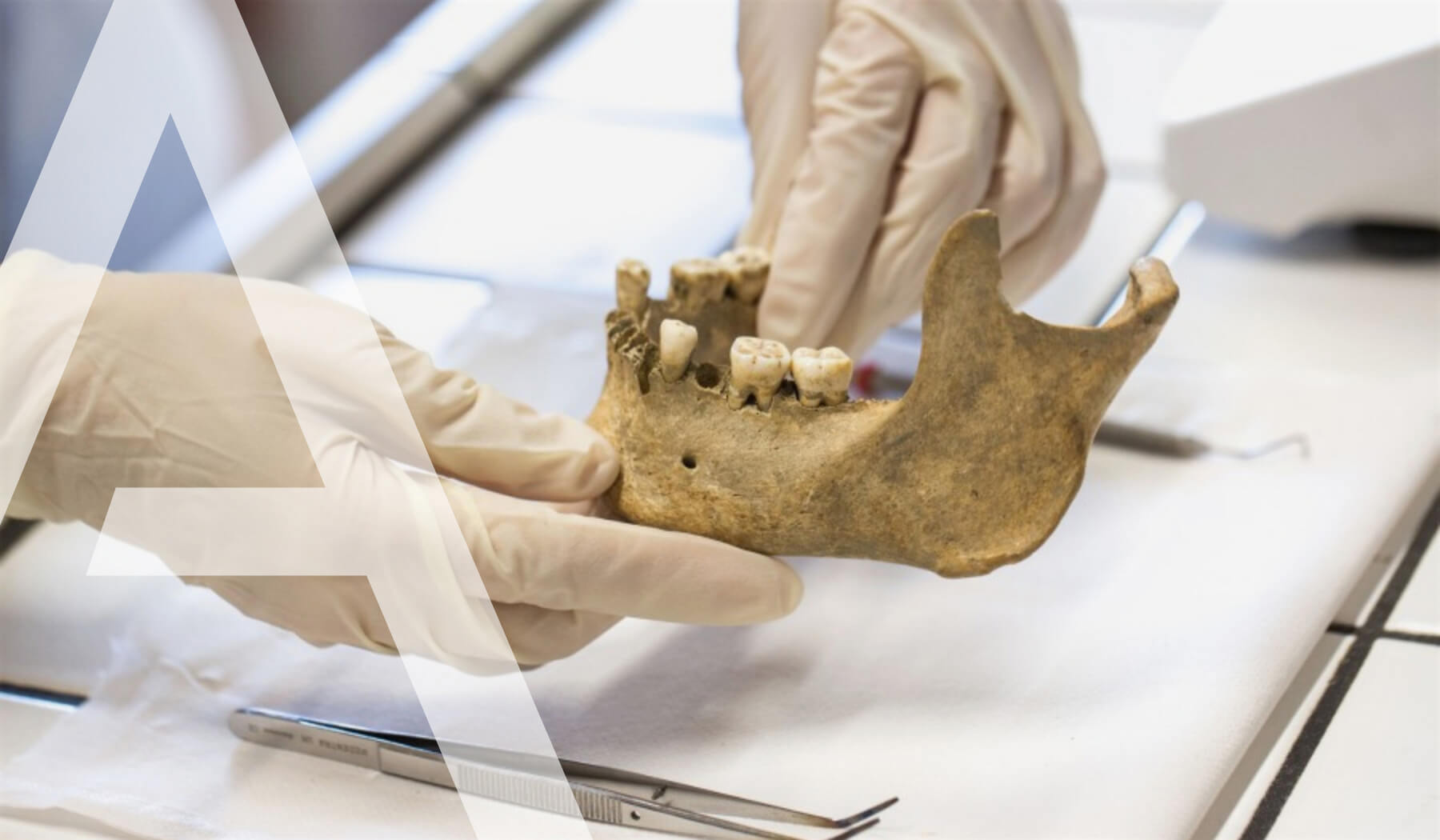
Bones are very good chronological markers in an archaeological dig, as they are closely linked to the stratigraphy in which they are found. A bone is composed of a mineral part, bioapatite, and an organic part, collagen. Collagen is the most suitable fraction, and is normally used for radiocarbon dating.
The first step in the dating process is to extract the collagen. To this end, they are treated with cold hydrochloric acid (HCl, 1 M) for 24 h, in order to eliminate any surface contamination and partially deteriorate the mineral part of the bone, thus making collagen extraction more efficient. Samples are then treated with sodium hydroxide (0.1 M) at room temperature and again with cold hydrochloric acid, to avoid absorption of atmospheric carbon dioxide. After washing with demineralized water, the samples are boiled to dissolve and recover the collagen.
The extracted collagen undergoes combustion at 920°C and is transformed into gas. During this stage, an initial check of the C/N ratio is carried out using an elemental analyzer (Elementar Vario ISOTOPE Select). This is an essential quality control step.
A C/N value between 2.9 and 3.6 indicates that the calogen is well preserved and will provide reliable dating. If the C/N ratio is outside this range, C14 dating of the collagen will not be possible. In this case, it will be necessary to use the mineral part of the bone and date the bioapatite.
Next, stable isotopes of carbon and nitrogen will be analyzed by IRMS. These values will provide information on the diet of the individuals. At the same time, carbon dioxide from combustion is separated from other residues using a zeolite trap. This carbon dioxide is then catalytically converted into graphite using an automated system (AGE 3, Ion Plus).
C14 dating and calibration
In order to validate our analytical protocols, it is essential to first check the precision of our measurements, as well as their reproducibility. To do this, we analyze international standards whose values are known and recognized. These values enable us to assess our uncertainties, around 0.5 pMC, and 0.1 to 0.2‰ for δ¹³C and δ¹5N. Real-time verification of measured values for standards enables us to identify and resolve any problems associated with pollution, graphitization and measurements.
Finally, the various carbon isotopes are separated by gas pedal mass spectrometry (AMS). Then, the 14C concentration was determined by simultaneously comparing 14C, 13C and 12C measurements with those contained in international standards (oxalic acid, standard CO2, charcoal). The conventional carbon-14 age was calculated using the method described by Stuiver and Polach. It takes into account correction for isotopic fractionation.
The results are calibrated using OxCal v4.4 software. The measurement taken is expressed in two different ways: part of Modern Carbon (or pMC) and conventional age. Conventional age is expressed in years before 1950 (BP standing for before present), which is the reference year. Age is expressed to one standard deviation. The dating intervals reflect a two-sigma distribution, i.e. 95.4% of all solutions. The dated event can be found in any interval, regardless of the probability distribution, which is given for information only.
Share this article

Related topics

Need more information or have a question?
Our team will get back to you as soon as possible.