CT scan and imaging

CT scan and imaging

For the characterization of archaeological artifactsscientific imaging is proving an increasingly important method, enabling virtual excavations of urns or cinerary amphorae, for example.

Contact our teams

Why use scientific imaging in archaeology?

In archaeological research, imaging technologies play an essential role in analyzing objects without damaging them. Non-invasive and precise, they enable :

  • Preserve the physical integrity of artifacts, especially fragile ones,
  • Avoid risky handling, especially of rare or sealed items,
  • Scientific documentation of objects discovered, with very high-resolution visual evidence,
  • Guide conservation or restoration choices, based on reliable observations.

It has become an indispensable examination method in modern archaeology, both upstream and downstream of excavation campaigns.

Request a quote
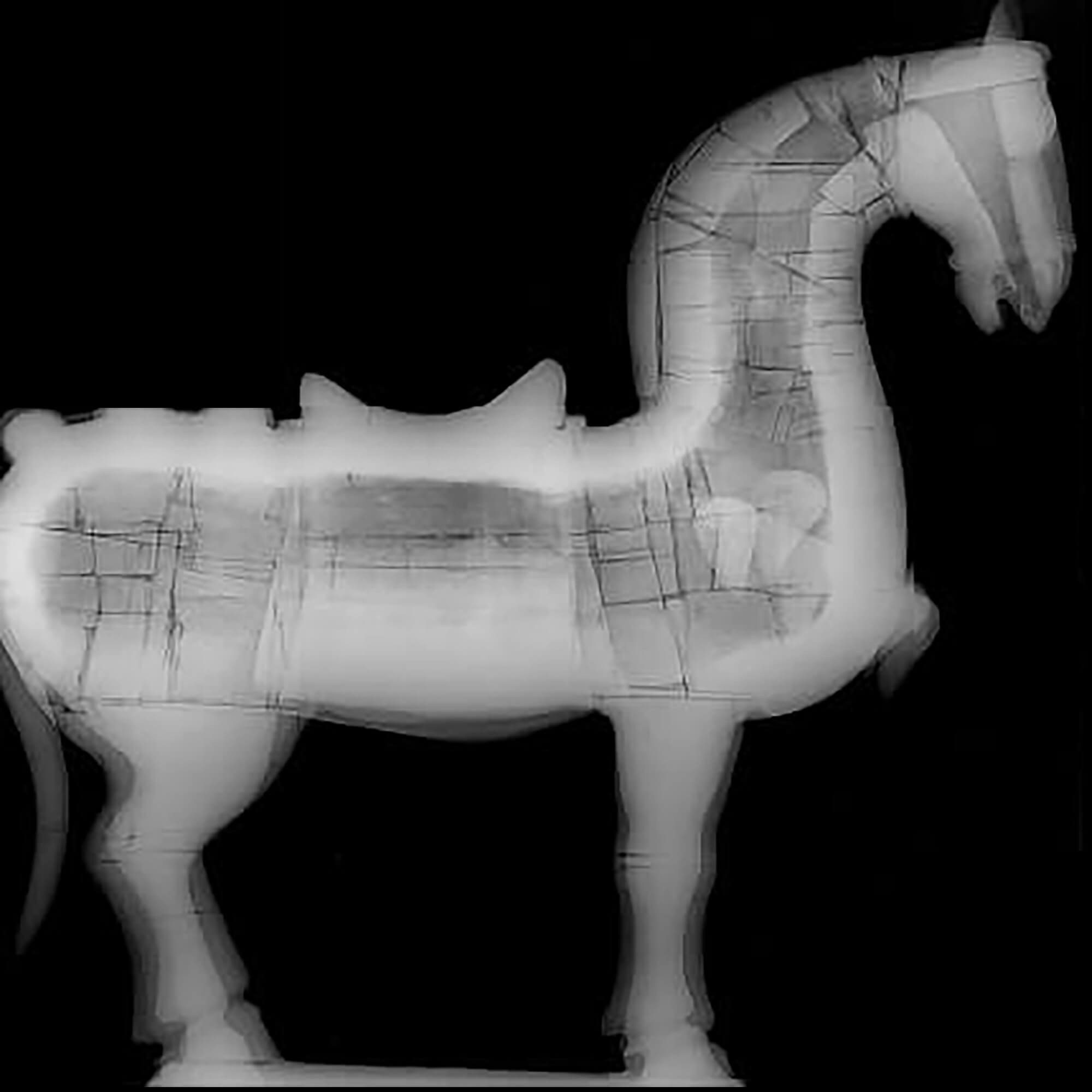
rx horse 1

On-site or in the laboratory:
two complementary approaches

CIRAM offers two modes of intervention depending on the project context:

  • On site: thanks to portable digital radiography equipment, our experts can work directly on excavation or storage sites. This enables rapid analysis without moving the objects.
  • In the laboratory: for more advanced requirements, artifacts can be transferred to our CT (computed tomography) scanner facilities. This enables detailed 3D reconstructions, fine digital segmentation and in-depth analysis.

Each approach has its own advantages, and can be used alone or in conjunction with the other for a complete study.

Contact our teams
shutterstock 1615376968

Specific applications of imaging techniques

The combined use of CT scan and X-ray radiography allows in-depth exploration of archaeological artifacts, with several specific applications:

  • Internal structure analysis: these technologies reveal details invisible to the naked eye, such as internal inclusions or structural anomalies.
  • Detection of cracks, porosity or corrosion: these can be used to identify signs of potential deterioration, such as cracks, porosity or corrosion, thus helping to assess the state of conservation of objects.
  • Digital reconstruction of fragmented parts: CT scanning enables fragmented objects to be reconstructed in 3D, facilitating their analysis and understanding prior to any intervention.

These techniques are essential in conservation and restoration studies, enabling fine analysis of artifacts without compromising their integrity and optimizing future interventions.

Request a study

HD imaging techniques

01 - On-site X-ray radiography

Digital X-rays, taken using the latest generation of portable equipment, enable on-site intervention, providing real-time images.

Thanks to a high-power generator and an advanced digital acquisition system, CIRAM captures images with a resolution of 5.5 million pixels via a large digital plate (40 x 40 cm). This technology makes it possible to analyze several objects simultaneously and to study large archaeological finds.

Angles and analysis are adjusted in real time for optimum results, providing a global and detailed view of artifacts without disrupting their integrity.

Read more

02 - Computed tomography for 3D visualization

Computed tomography (CT scan) enables three-dimensional analysis of objects, revealing their internal structures without recourse to destructive methods. This technique provides detailed information on the manufacturing methods and state of preservation of artifacts.

Using the appropriate imaging modes, CIRAM optimizes material visualization, enabling ultra-precise renderings. Virtual excavations carried out with this technology offer a complete digital exploration of objects, and can be presented in video form, adding a temporal dimension to the 3D reconstruction.
This approach enables exhaustive, non-intrusive analysis of the objects studied.

CIRAM Laboratories,
expert in scientific imaging

CIRAM laboratories are at the forefront of innovation in the field of scientific imaging applied to archaeology. Thanks to a team of experts and state-of-the-art technologies, CIRAM offers non-destructive imaging solutions for the analysis and conservation of archaeological artifacts.

Combining X-ray and CT scan techniques, CIRAM provides a detailed exploration of objects, from their internal structure to their state of preservation.

These technologies, combined with complementary analyses such as carbon dating by AMScarbon dating thermoluminescence dating, anthracology/xylology, organic residue analysis or isotope analysisanalysis, provide an in-depth understanding of artifacts, while guaranteeing their preservation.

Contact our teams

Are you asking yourself these questions?

What is a virtual dig?

A virtual excavation allows you to explore an artifact in 3D, without physically manipulating it. It enables the internal structure of the object to be visualized and analyzed using technologies such as CT scanning, with no risk to the integrity of the artifact.

What's the difference between X-rays and CT scans?

X-rays are ideal for obtaining quick snapshots of the internal structure. CT scans, on the other hand, generate three-dimensional images, enabling deeper and more complete exploration of the object.

What types of artifacts can be analyzed by X-ray or CT scan?

Our techniques can be applied to a wide range of artefacts, from fragile objects such as ancient pottery to metal structures, wood or bone pieces, enabling complete exploration without altering their condition.

How long does a CT scan take?

Analysis time varies according to the size and complexity of the object, but generally, a complete analysis takes from a few hours to a few days, depending on the specific requirements of the project.

Make an appointment with an expert

Get all the answers to your questions!

Make an appointment

Explore our dating and analysis resources

Archaeology
Comparison between carbon-14, TL, and OSL: which method should you choose?

Comparison between carbon-14, TL, and OSL: which method should you choose?

Choosing the right dating method in archaeology is not just a technical issue: it is a key decision that guides the entire interpretation of a site. Which technique to choose...

Read the article

Archaeology
The limits of carbon-14 dating: when should we turn to other methods?

The limits of carbon-14 dating: when should we turn to other methods?

How do you know whether a work of art, an archaeological object or a heritage item is really as old as it claims to be? Carbon-14 dating is often the method of choice, but it can also be used to...

Read the article

Archaeology
What role does anthracology play in preventive excavations?

What role does anthracology play in preventive excavations?

Anthracology plays a key role in preventive excavations: by studying archaeological coals, it sheds light on past human practices and paves the way for carbon dating...

Read the article

Archaeology
Mass spectrometry in archaeology: what for?

Mass spectrometry in archaeology: what for?

What methods are suitable for dating a fragile artifact, tracing the origin of a material or identifying millennia-old organic residues? Mass spectrometry provides access to...

Read the article

Archaeology
Dating for archaeology: why combine several methods?

Dating for archaeology: why combine several methods?

The cross-fertilization of dating techniques for archaeology guarantees the reliability of analyses in response to the complexity of the contexts and materials studied. Find out why...

Read the article

Archaeology
The importance of calibration in carbon-14 dating

The importance of calibration in carbon-14 dating

How can we guarantee the reliability of archaeological dating in a context where every year counts? Find out why carbon-14 calibration curves and laboratory expertise...

Read the article

Request a quote