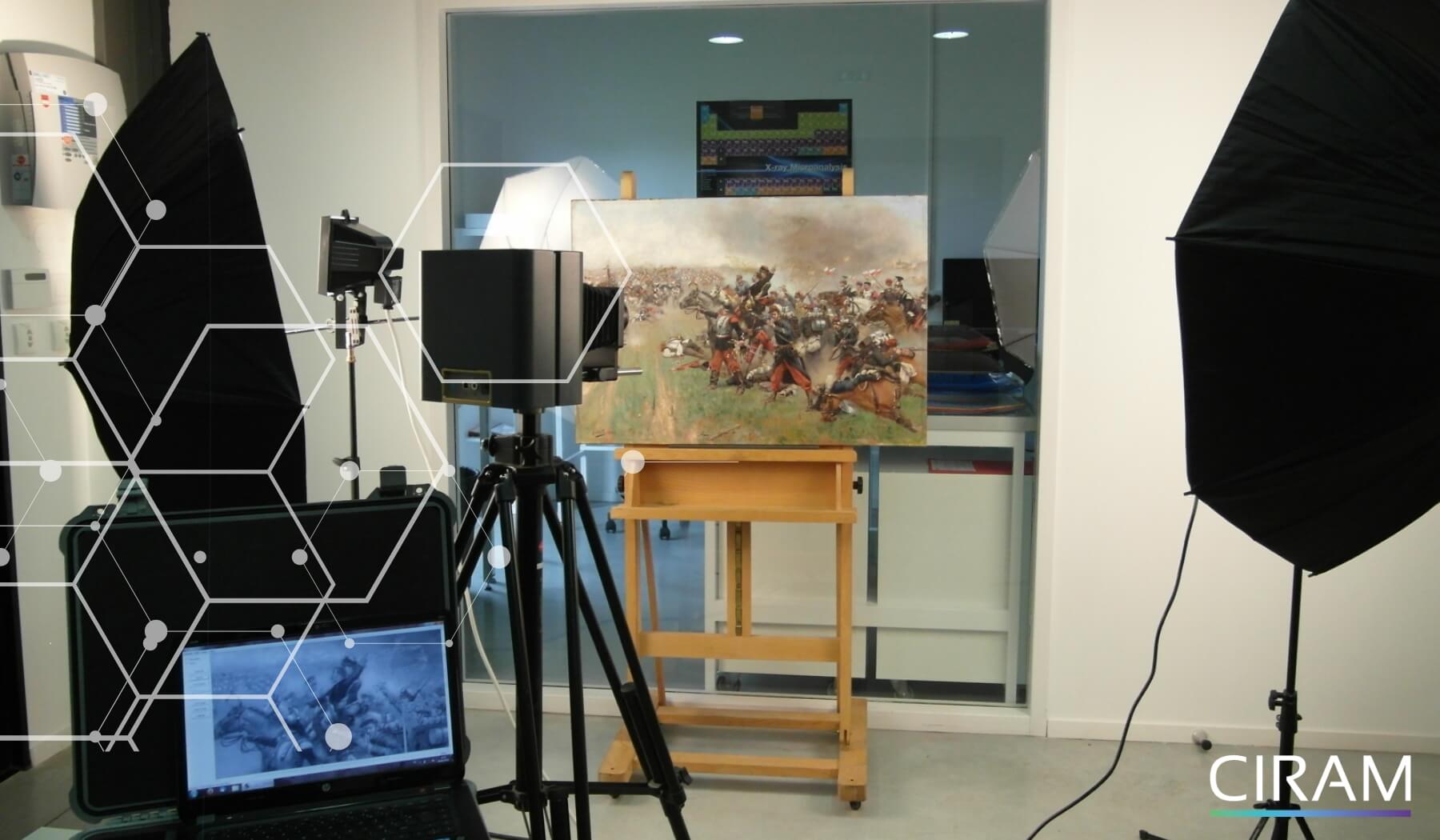

Article Outline
- Can a painting be dated using carbon-14 dating?
- Which materials in a painting can be dated?
- Why isn't carbon-14 dating sufficient to authenticate a painting?
- An anthropological and historical approach to complete the results
- How is a painting dated?
- The principles of carbon-14 dating
- Carbon-14 variation over time, an important factor to take into account
- Some examples of paintings dated and authenticated by carbon 14

Can a painting be dated using carbon-14 dating?
The answer is yes, but only partially. We can only date the organic materials it is made of, such as canvas, wood, or paper. We cannot date the pigments, and it is sometimes difficult to date the varnish.
In summary:
- Carbon-14 dating is used to date the organic materials that make up the painting, while thermoluminescence dating is used to date materials that have been heated. Pigments, therefore, cannot be dated using these methods.
- Dating must be supplemented by material analysis, scientific imaging, and historical expertise.
- Combining these methods makes it possible to authenticate works of art and identify counterfeits.
The scientific approach based on materials is transchronological. This method is an essential step in authentication, but it must be supplemented by other scientific analyses. There are two dating methods used by CIRAM laboratories:
- Carbon 14, reserved for organic materials: wood, paper, ivory, bone, leather, textile
- Thermoluminescence, dedicated to terracotta and heated materials.
Which materials in a painting can be dated?
Not all materials used in a painting can be dated using carbon-14, as shown in the table below:
| Materials used in the painting: | Carbon-14 dating: |
| Fabric (linen, hemp, etc.) | Yes |
| Wood | Yes |
| Paper | Yes |
| Cardboard | Yes |
| Ivory | Yes |
| Varnish | Yes: if they are natural and contain organic matter No: if they are synthetic or mineral in origin |
Pigments | No |
Why isn't carbon-14 dating sufficient to authenticate a painting?
Please note that the date on a work’s medium does not automatically correspond to the date the work was created.
When studying paintings, various imaging techniques—such as those using natural light, raking light, ultraviolet (UV) light, or infrared (IR) reflectography—complement conventional dating methods. However, one problem remains: how can we analyze materials that cannot be dated, such as the pigments used in paintings?
An anthropological and historical approach to complete the results
Historical knowledge of pigment manufacturing techniques will provide chronological data: the use of chromium oxide as a green pigment from 1840 onwards, for example, or the manufacture of titanium white (titanium oxide), which began in the 1920s. These investigations also have their limits: natural pigments provide no real chronological information, as in the case of ochre, which was used for the Lascaux cave paintings!
How is a painting dated?
Dating a painting begins with identifying the materials it is made of in order to determine which ones can be analyzed. A very small sample is then taken from an organic material, such as canvas, wood, or paper. After measuring the carbon-14 levels and calibrating the results, the data obtained are interpreted by comparing them with pigment analyses, scientific imaging, and historical knowledge.
The principles of carbon-14 dating
Carbon-14 dating measures the time that has elapsed since the death of a living organism. Just as death brings human life to an end, a plant’s life ends when it is harvested. For a painting, this corresponds to the time when the flax or hemp used to make the canvas was harvested or when the tree used for the support or frame was felled.
The principles of carbon-14 dating are based on the instability of the carbon-14 isotope. A living organism contains a constant amount of carbon-14 due to exchanges with the atmosphere (respiration or photosynthesis). When the organism dies, these exchanges with the outside world cease, and the amount of carbon-14 then decreases according to a known exponential rate. Its concentration is halved every 5,730 years. The dating limit is approximately 60,000 years. Beyond that, the amount of carbon-14 is too low to be measured by current techniques.
This revolutionary technique earned its inventor, Willard Frank Libby, the Nobel Prize for Chemistry in 1960.
Carbon-14 variation over time, an important factor to take into account
Carbon-14 dates are expressed in years “Before Present” or “BP.” The “present” for carbon-14 was set at 1950 by Libby. Today, however, these values must be corrected because the concentration of carbon-14 has varied over time due to factors such as solar activity, climate change, and industrial activity. These results are referred to as calibrated results, obtained using calibration curves. These curves allow the BP age to be converted into calibrated date ranges associated with a probability percentage (for example, 450 ± 25 years BP corresponds, after calibration, to the range 1422–1471 AD—with a 95.4% probability).
The onset of industrial activity, for its part, led to a decline in Carbon 14 levels and imposed limits on the precision of measurements. Conversely, atmospheric nuclear testing has led to an artificial rise in Carbon 14 levels worldwide. This makes it possible to obtain very precise dates (up to one or two years) for the second half of the 20th century.
Some examples of paintings dated and authenticated by carbon 14
The following examples illustrate how carbon-14 dating can reveal chronological inconsistencies, but also why it must always be cross-checked with other scientific analyses.
In art history, cases of forgery are common, and it is often through a thorough analysis that inconsistencies have been uncovered. Here are two examples:
- A painting by a Russian Suprematist painter, dated 1920, had its canvas support finally dated post 1954.
- A Picasso composition proposed for dating in the early 20th century revealed, after dating the paper support, that the paper had been manufactured before 1954, and was therefore incompatible with the presumed period.
Generally speaking, it's much easier to prove that a painting is fake than to establish its authenticity:
- The dating of a painting attributed to Van Gogh was carried out in two stages. Dating of the support suggested a date compatible with the painter's activity, at the end of the 19th century. Pigment analysis led to a similar conclusion, since the pigments detected were known in the 19th century and had been found in other works by Van Gogh. These included vermilion red, copper arsenate green, zinc white and ochre. However, these pigments were known and used by all painters at the same time, and even today. The Van Gogh committee, made up of art historians, had to decide in favor of an original work.
- Conversely, analysis of a 14th-century illuminated parchment confirmed the dating of the support. As for the pigments, they proved to be modern... It was an "intelligent" copy made before 1950... on old paper. It is therefore essential to combine analytical techniques to detect forgeries.
Carbon-14 dating is a major tool for the study and authentication of paintings, but it cannot, on its own, establish the authenticity of a work. Only a multidisciplinary approach, combining carbon-14 dating, chemical analysis of materials, scientific imaging, and historical-artistic expertise, allows for a reliable interpretation of the results.
Share this article

You might be asking yourself these questions about dating paintings?
No. Carbon-14 dating applies only to materials of organic origin. Mineral pigments and most varnishes cannot be dated using this method. Whether dating is feasible therefore depends on the materials from which the artwork is made.
Accuracy depends on several factors: the nature and state of preservation of the sample, the period in which it was produced, and natural variations in atmospheric carbon-14. Results are expressed as calibrated date ranges associated with a statistical probability. For materials dating from the second half of the 20th century, the “bomb peak” method can sometimes achieve an accuracy of one to two years.
Most pigments used in painting are of mineral origin (ochre, azurite, vermilion, titanium white, etc.) and therefore do not contain organic carbon that can be measured using the carbon-14 method. They cannot be dated directly. However, their chemical composition serves as an excellent chronological marker: certain pigments were not produced or used until a specific period, and thus help verify the accuracy of an attribution.
Yes, in many cases. If the dating of a canvas, paper, or wooden support is inconsistent with the presumed date of the work’s creation, the hypothesis of a forgery can be substantiated. However, consistent dating alone does not prove a painting’s authenticity. The results must be cross-referenced with pigment analysis, scientific imaging, and historical expertise.
Dating involves determining the age of one or more materials that make up the painting, such as canvas, wood, or paper. Authentication is a much more comprehensive process. It relies on a combination of several approaches: dating, material analysis, scientific imaging, provenance research, stylistic examination, and expertise in art history. Dating is therefore an essential element of authentication, but it is not sufficient on its own.
The carbon-14 method can be used to date organic materials up to approximately 60,000 years old. This limit is far greater than the age of the painted works preserved today. In practice, the method is particularly well-suited for studying ancient paintings on canvas, wood, or paper, ranging from the medieval period to contemporary works, provided that the organic materials are sufficiently well-preserved to be analyzed.
Yes, carbon-14 dating requires the removal of a sample. However, the amount of material removed is extremely small, and the sample is taken from an inconspicuous area of the artwork to minimize its impact. Before any work is done, the laboratory works with the owner or curator to determine the most appropriate sampling strategy.
Related topics





Need more information or have a question?
Our team will get back to you as soon as possible.