How to recognize bronze and differentiate it from brass?
Distinguishing a work of art in bronze from one in brass is not possible at a glance, however expert. Deceptive patinas, invisible restorations, sophisticated forgeries...

CIRAM authenticates and dates your works of art in wood, ivory or paper, using cutting-edge scientific methods adapted to each organic material.
Contact our teams
The scientific dating of a work of art begins by identifying the materials it is made of.
At CIRAM, each organic material - wood, ivory, paper, textile - is subject to a specific protocol. Our scientists adapt their analysis methods according to the nature and state of conservation of the samples. The radiocarbon dating is particularly well-suited to organic materials, as it enables the age of an object to be accurately estimated.
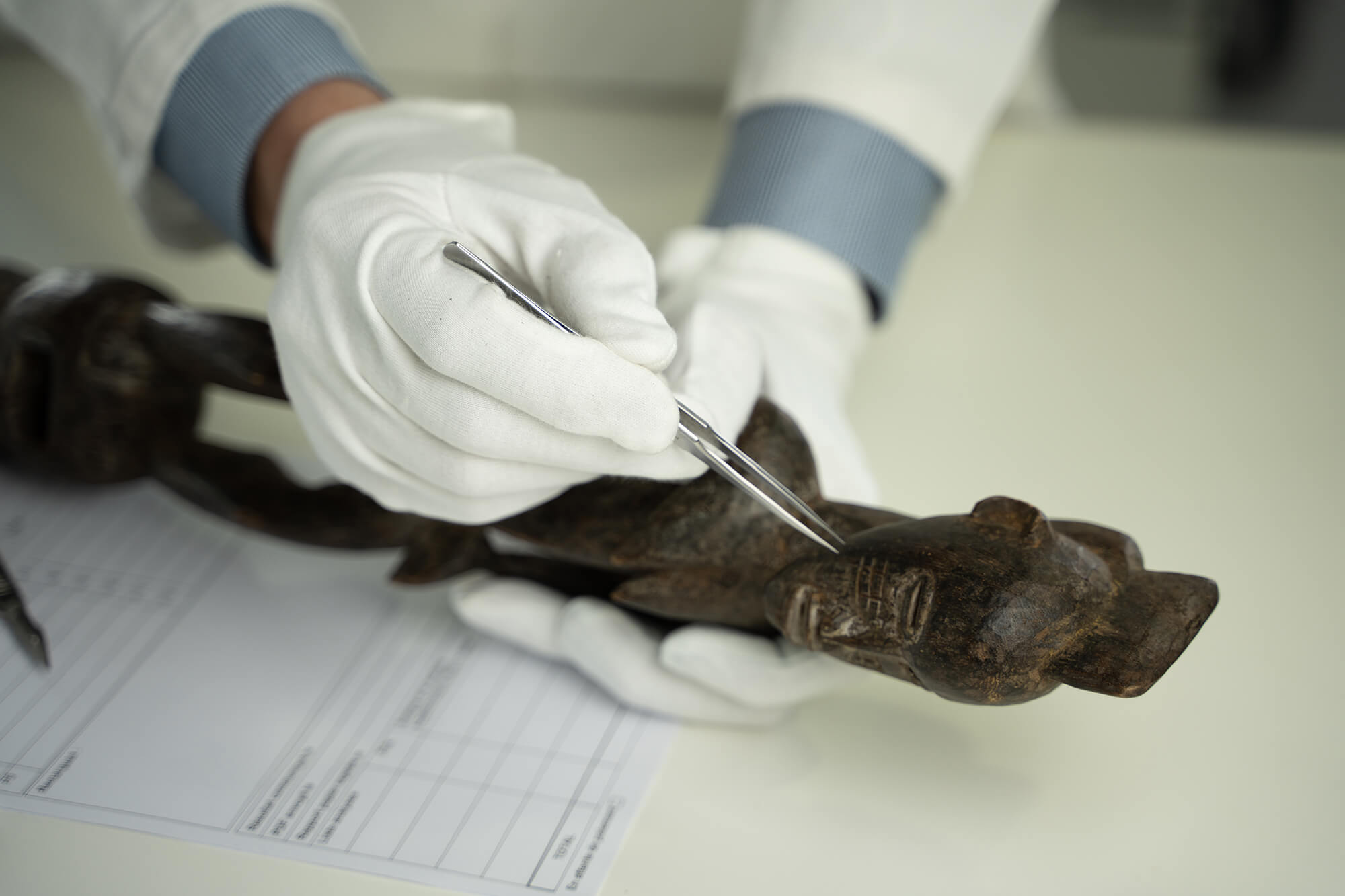
Our laboratories take into account the specific constraints of art objects (fragility, stratification of materials, presence of restorations) to guarantee reliable results, without altering the integrity of the pieces entrusted to us. Each work is unique, and so is our approach.
Request a quote
As the world leader in carbon-14 dating applied to art, CIRAM masters every stage of the laboratory process.
After chemical pre-treatment, the scientists extract the organic carbon from the sample, then transform it into pure graphite. This is then analyzed by particle gas pedal (AMS) to measure the isotopic ratios of carbon-14, carbon-13 and carbon-12. This measurement yields a raw radiocarbon age, expressed in BP years.
This method is applicable to all organic materials: wood, ivory, paper, bone, leather or plant and animal fibers. CIRAM also applies strict quality control protocols, in line with international standards (ASTM D6866 and EN 16640), to guarantee the reliability and reproducibility of results.
Contact our teams
Carbon-14 dating gives a gross age expressed in "Before Present" (BP) years, with 1954 as the reference point. However, this estimate is based on an assumption of stability of carbon 14 in the atmosphere, which has been scientifically contradicted. In fact, variations linked to climate, the solar cycle or human industrial activity modify these concentrations.
CIRAM therefore performs an essential step: calibration.
Using internationally recognized calibration curves, the BP age is transformed into calibrated dates, with a high probability rate. This conversion anchors the object in a precise historical period (e.g. 730 ± 20 years BP corresponds, after calibration, to the interval 1265 - 1297 AD. - probability 95.4%).
Request a studySamples are never analyzed directly after collection. Prior to analysis, they undergo rigorous chemical pre-treatment , including the ABA (Acid-Base-Acid) protocol, designed to eliminate all contaminants such as varnishes, glues, patinas, concretions and other sources of external pollution.
The aim is to isolate the datable fraction of the material: cellulose for wood or paper, collagen for ivory and bone, or keratin for materials such as horn.
Once this stage is complete, the researchers extract the carbon present in the material, which they then transform into graphite, a form of pure carbon essential for radiocarbon dating.
Carbon 14 is measured on a graphite target using a particle gas pedal coupled to a mass spectrometer (AMS). The isotopic ratios 14C/12Cand 13C/12Care measured to obtain the pMC value (percentage of modern carbon) and the gross age (before present dating).
This measurement takes into account isotopic fractionation.
For every 30 samples analyzed, we measure 8 international standards (oxalic acid OxII, SRM 4990C, Kauri wood C9 and phthalic acid blank), for greater precision and real-time quality monitoring. What's more, our dating is carried out in compliance with international standards(ASTM D6866 and EN 16640).
Once the radiocarbon measurement has been carried out, our engineers calibrate the raw age obtained. This crucial step transforms the initial data into calibrated dates, the only ones that can truly be used to situate an object in time.
CIRAM also takes into account certain specific markers, known as modernity markers, to accurately assess the age or modernity of an object. For example, atmospheric nuclear testing from the 1950s onwards enriched the environment with carbon-14. Thus, an organism that lived after 1954 will have an abnormally high carbon-14 content. This signal clearly distinguishes an ancient work from a modern reproduction.
CIRAM 's state-of-the-art laboratories specialize in carbon-14 analysis to deliver precise, scientifically reliable dating of your art objects. Our teams of researchers and engineers combine several complementary methods to refine authentication: radiocarbon dating, of course, but also xylologywhich enables us to identify the wood species and estimate its geographical origin.
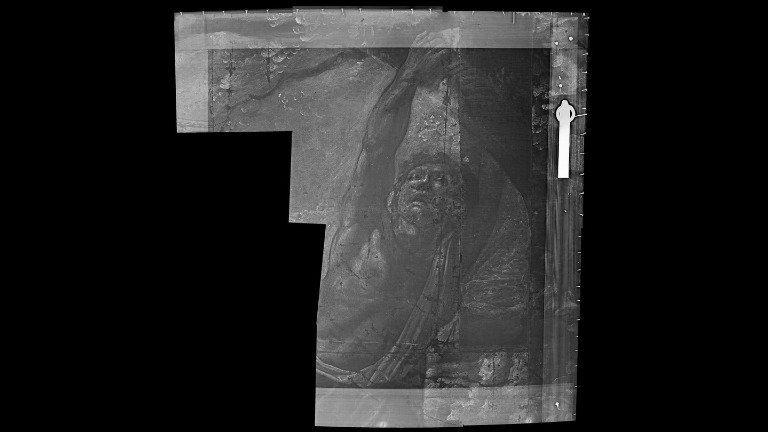
We also use techniques such as X-ray radiography and 3D scanning, useful for revealing internal structures, restorations or hidden additions. When you choose to entrust your works of art to CIRAM laboratories, you benefit from recognized expertise to guarantee accurate and reliable results.
Trust our experts to support you in your analysis projects.
Contact our teamsWe use carbon-14 dating, a precise scientific method for determining the age of organic material by measuring the concentration of carbon-14 still present.
Yes, our engineers can spot the markers of modernity, such as an abnormally high carbon-14 content due to nuclear testing after 1950, which makes it possible to identify recent copies.
Absolutely. Our experts adapt the analysis methods to each material present in the work and can cross-reference the results to propose a reliable dating of the object as a whole.
Yes, we offer complementary analyses such as xylology (wood identification), radiography or 3D scanning to study the internal structure or detect possible restorations.
Simply contact us via our contact form or by telephone. After reviewing your request, we'll arrange an appointment with you at home or at the laboratory, so that we can show you the appropriate methodology and take the samples.
Distinguishing a work of art in bronze from one in brass is not possible at a glance, however expert. Deceptive patinas, invisible restorations, sophisticated forgeries...
A simple signature can make the difference between an anonymous work and a masterpiece valued in the millions on the art market. But what happens when that signature is...
Knowing how to recognize an authentic antique bronze is a strategic issue for art professionals, to guard against fakes. Patina, composition, corrosion: every clue can help you...
How to analyze a work of art without damaging it? Thanks to non-destructive analysis techniques, it is now possible to access valuable information about pigments, re...
Should optical imaging or radiography be used to analyze a work of art, an archaeological object or an industrial material? Behind this question lie the crucial issues of...
X-rays of paintings reveal what the eye cannot see: internal structures, hidden restorations and forgotten signatures. Thanks to advanced scientific analysis techniques...