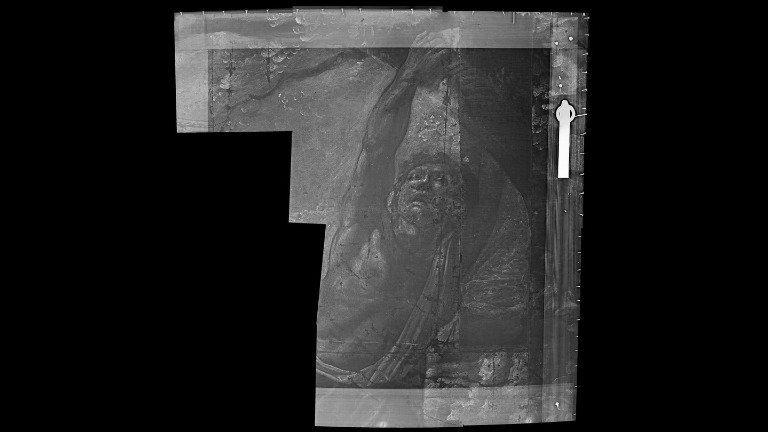

How do X-rays reveal the hidden history of a painting?
Reading time:
Written by:
Article Outline
- How does X-ray analysis of a painting work?
- Why supplement X-rays with other tests?
- Why X-ray a painting?
- Authenticating and dating paintings: material evidence before a transaction
- Restoration and conservation: concrete examples and benefits
- Integrating results into documentation and the art market

X-ray analysis of paintings allows us to examine a work’s internal structure without damaging it. Using X-rays, this technique reveals past restorations, retouching, cracks, the construction of the support, and other elements invisible to the naked eye. Today, this imaging technique is an indispensable tool for the study, conservation, and authentication of works of art. Used in conjunction with other scientific analysis methods, it provides additional information that enhances our understanding of a painting’s material history. X-ray analysis is an integral part of a more comprehensive approach tothe scientific analysis of artworks.
In this article, we discuss how it works, what it can reveal, and in what situations it is used.
In summary:
- X-ray analysis reveals the internal structure of the works and detects restorations, retouching, or invisible alterations.
- This non-destructive method complements the authentication and preservation of paintings.
- When combined with other scientific analyses, it provides objective evidence to support the authentication of works of art.
How does X-ray analysis of a painting work?
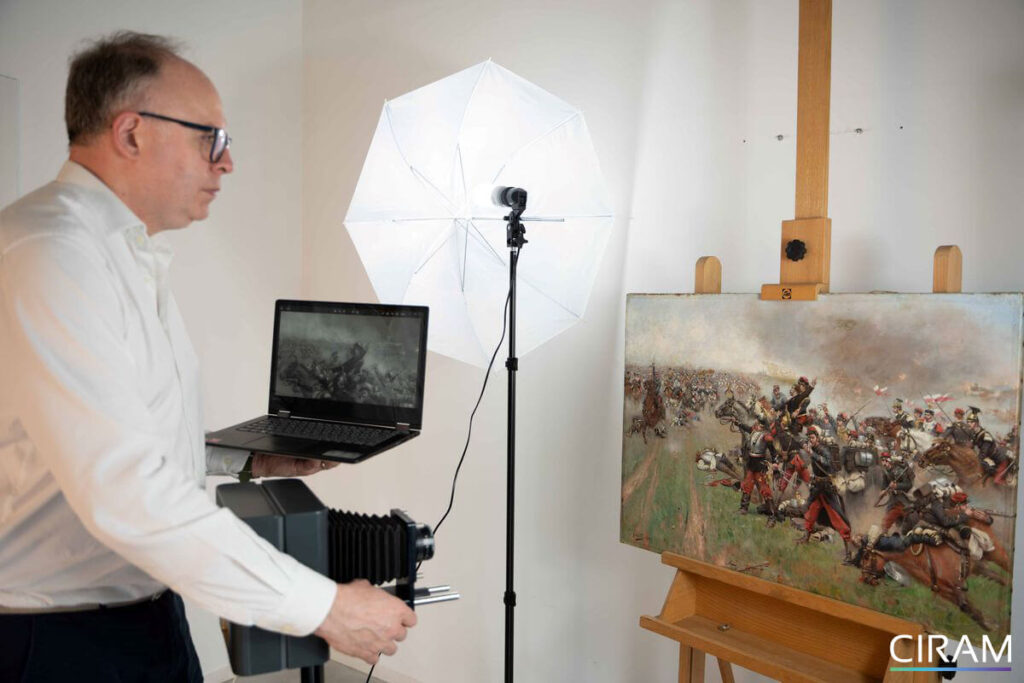
X-ray examination is an imaging technique that uses X-rays to examine the interior of a painting without having to take it apart or remove any samples.
The X-ray beam will pass through the paint and its substrate and be captured on a digital plate. Each material present—such as pigments, wood, canvas, and nails—absorbs the rays differently, producing a high-contrast image of the internal structure.
X-rays are used, in particular, to:
- reveal old restorations hidden beneath layers of paint
- identify cracks , repairs, deformations of the substrate, or other structural damage
- view the revisions (changes made by the artist during the creative process)
- display hidden elements such as a signature, a drawing, or iconographic elements
This information is particularly useful before a restoration, appraisal, or purchase.
X-ray analysis is a non-destructive method. The X-rays used do not alter the pigments or the support and allow a work of art to be examined without compromising its preservation.
To learn more, see our article on non-destructive analysis of works of art.
Why supplement X-rays with other tests?
X-ray analysis applied to paintings and artwork differs from other scientific imaging techniques in its ability to penetrate all layers of the object, from the varnish to the support. Unlike infrared imaging methods, which primarily target underlying drawings, or ultraviolet imaging, which is limited to the pictorial surface, X-ray imaging provides a comprehensive and in-depth view of the artwork.
However, there are certain limitations: analysis can be complex when dealing with mixed materials (canvas on a metal frame, modern reinforcements, wooden parquet), requiring the use of complementary methods such as computed tomography (CT scan).
This complementary approach is at the heart of the scientific methodology used by specialized laboratories such as CIRAM. X-ray analysis is thus combined with other imaging techniques, carbon-14 dating, and chemical analyses to produce a comprehensive and reliable assessment.
Why X-ray a painting?
X-ray imaging is not limited to producing a simple technical image: it serves as a strategic tool for making informed decisions, whether regarding authentication, dating, restoration, or the revelation of a work of great value.
Authenticating and dating paintings: material evidence before a transaction
For gallery owners, experts, and art collectors, the question of a painting’s authenticity is crucial before any purchase. X-ray analysis of paintings thus provides objective physical evidence that either supports or refutes an attribution.
X-rays of the paintings can be used to :
- detect substantial modifications incompatible with the presumed period of creation: addition of modern supports, industrial retouching, anachronistic materials, etc.
- compare the internal structure with referenced works from the same studio
- check the consistency of assembly components (dowels, nails, covering)
- to supplement the dating of a painting by comparing the results with those obtained through carbon-14 dating or chemical analysis of the materials
In practice, radiography applied to paintings clearly answers the question: how can a work of art be scientifically authenticated before being sold? It is the method of analysis that provides material proof. This analysis is indispensable for any appraisal report on serious paintings on the international market.
Restoration and conservation: concrete examples and benefits
X-rays of paintings reveal the complete stratigraphy: preparatory layers, repentirs, old restorations in the context of a restoration operation. This technical information makes it possible to adapt protocols and avoid successive treatments that would compromise the integrity of the work.
It also identifies:
- structural cracks invisible to the naked eye
- old consolidations likely to deteriorate
- heterogeneous materials (combination of wood and metal) requiring differentiated conservation
For these reasons, radiography applied to paintings provides a concrete answer to another crucial question asked by art professionals: what results can be expected for the conservation of paintings? By X-raying your work, you can obtain a detailed map of any deterioration, which is essential for drawing up an estimate, planning interventions and documenting prior condition.
Last but not least, this imaging method is a genuine scientific documentation tool for enhancing the value of the work: incorporating radiographic images and observations into the technical file enhances traceability and credibility with institutions, collectors and insurers.
Integrating results into documentation and the art market
After X-raying the painting, the laboratory provides an illustrated and commented file including :
- detailed X-ray images
- observations on internal structure, previous restorations and any hidden signatures
- a summary of technical limitations and recommendations for any additional tests (CT scan or UV imaging)
These elements provide undeniable added value when it comes to securing a transaction or acquisition, planning a restoration, and enhancing the traceability and visibility of the artwork in the art market.
X-ray analysis is now one of the most useful imaging techniques for studying a painting without damaging it. By revealing the internal structure of the artwork, it provides valuable information about its creation, state of preservation, and history. Combined with carbon-14 dating, chemical analyses of materials, and other scientific imaging techniques, it is an essential tool for the study, conservation, and authentication of works of art.
Share this article

You may be wondering about these questions regarding X-ray analysis of paintings?
Yes. X-ray analysis is a non-destructive testing technique. The X-rays used do not damage the pigments, the support, or the varnishes. It allows us to examine the interior of a painting without taking samples or altering its condition.
X-ray analysis reveals the internal structure of a painting. It can reveal overpaintings, past restorations, cracks, support joints, nails, reinforcements, or elements covered by layers of paint that are invisible to the naked eye.
X-rays are used prior to restoration, during an appraisal, or in connection with a sale or acquisition. They provide a better understanding of the work’s state of preservation, help identify previous interventions, and complement scientific analyses.
Related topics



Need more information or have a question?
Our team will get back to you as soon as possible.