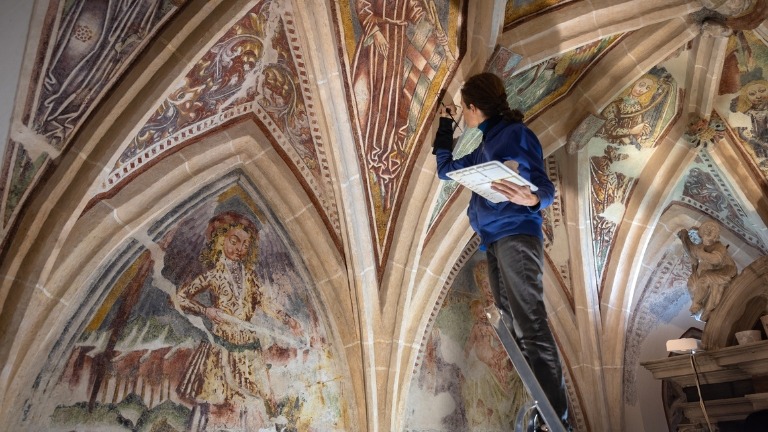

Today's art market players are demanding greater traceability, authenticity and conservation. In response to these issues, non-destructive analysis methods provide a reliable scientific answer that respects works of art. Without taking any samples or making any alterations, they reveal elements invisible to the naked eye: pigments, restorations, erased signatures, internal structures or even anachronistic materials.
Whether you're a gallery owner, independent expert, curator, restorer or collector, these techniques provide you with a strategic tool for securing an acquisition, justifying an attribution or documenting a state of conservation.
In this article, we explain why and how non-destructive analysis is becoming the benchmark solution for many applications. You'll discover the main methods used by laboratories, the information obtained on the work and how to choose a reliable laboratory to carry out your non-destructive analyses.
Non-destructive analysis: a strategic choice for enhancing, preserving and securing your works of art
It is becoming increasingly popular with art market professionals: non-destructive analysis has established itself as a reliable method for authenticating, documenting and enhancing the value of a work of art, without ever altering its material.
Preserving the physical integrity of works of art while accessing the essentials
Non-destructive examination of a painting or art object means that the integrity of the work is not compromised, while at the same time providing access to vital information for its study. Unlike invasive methods, which involve irreversible sampling of the object, non-destructive analysis methods enable a multi-layered reading of the work without direct contact or alteration.
This applies equally to the authentication of a painting without sampling, the detection of recent interventions or the study of the constituent materials of an archaeological artifact. Thanks to these methods, a professional can :
- detect restorations invisible to the naked eye
- spot a preparatory drawing or a repentance
reveal a hidden signature - check the consistency of a stylistic or chronological attribution
- or detect later additions or exogenous elements.
The non-destructiveness of the technique used is not just a guarantee of quality or a simple precaution: it is now a market expectation and a guarantee of professional expertise.
Information accessible through non-destructive techniques
Non-destructive analysis techniques offer reliable, scientifically exploitable results that are accepted in demanding contexts such as auctions, insurance or donation procedures.
These methods enable claimants to obtain :
- analysis of paint pigments
- non-destructive chemical characterization of varnishes, binders or patinas
- indirect dating by studying materials
- and precise mapping of conservation status
Some information requires advanced methods, but remains accessible via scientific imaging (infrared, X-rays, UV...) without recourse to destructive methods. This is the case for analyzing the chemical composition of paint layers or the internal structure of a sculpture.
As such, non-destructive analysis combines scientific rigor, respect for the object and strategic added value for anyone involved in the management, transmission or sale of works of art.
Discover the scientific imaging techniques used in non-destructive analysis
It is important to adapt the choice of method used to the work of art being studied. Here, non-destructive analysis techniques offer a range of complementary tools for revealing the invisible, from pigment to internal structure.
Scientific imaging: seeing the invisible to better understand history
Today, scientific imaging techniques are essential for non-invasive analysis of paintings, sculptures, archaeological objects and ceramics. They enable non-contact examination of a work of art, while providing usable, high-resolution information.
Some of the leading methods currently in use include :
- Infrared reflectography: essential for studying paintings. It reveals preparatory drawings, repentirs and even erased signatures. It offers a detailed understanding of the creative process.
- X-ray radiography: for in-depth inspection of the integrity of a work of art. Widely used for paintings and composite objects, it reveals breaks, exogenous materials, internal assemblies or complex stratigraphy.
- UV fluorescence: particularly useful for detecting areas of restoration or varnish variations, it provides information on the material history of the work, sometimes invisible to the naked eye.
- CT scan (computed tomography): enables virtual excavations and 3D modeling of an art object. This method is crucial for the study of funerary urns, composite fetishes or fragile objects where physical intervention is out of the question.
These analysis techniques are not only complementary, they are also recognized for their reliability in the context of scientific expertise of works of art. A laboratory specializing in the scientific imaging of works of art will be able to support professionals in their choice of specifically applicable analysis methods.
Scientific imaging techniques adapted to all types of objects and contexts
The effectiveness of a non-destructive analysis depends on the choice of the appropriate method(s), which varies according to :
- the nature of the work (wood, canvas, stone, metal, ceramic),
- the type of information required (pigments, restorations, dating, internal structure),
- and logistical constraints (whether or not the work can be transported).
Portable imaging techniques also make it possible to carry out expert appraisals on site, without having to move the work. This is a major advantage for private collections or monumental furniture.
Finally, complementary chemical analyses such as Raman spectroscopy or X-ray fluorescence enrich the study and reading of the work, without altering the material. The complementary nature of these tools means that laboratories specializing in art analysis can deliver complete, reliable diagnoses that can be used without sampling.
The role of scientific imaging laboratories in the study of works works of art
Choosing the right laboratory is decisive for obtaining quality analysis results. Selecting a reliable laboratory promises art professionals methodological rigor, clear reports and confidentiality. These are essential elements in meeting your authentication, enhancement and conservation needs.
Why choose a specialized laboratory like CIRAM?
The reliability of the results has a direct impact on the commercial, heritage or insurance value of a work of art. For this reason, it is crucial that the non-destructive analysis laboratory is recognized for the quality of its deliverables. CIRAM, a leading laboratory in the art market, stands out for its dual expertise: mastery of cutting-edge scientific imaging techniques and a keen understanding of the needs of the art market.
Professionals call on CIRAM to benefit from :
- The multidisciplinary expertise of its teams (physical chemists, art historians, restorers, engineers)
- A complete range of laboratory and portable technologies for in situ assessments
- Detailed, clear and usable reports for auctions, insurance files, restorations or donations
CIRAM's turnaround times are also adapted to professional constraints: a non-destructive analysis report is generally available within 2 to 4 weeks. In the event of an emergency (transport of work, nearby sale), accelerated procedures are possible.
With regard to confidentiality, CIRAM is committed to the total protection of data, visuals and results, within the framework of strict contracts. The integrity of the works is also guaranteed by secure handling and rigorous storage conditions, whether the analysis is carried out on site or in the laboratory.
Concrete added value for your works and decisions
Reliable and rigorous non-destructive scientific diagnosis by CIRAM is a strategic tool for :
- validate and justify attribution or provenance
- argue an insurance value
- documenting a future restoration
- support a sale or donation to institutional players
The quality of the scientific expertise depends largely on the laboratory selected, and provides legal and economic security, while consolidating the traceability of works in an increasingly demanding market. CIRAM not only provides analysis services, but also advises on the study strategy to be adopted (selection of applicable methods) and the interpretation of results. This is an essential guarantee of quality for professionals wishing to combine rigor, preservation and enhancement of their works of art.
Non-destructive analysis of works of art is therefore a strategic lever for art and heritage professionals. These methods preserve the integrity of works of art, while providing reliable, usable data on their composition, history and authenticity. Thanks to a combination of scientific imaging techniques (infrared, X-ray, UV, CT scan, etc.) and advanced physico-chemical analyses (Raman spectroscopy, X-ray fluorescence, etc.), specialized laboratories are able to obtain a fine, non-invasive reading of the most precious objects.
As a recognized expert in carbon-14 analysis, scientific imaging and material dating, CIRAM assists collectors, experts and institutions in their appraisal, restoration, enhancement or sale projects. Our laboratories are your ally in securing your object in a market seeking rigorous analysis of its history.
Would you like to have a work of art analyzed without altering it? Not sure which non-destructive analysis techniques are right for you? Ask our experts for a study by contacting us via our website.