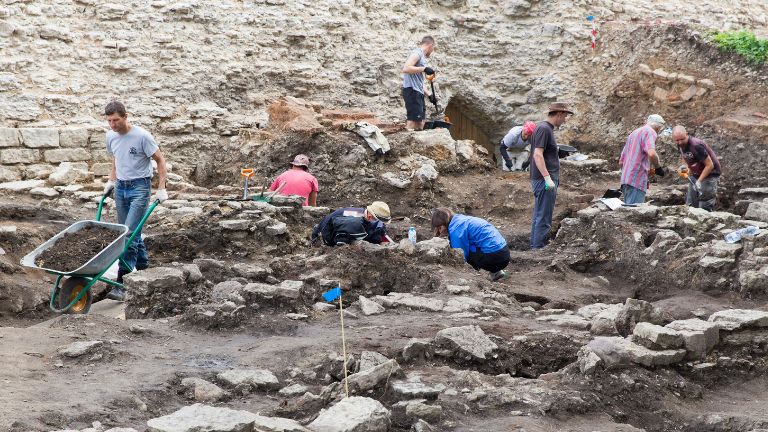

For preventive archaeology, carbon-14 dating remains one of the essential methods for establishing precise and reliable chronologies. In this article, we explore its fundamental role in the analysis of organic remains, from rigorous protocols to the interpretation of results. Find out how this technique supports development projects while preserving our heritage, and why working with specialist archaeology laboratories like CIRAM guarantees high-quality analyses.
The fundamentals of preventive archaeology and carbon-14 dating
Preventive archaeology is a key discipline in the preservation of cultural heritage that may be threatened by development projects. It intervenes upstream of construction work to detect, analyze and protect archaeological remains. Carbon-14 dating is one of the essential tools in this process, providing crucial precision in establishing the chronology of the sites studied, thus supporting archaeologists in their mission to understand the past.
Preventive archaeology: definition and challenges
Preventive archaeology, as defined by law in France (the January 17, 2001 law on preventive archaeology), aims to safeguard, through archaeological study, soil archives endangered by public or private works. Unlike programmed archaeology, which is based on planned scientific projects with no urgency, preventive archaeology responds to the time constraints imposed by construction sites.
This process involves several stages:
- Diagnosis: archaeologists carry out surveys to assess the presence and condition of remains.
- Excavations: if significant elements are discovered, an extensive excavation phase is carried out to document and study the remains.
The challenges of preventive archaeology are manifold: it enables us to better understand the ways of life of past civilizations, preserve irreplaceable data and reconcile modern development with heritage protection.
Carbon-14 dating is a key analytical method for achieving these objectives. It enables researchers to establish precise archaeological contexts by dating organic materials such as bones, wood or charcoal. This study helps to reconstruct human and civilizational histories, some of which date back several millennia.
The basics of carbon-14 dating
Carbon-14 dating involves studying the decay of a radioactive isotope present in living organisms. After their death, the quantity of carbon 14 decays at a constant rate, with a half-life of 5,730 years. By measuring the quantity of carbon 14 remaining in a sample, scientists can determine its age with remarkable precision, ranging from the very recent (20th century) to the very ancient, going back 50,000 years.
However, it is important to be aware of the possible limitations of carbon-14 dating:
- Contamination: samples may be altered by modern elements or natural pollutants, which would distort the results.
- Calibration: raw results need to be adjusted using calibration curves, as atmospheric carbon-14 levels vary in space and time.
These challenges underline the importance of adhering to strict protocols during sampling and analysis. Thanks to carbon-14 dating, preventive archaeology can better understand the temporal organization of the sites studied, offering a more complete and accurate reading of our historical heritage.
The application of carbon-14 dating in preventive archaeology projects
Archaeologists frequently use carbon-14 dating in preventive archaeology projects. The reliability of this analytical method relies on the implementation of rigorous protocols, from sample collection in the field, through chemical pre-treatment, extraction, automatic graphitization and AMS measurements, to laboratory interpretation of results. This approach guarantees reliable and precise analyses, essential for establishing an accurate chronology of the remains.
Steps for integrating carbon-14 dating into a project
1. Sample collection
Archaeologists have to collect organic materials(bones, charcoal, macro remains, organic residues, peat, shells, etc.) in compliance with strict protocols on the excavation site. These samples must be carefully handled to avoid any contamination that could distort the results of the study.
Each sample taken is accompanied by detailed documentation, including stratigraphic position, geographical context and environmental conditions. This documentation stage is essential to ensure consistent interpretation of the data in subsequent analyses.
2. Laboratory preparation
Samples are then transported to the laboratory, where they undergo various treatments prior to dating. They are mechanically cleaned and undergo ABA chemical treatment, and collagen extraction for bones, to eliminate contaminants such as modern carbonates or parasitic organic matter. Next, organic carbon is extracted from the sample by automatic graphitization, and carbon and nitrogenisotope analysis is carried out in parallel.
This process enables scientists specializing in carbon-14 dating for archaeology to ensure that only molecules of organic origin are analyzed, providing accurate results without contamination. Compliance with this protocol is essential to avoid errors and guarantee reliable dating.
3. Measurement and calibration
Analysis of archaeological samples by carbon-14 dating is carried out using advanced technologies such as a particle gas pedal coupled with mass spectrometry (AMS). This method detects minute quantities of 14C in the sample, offering unrivalled precision even for very ancient remains.
However, this raw measurement cannot be used as it stands. In fact, these results are obtained in BP years (Before Present, with 1950 as the reference), and are referred to as "raw age". They must be corrected, or "calibrated". This stage uses international calibration curves, which take into account variations in atmospheric carbon-14 levels over time. The final result then provides calibrated date intervals, an essential element for reliable interpretation.
Interpretation of results and practical applications
Interpreting the results of carbon-14 dating in preventive excavations requires in-depth expertise. Data from various analyses (carbon 14 or other) are then cross-referenced with stratigraphic and contextual information to avoid any errors. For example, the position of samples in a stratigraphic sequence enables us to check their consistency with other dated remains.
Case study: a prehistoric site
At a Bronze Age site in France, analysis of charcoal associated with a combustion structure revealed human occupation dating back some 4,000 years. This dating has enriched our understanding of human practices of the period, by identifying specific lifestyles linked to the exploitation of natural resources.
The wealth of results obtained illustrates the importance of using carbon-14 dating to reconstruct the chronologies of archaeological sites. It contributes not only to our historical knowledge, but also to guiding decisions related to heritage preservation.
Thanks to a strict methodology and cutting-edge tools, carbon-14 dating has become an essential technique for meeting the challenges of preventive archaeology. It provides the precision essential to understanding the sites studied, while supporting scientific and operational decisions. Archaeologists, constrained by the deadlines linked to the nature of preventive archaeology excavations, will need to call on specialists in the analysis of archaeological remains to benefit from their expertise and responsiveness.
The role of laboratories in preventive archaeology
Laboratories specializing in archaeomaterial dating and analysis, such as CIRAM, play a central role in preventive archaeology projects. The laboratories' scientific and technical expertise guarantees reliable analyses, tailored to the needs of archaeologists and the constraints of development projects. Thanks to state-of-the-art tools and close collaboration with field teams, these laboratories contribute to the protection and study of archaeological heritage.
Specialized laboratory expertise and services
Laboratories like CIRAM offer a range of essential services for the dating and analysis of organic materials sampled on site. Their expertise is based on advanced technologies, in particularparticle gas pedal mass spectrometry (AMS), which enables precise measurement of the quantity of carbon 14 in even very small and/or very old samples.
Laboratories can carry out a variety of studies:
- Bone dating: essential for studying the occupation of settlement areas or burial practices.
- Analysis of old wood: to understand how forest resources were used or how habitats were built.
- Study of charcoal: this is the key to reconstructing environmental contexts or identifying traces of combustion.
- Sediment dating: used to establish a chronology of natural or anthropogenic deposits in archaeological sites.
These services meet the specific requirements of preventive archaeology projects, where speed and precision are often crucial to meeting tight construction deadlines while preserving heritage.
Collaboration between laboratories and archaeologists
Close collaboration between laboratories specializing in carbon-14 dating and archaeologists is essential to guarantee the quality and relevance of analyses. Preventive archaeology teams can thus benefit from :
1. Advice in the field:
Laboratories specialized in archaeology provide their expertise right from the artifact collection phase. They guide archaeologists through sample collection and storage protocols, to avoid contamination or errors linked to inappropriate handling. This advice ensures the preservation of artifacts for analysis.
2. Detailed reporting:
Analysis results are synthesized in clear, comprehensible reports that can be used by archaeological teams. These documents include calibrated data, scientific interpretations and recommendations for integrating the results into the overall archaeological context.
3. Ongoing scientific support:
The laboratories are also involved in data interpretation, working closely with archaeologists. This collaboration between laboratories and preventive archaeology teams enables isotope analysis data to be cross-referenced with excavation data, guaranteeing a more complete and applied understanding of the sites studied.
Specialized laboratories are not service providers. They provide a level of advice that enables archaeologists to properly collect, analyze and understand dates and other scientific analyses. In this way, we can better understand and preserve our heritage.
Carbon-14 dating has established itself as a fundamental tool for preventive archaeology, enabling precise and reliable chronologies to be established for the remains of the past. In this article, we explore how this method, integrated into a rigorous analysis process, enriches our understanding of excavated sites while meeting the requirements of today's development projects.
Specialized laboratories, such as CIRAMlaboratories, play a key role in this process. They provide archaeologists with scientific expertise and tailor-made support for preventive archaeology professionals wishing to improve their knowledge of excavated sites. To guarantee the success of your projects and benefit from our recognized expertise, request a study with CIRAM scientists today. Let's work together to preserve our heritage while respecting the challenges you face.