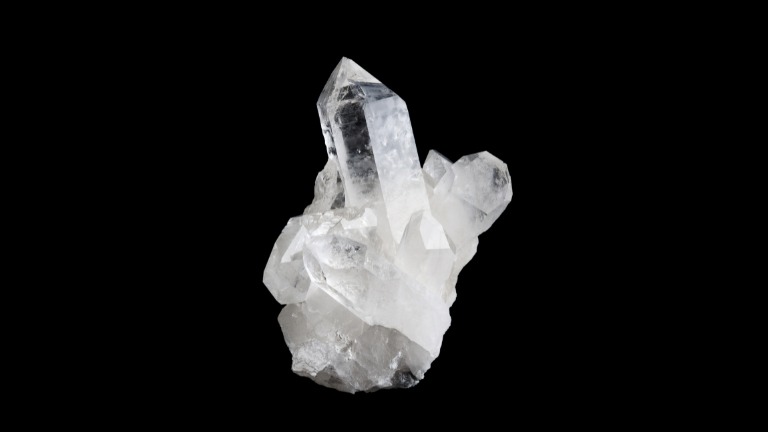

Many art collectors and art market professionals are wondering how to recognize genuine rock crystal without risking damage to the object?
Between glass imitations, modern treatments and uncertainties about provenance, art market professionals today need non-destructive analysis methods to authenticate, date and enhance the value of their pieces. In this article, we present why it is essential to be able to authenticate your rock crystal work, and what non-destructive scientific methods are useful to achieve this. We conclude with the crucial role of laboratories in assisting art collectors through the authentication process to enhance the value of their artistic heritage.
Understanding the challenges of authenticating rock crystal in the art market
The ability to rigorously identify genuine rock crystal is becoming a strategic challenge for art market professionals, given the proliferation of fakes and the continuing sophistication of imitations. Authenticity has a direct influence on the value, traceability and heritage conservation of antique objects.
Why is the authenticity of rock crystal crucial?
Rock crystal, a perfectly transparent variety of quartz, has been used since Antiquity in the creation of precious, religious or decorative objects. Its market value is based on several factors: the authenticity of the material, its geological origin, its age, and the traces of use or machining that bear witness to its history.
It is therefore important to know how to recognize a genuine rock crystal in order to secure a transaction, whether for the sale, acquisition or restoration of a work of art. This avoids misattribution and justifies the intervention of an expert in rock crystal analysis. Conversely, incorrect identification can lead to the object being undervalued or even downgraded. Imitations in glass or synthetic quartz, which can sometimes be extremely convincing, pose a real challenge without recourse to advanced scientific analysis.
Physical criteria for identifying a true rock crystal
Natural rock crystal has specific characteristics:
- High hardness (7 on the Mohs scale),
- No air bubbles, unlike blown glass,
- Natural mineral inclusions, often invisible to the naked eye but detectable by imaging,
- Refractive properties different from glass or modern substitutes.
One of the most common confusions we see is the difference between rock crystal and glass. This error is all the more problematic on objects that have been transformed or restored. Visual analysis is often insufficient: only a thorough rock crystal expertise, including non-destructive analysis, can eliminate any ambiguity. This is where materials science comes in.
Scientific methods and non-destructive analysis to authenticate a rock crystal
Today's art professionals rely on non-destructive scientific analysis to confirm the authenticity of a real rock crystal, without altering the work. This makes it possible to overcome the limitations of conventional observation, and provides scientific proof that can be used to enhance the value of the work.
The limits of classical methods and the contribution of science
Visual tests or simple observation with a magnifying glass are not enough to establish reliable authentication, even when carried out by specialists in this material. While crystal hardness or refractive index can provide an initial diagnosis, these criteria are often unusable on worn, fragmented, restored or weathered pieces. Similarly, destructive chemical analysis is not an option when authenticating valuable heritage objects.
Another common difficulty is that modern treatments (polishing, filling, restoration) can distort visual analysis and mask the true origin of the material. For this reason, scientific rock crystal analysis techniques are essential in order to take an essential step forward in the reliability of expert appraisals, by providing measurable and reproducible data.
Non-destructive analysis techniques: preserving while revealing
Laboratories specializing in the analysis of art objects have developed a variety of analyses for the appraisal of rock crystal works. Among these, non-invasive analyses play a central role:
- Non-destructive imaging (X-rays, infrared, tomography): these reveal the crystal's internal structure, the absence of air bubbles, the presence of natural inclusions or hand-cut defects.
- Surface hydration analysis (ERDA): this technique makes it possible to date the last cut of a crystal without removing a fragment. It is used to differentiate an old object from a recently cut fake.
- Physico-chemical analysis: optical and electron microscopy (SEM-EDX), X-ray diffraction or Raman spectrometry can be used to identify mineralogical composition, assess purity, study tool marks to deduce a chronology of intervention, or even trace the material's geological origin.
These methods meet the need to analyze works of art without compromising their integrity, and are integrated into protocols developed specifically for the art market. They provide answers to questions such as how to analyze a rock crystal object without damaging it? or what tests are needed to verify its authenticity?
Integrating scientific expertise into the development of rock crystal objects
The results of analysis of rock crystal objets d'art only take on their full meaning if they are correctly interpreted, contextualized and valorized in a market logic and heritage traceability.
How do I choose a rock crystal laboratory?
The quality of a rock crystal analysis report depends largely on theexpertise of the laboratory chosen. For art market professionals, it is essential to choose a structure that masters both advanced scientific techniques and the specific constraints of the art sector: unique objects, sensitive works, need for non-destructive analysis.
The CIRAM laboratoriesThe CIRAM laboratories, recognized in France and internationally as market leaders in art market analysis, offer a range of specialized services.
In particular, surface hydration analysis using particle gas pedals, ERDA (Elastic Recoil Detection Analysis) and RBS (Rutherford backscattering) measures the penetration of water into the rock crystal lattice. This analysis enables us to assess whether the object has undergone a long-term hydration process. This hydration is associated with the age of the carving phase. An ancient object (several centuries old) will show a high degree of hydration, while a modern object (less than 200 years old) will show a very low degree of hydration. An ancient object will be characterized by the significant penetration of hydrogen atoms inside the rock crystal over a thickness of just a few micrometers.
In addition to advanced analysis techniques, CIRAM 's scientists offer personalized support, from the choice of applicable methods through to restitution in a format that can be used by experts, auctioneers and collectors.
This level of support enables us to meet the specific needs of art market players, such as how to interpret tool marks on a rock crystal, how to date a sculpture, or how to determine the geographical origin of an object?
Enhancing the value of analysis results in appraisals and transactions
The analyses carried out by the laboratories enable the results to be integrated into a rock crystal expertise report. The aim is not only to deliver raw data, but also to match these results with a historical provenance, a stylistic or archaeological context, and an intention to add value to the work.
A clear, usable scientific report can strengthen a sales file, support a certification application, justify restoration work, or serve as evidence in a dispute over the authenticity of an object. In some cases, the data can even be used to establish a link with a known workshop or specific extraction area, considerably enhancing the object's cultural and commercial value.
When carried out by recognized laboratories such as CIRAM, and properly integrated with documentation, art analysis becomes a tool for securing, enhancing and preserving cultural heritage.
Today, the authentication of a rock crystal object cannot be limited to visual observation or basic tests. The challenges of enhancing the value, traceability and conservation of works of art now require the use of non-destructive scientific techniques, capable of revealing the nature, origin and age of the material without altering it. As a reference laboratory for art market professionals, CIRAM offers a comprehensive approach combining imaging, dating (including radiocarbon analysis) and physico-chemical expertise, with reports that can be used for sales, restoration or certification purposes. Request a study from the CIRAM laboratory and benefit from tailor-made support for your rock crystal objects.