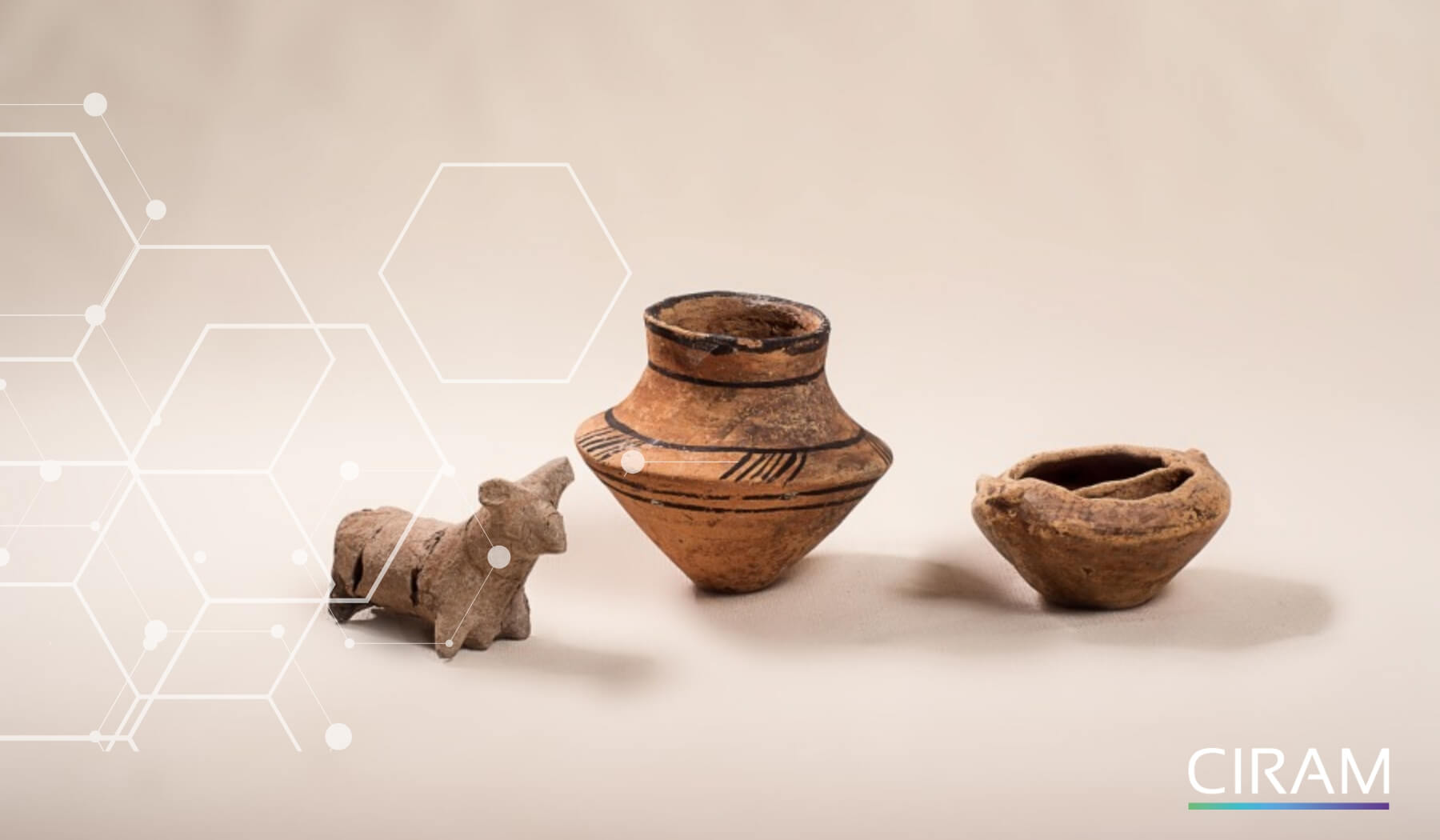


Discover CIRAM's thermoluminescence test protocols, measurements and results interpretation.
In summary:
- Thermoluminescence allows dating of terracotta, ceramics, and certain porcelain objects.
- It evaluates the time elapsed since the last firing of the object.
- The pre-dose method can be used for certain porcelains and earthenware that are difficult to analyze by conventional thermoluminescence.
- Combined with other techniques, such as X-ray imaging, it contributes to the authentication of ancient objects and the detection of fakes.
The thermoluminescence laboratory test
The dating of materials provides a valuable chronological marker for authenticating a work of art. However, it is necessary to distinguish the dated event from the one we are trying to date: dating a material does not mean dating its use by humans.
Our scientists use carbon-14 dating for organic materials, but we also use other dating methods for inorganic materials. For heated objects, CIRAM uses thermoluminescence, which applies to ceramics, porcelain, and terracotta in general. This method allows us to date objects up to approximately 300,000 years old.
Thermoluminescence does not apply to all materials. For stone, metal, glass, or pigments, CIRAM laboratories can use other analysis methods to help authenticate them.
The phenomenon of luminescence
In 1664, Boyle reported the phenomenon of luminescence stimulated by heat input or thermoluminescence (TL). Scientists began studying its physical properties in the 1930s, thanks to the development of photomultiplier tubes. In the 1950s, they explored the potential of thermoluminescence for dating archaeological materials, particularly ceramics. However, the application of TL to dating only came to fruition around the mid-1960s in England. It wasn't until 1967 that the first TL dating work was seen in France.
The principle of thermoluminescence
TL is based on the study of natural radioactivity and the ability of crystals contained in baked clay to accumulate the effects of this irradiation. In other words, TL corresponds to the emission of light (luminescence phenomenon) caused by an input of energy in the form of heat (thermo). The energy accumulated by the crystals depends on the duration of exposure to natural radioactivity and the intensity of this irradiation. Thermoluminescence makes it possible to estimate the dose accumulated since the last firing of the material.
TL tests are used to determine the natural radiation dose (QNat) received since time zero (i.e. the last time the material was heated). For true TL dating, two values need to be measured:
- QNat: actual irradiation dose ;
- I: annual radiation dose.
TL dating of objects out of their burial context does not allow for real dating. However, the measurement of QNat will assess the age and provide objective information on the authenticity or not of the studied object. For this, an annual irradiation dose between 3 and 6 mGy/year will be considered, which corresponds to the vast majority of cases encountered. The absence of annual dose measurement limits the accuracy of thermoluminescence dating tests to approximately 20 to 30% of the estimated age.
Distinction between forgeries and authentic objects
The examination of thermoluminescence curves can provide clues about the age of an object and help distinguish an old object from a recent imitation.
Thermoluminescence dates the last significant heating of the material, generally the firing during its manufacture. It therefore does not, on its own, allow dating of the object's use by humans.
The thermoluminescence test
The TL test is relatively simple to perform. However, the diversity of materials makes it complex to adapt measurement protocols and interpret the results.
Porcelain, like earthenware and stoneware, is fired at high temperatures during its manufacture. This heating can lead to partial or total amorphization of the material and alter the crystalline defects that store natural radioactivity energy. The physical properties necessary for classic thermoluminescence can then be modified, making the material difficult to date by this method.
For these materials, laboratories can adapt the measurement protocol. The so-called pre-dose method, particularly suitable for porcelain and earthenware, is based on the study of a low-temperature signal, around 110 °C, with heating that can be limited to 200 °C, compared to a temperature that can reach 500 °C for classic TL.
The evolution of forgers' methods, linked to their growing understanding of analytical techniques, makes the use of TL increasingly necessary to detect fakes. To authenticate works of art, this method can be combined with other investigative techniques, notably X-ray imaging (radiography or CT scan), which provides complementary information on the object's structure.
The quest for authenticity in terracotta objects
Factual data from physicochemical analysis, cross-referenced with knowledge of the evolution of forms and techniques, contribute to the quest for authenticity.
To establish an accurate diagnosis, our scientists rely on a range of clues, while taking into account the limitations of each approach. If certainty is the absolute goal of authentication, it remains rarely attainable. However, detecting a fake is generally more obvious than absolutely confirming the authenticity of an object. Thanks to their expertise and know-how, CIRAM laboratories provide objective and relevant results.
Share this article

You may be asking yourself these questions about TL-OSL?
Thermoluminescence allows dating mineral materials that have been heated, such as terracotta, ceramics, and certain porcelain objects. It estimates the time elapsed since their last firing.
Thermoluminescence can help distinguish an ancient object from a recent imitation by estimating the time elapsed since its last firing. To strengthen authentication, it can be supplemented by other analyses, notably X-ray imaging.
Thermoluminescence applies to certain heated mineral materials, while carbon-14 dating concerns materials containing carbon of biological origin. These methods therefore meet different needs and can be complementary.
Yes. However, high cooking temperatures can alter the material's properties and complicate analysis. The pre-dose method can then be considered depending on the object's characteristics.
Related topics


Need more information or have a question?
Our team will get back to you as soon as possible.